Research

Article Contribution to SBL Volume

I was glad to finally receive proofs last week of a piece I wrote nearly three years ago. Over the summer of 2013 I conducted research for a paper that I presented in Munich at the triennial IOSOT congress, in the IOSCS Section. This work was aimed at preparing myself for the sort of research I am currently involved in with my dissertation, namely Septuagint lexicography and the textual history of the book of Judges. You can read a bit about my preparations and reflections on the congress if you want.

The paper, which is entitled “Lexical Possibilities in Septuagint Research: Revision and Expansion,” picks up the lexicographical torch from John A. L. Lee’s dissertation by reinvestigating Koine documentary evidence contemporary with the translation of the Septuagint (~3rd c. BCE – 1st c. CE) for occurrances of ὁράω and βλέπω. Lee found a semantic shift and replacement between the former and latter in his own work, and I basically set out to find new instances of the words in the evidence since Lee to see if his conclusions hold up. Spoiler: they do.

Here’s the paper abstract:

This paper reviews the findings of John A. L. Lee regarding historical linguistic investigation of Koine Greek documentary evidence in his published dissertation. With the passage of over three decades since Lee’s work, much more papyrological and inscriptional evidence has surfaced. Moreover, a significant amount of the data is now digitized and searchable. Therefore, this paper begins to pursue the course set out by Lee himself in the introduction to the published version of his dissertation where he suggests it could surely “benefit from revision or expansion” in light of new data. To do so, here the digital databases of documentary evidence are investigated for occurrences of ὁράω and βλέπω that are additional to those found by Lee. After assessing the use of the two words in new evidence, a “revision” of Lee’s conclusions is offered. Even in light of new data, Lee’s conclusions prove remarkably accurate, suggesting the potential of his methodology for further application and even “expansion.” Accordingly, this paper also discusses the difficulties inherent in documentary evidence research and possible ways forward, with particular attention to the double text of LXX-Judges.

Me right between some schnitzel and a stein of Munich’s finest

If you’re really interested, you can read the paper on Academia.edu. Seeing as I just got proofs this week, it will hopefully be published before the SBL conference in November. It will appear in XV Congress of the International Organization for Septuagint and Cognate Studies (IOSCS), Munich, 2013. Edited by Wolfgang Kraus, Martin Meiser, and Michaël van der Meer. SBLSCS 64. Atlanta, Ga., SBL Press, 2016.

Upcoming Presentations at SBL 2016

Remember the Alamo! (And the book exhibit. Never forget the book exhibit)

It’s still six months away, but there’s increasing buzz already about the 2016 Biblical Studies conference season. This year, ETS, IBR, and SBL will be held in San Antonio, Texas, between the 15th-22nd of November. I’ve said this many times before, but the annual conferences are a great experience, if completely exhausting. If you are a poor graduate student interested in going, you should definitely consider it (something I’ve posted about here and here). I have repeatedly benefited from joining and participating in the biblical studies societies ever since I was in my master’s degree program, so I always recommend it to others.

Each year I attend, these conferences get more enjoyable. This is due mostly to the fact that I have gotten to know more and more people, and attending the conferences is sometimes the only place I will see them and get to catch up. Another reason they get better over time is by participating. I’ll be presenting at ETS and/or SBL for my third year now (here and here) and I have found that it’s always worth the time for useful feedback from colleagues.

Upcoming Presentations

As I mentioned in my last post, this year’s Septuagint Studies session at ETS will be an exciting event. Since I am on the steering committee and presented at the inaugural panel for this session in 2015, I won’t be presenting anything at ETS this year. However, I am really jazzed to see what kind of crowd shows up for what is a stellar lineup of biblical scholars talking about one of my favorite subjects.

Although I wasn’t sure it would work out this way, I have two presentations scheduled for the SBL conference. “How unwise,” you may think, “You’ll never get two quality papers written.” Well, yes that may be true, but it is just slightly more feasible than my predicament last year, when I had three presentations. So writing two papers seems quite manageable to me at this point.

The IOSCS Session

As someone involved in Septuagint studies, I’ve been a member of IOSCS for several years, and I’m looking forward to presenting at this session at SBL for the third time. Because of a family health crisis that began in summer of 2015, I have had to step away from my dissertation for this academic year and focus on other important things. Thankfully, however, I have been able to stay active in various personal projects, one of which is the paper I’ll be presenting at the IOSCS session (and which is an outgrowth of part of my dissertation research).
The title of this paper is “The Lexical Value of the Septuagint for the Koine: The Use of ΠΑΡΑΤΑΞΙΣ in Marcus Aurelius,” and it will focus on one particular use of παράταξις in the Confessions. In the midst of discussing valorous ways to die as a devout Stoic, Aurelius uses Christians as a counter-example, stating that their manner of martyrdom is disdainful. The phrase where the reference occurs is disputed as a late scribal insertion, however, in part because it is one of the earliest references to Christians in ancient secular literature. But another reason is because the use of παράταξις in the phrase is difficult to construe. My paper will look at contemporaneous usage of the word (a considerable amount of which occurs in the LXX) and engage with the arguments for and against the phrase’s meaning and originality. This will also demonstrate the value of the Septuagint as a legitimate kind of lexical “database” for standard Greek usage (hence the paper title).

The Cognitive Linguistics in Biblical Interpretation Session

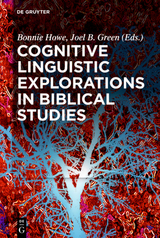
My second paper will be in a session that I’ve never participated in before, Cognitive Linguistics in Biblical Interpretation. This may seem like a random juke in terms of the general focus of my research. But I’ve been interested in cognitive linguistics for several years now, and a lot of my research requires that I read in theoretical linguistics anyway. The fascinating book featured right (which I’ll be reviewing for BBR in time) is just one example of the growth of this approach in biblical studies.

The paper I’ll be presenting here is called “‘Build Up the Walls of Jerusalem’: The Cognitive Unity of Psalm 51.” In sum, it’s common to read in commentary upon Ps. 51 that the last “chunk” of the psalm (usually vv. 15ff) was a later addition. The reason often given is that the sudden “topic” shift in v. 15 and mention of (what sounds like) a destroyed Jerusalem in v. 18 exhibits a second and later (i.e., postexilic) hand. My paper will examine this psalm from a “cognitive” perspective and demonstrate its unity and coherence in the face of the typical redaction critical conclusions.

Plenty of Time … Right?

Of course, these papers don’t exist yet. I’ll need to write them at some point. The challenge, I often find, is translating a proposal into a full-blown paper that is worthwhile and constructive … oh, and doing it on time for the conferences. Hopefully the next six months will allow just that to happen!

Two Recent Book Reviews, and Some On the Way

I’ve been working on reviewing books pretty steadily over the last year or so. It’s a good discipline to keep you reading texts closely, keep up with topics of interest that are not immediately connected with my dissertation, and get my hands on some free premium volumes.

Two of my reviews were recently published in the Bulletin for Biblical Research, the journal of the Institute for Biblical Research (IBR). At the moment BBR is holding first place in my review contributions, mainly because they publish so many and there is plenty of opportunity to do it.

Here are the two that I reviewed in BBR 25.3 (2015).

The Hebrew Bible (BHS) Reader’s Edition

It’s an odd task to review a Reader’s Edition. In case you don’t know, a Reader’s Edition is simply a primary text – in this case Biblia Hebraica Stuttgartensia – reproduced with vocabulary helps included throughout. In this case, any word that occurs seventy times or fewer in the Hebrew Bible is given a note in the text that corresponds to a footnote, where the parsing (where appropriate) and a contextual gloss appears. This allows you to read your Hebrew as easily as you like, whenever you hit an unknown word it’s there for you to check and/or parse.

I really like this volume. It’s very well produced by Hendrickson, one of the highest quality publishers in the industry in my opinion when it comes to primary sources. The German Bible Society teamed up with Hendrickson to allow them to use the BHS 5th edition text (’97), so aside from the Masorah Parva and textual apparatus, you’re also getting a high quality scholarly source also. In terms of kethiv/qere variants, the editors of the Reader’s Edition have smoothed things out using their apparatus at the bottom of the page.

There are a few drawbacks. For the most part, this consists of the parsing system used throughout. It is based on LaSor’s system, and takes some getting used to. Ideally, you can parse everything yourself anyway so you won’t need it much!

You can read my review here.

Adams and Socio-Economics of Second Temple Judaism

A lot of my research includes reading about Judaism. That may sound surprising if you know I work in Septuagint studies. But believe it or not, the Septuagint was produced by Jews. Ta-da! Although I tend to read a great deal more about Jewish life in Ptolemaic Egypt, where most of the translation work likely occurred, I am also interested in other diaspora communities and, of course, Palestinian Judaism.

That’s why I picked up Adams’ volume Social and Economic Life in Second Temple Judea to review. I was astounded to read that there is no other volume specifically focused upon this subject-matter, something I am still somewhat inclined to doubt (although I have yet to find proof otherwise). Naturally many of the other tomes on Second Temple Judaism treat socioeconomics in passing or so some extent, but it is not the main focus.

A variety of topics are covered: family and the household, the lives of women and children, the marketplace, the state, and the ethics of wealth and poverty. There is the natural challenge of lack of sources in many parts of this study (especially women and children), so Adams makes up for it by contemporary anthropological studies. This can be problematic, as you can read in my review. More so, however, is his use of almost the entire Old Testament as “evidence” of life in the Second Temple period. If you’re not aware of higher critical assumptions, they more or less allow Adams to presume that most/all of the OT was written or finalized in the Second-Temple period, thus allowing him to use it as a primary source. I find this approach specious, but it’s a different kettle of fish for a different day.

You can read my review here.

Some Reviews in the Pipeline

I have a few reviews that will be coming out soon, and some I’m looking forward to producing. I have two reviews coming out in the Westminster Theological Journal that I will post here in time. I’m more interested in reading these three volumes, however: