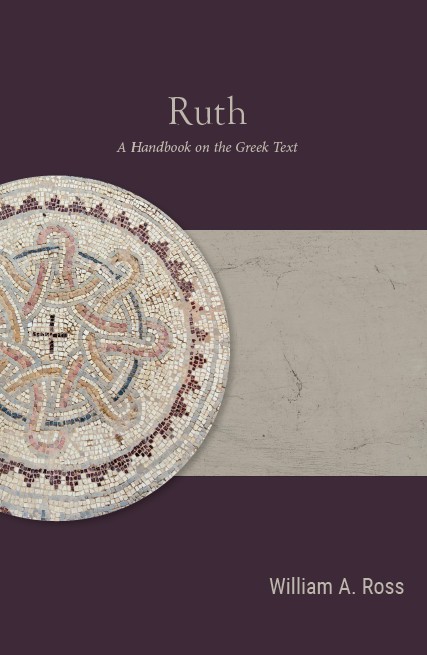
This morning I’m excited to announce a new book coming to press very soon: Ruth: A Handbook on the Greek Text. This new volume is part of the ongoing Baylor Handbook on the Septuagint series (BHLXX).
I drew some attention to this series a while ago in an interview with Seth Ehorn, who is one of the two series editors (the other is Sean Adams) and a contributor to the series as well. There are now six volumes in the series.
Below you can see two recent podcast interviews I did about the book, one with Baylor Press and the other with the new RTS Institute for the Study of Ancient Texts.
Endorsements
In line with the ‘Greek priority’ approach to the Baylor series of Handbooks on the Septuagint, William Ross focuses on the Greek text of Ruth as a document in its own right, rather than as a translation of the Hebrew. LXX Ruth has often been regarded as a ‘literal’ rendering in ‘unintelligent’ Greek, and related to the Hebraizing ‘Kaige’ revision. However, Ross demonstrates that a direct, close translation of the Hebrew may nonetheless display a remarkable degree of faithfulness to the literary conventions of post-classical Greek in the first century BCE. Such an approach reflects the translator’s high educational level as well as the expectations of his audience.
~Alison Salvesen, Professor of Early Judaism and Christianity, University of Oxford
Ross’s Handbook of Ruth is both up to date and deeply engaged with the Greek-priority approach, which characterizes the BHLXX series. With a firm grasp of the most recent research, Ross offers a fresh, clear, and rigorous guide to the Greek translation of the book of Ruth.
What sets this linguistic commentary apart is that it challenges inherited assumptions tied to the so-called “literalism” of the Greek book of Ruth. By repositioning the language of Ruth within the frame of post-classical Greek, Ross opens up new interpretive possibilities that invite readers to encounter this biblical text afresh and to change its overall assessment. This is an excellent resource for scholars, students, and anyone interested in the history of Ruth and in Septuagint studies.~Anna Angelini, Assistant Professor, University of Siena
This volume manages to provide a fresh and careful interpretation of Septuagint Ruth in keeping with the series’s linguitic focus. Concise yet insightful remarks guide the reader through every word or phrase, supported by a wide range of evidence. Ross is to be commended for producing a very readable handbook while integrating the latest research on post-Classical Greek. As a result, the work is well-suited for a broad audience and particularly suitable for classroom use or as a companion to the study of this biblical book in its Greek version.
~Jean Maurais, Vice-Dean and Professor of Old Testament, Faculté de Théologie Évangélique de Montréal