The Cambridge Greek Lexicon: An Interview with Prof. James Diggle

Several years ago I posted about the ongoing Cambridge Greek Lexicon project, which at that time was nearing completion at the Faculty of Classics. There is much to say about the project, and the Faculty has an excellent website that explains much of the history. As often happens with very large-scale projects — like a lexicon of ancient Greek, built from the ground up — things were periodically delayed. But I have it on good authority that publication is now extremely imminent.

That good authority is Prof. James Diggle himself, who is the main editor of the lexicon. He was kind enough to respond to several questions I had whirling around in my head, knowing that the lexicon must be near to publication. I’m grateful for his willingness to shed some more light upon the process and what we can expect of this exciting new resource. (more…)
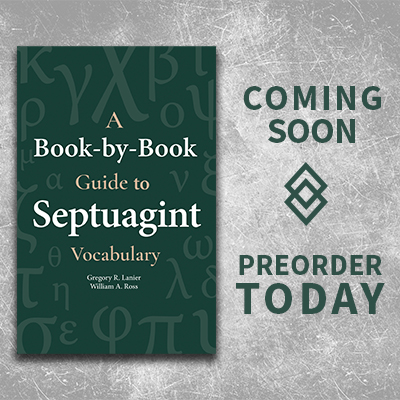

Book Announcement: A Book-by-Book Guide to Septuagint Vocabulary

I am very excited to announce a new book that I’ve produced with my partner in crime, Greg Lanier: A Book-by-Book Guide to Septuagint Vocabulary (Hendrickson 2019). The volume is set to release in December, but it is currently available for pre-order (click on the image).

As many readers will know, while we were both involved in our doctoral research at Cambridge, Greg and I teamed up to produce Septuaginta: A Reader’s Edition (Hendrickson 2018). That project has seen a lot of success now that it’s in the hands of Greek-lovers everywhere. But it wasn’t too long after the manuscript was finished for the Reader’s Edition that Greg and I got to work on this new project, the Book-by-Book Guide. The basic idea is pretty simple, but (we hope) very powerful. (more…)

Trismegistos: Support an Invaluable Digital Resource

Septuagint scholarship has many facets to it. It touches on a great many aspects of biblical studies, such as textual criticism, diaspora Judaism, reception history, early Christianity, κτλ. But it also overlaps with other disciplines focused on the ancient world, such as classics, egyptology, epigraphy, and papyrology. In terms of its overlap with the latter, Septuagint scholarship has much to gain from interdisciplinary study of language and social context.

When it comes to original research conducted with the primary texts, there are few resources more valuable than Trismegistos. Many of my readers — even those who don’t consider themselves newcomers to the Septuagint — will have never heard of this website. That’s why I am posting about it, particularly since it is now at risk of running out of money and human resources to keep going. (more…)