Tyndale House Workshop in Greek Prepositions
 I am pleased to announce an event that will bring together experts in a variety of disciplines in order to tackle an age-old problem with new theoretical approaches. This summer those pesky Greek prepositions are getting a lexicographical makeover at a two day “workshop” in Cambridge, England. The event is called:
The Tyndale House Workshop in Greek Lexicography: Cognitive Linguistic Approaches to Lexicography and Theology
This event will take place from 30 June-1 July 2017 at Tyndale House, Cambridge, the biblical studies research library par excellence. Although it is a fairly brief event, this workshop is structured to offer the maximum punch to advance the state of the question in the semantics of Greek prepositions. And, as is evident from the tagline, cognitive linguistics is central to our approach.
The Back Story
Last June I found myself in the small, bible-software-saturated city of Bellingham, Washington, shortly after finishing up a seminar in Septuagint studies at Trinity Western University. The idea for this preposition workshop began to take shape during this visit – naturally, over some delicious local brews. I sat down with Steve Runge, Rick Brannen, and Mike and Rachel Aubrey to discuss collaborating on a longer-term project applying newer linguistic theories to challenges within traditional approaches to Greek grammar.
This workshop will focus on prepositions and is the first in what we hope will be a series of similar events that will subsequently deal with connectives and particles. It remains to be seen whether and how that plays out, but at the moment Steve and I are teaming up to organize a top-notch preposition workshop and then
making the 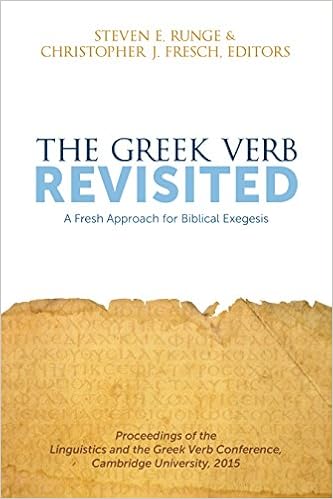 proceedings available in published form.
In case you are wondering: Yes, this workshop is intentionally designed to replicate the Linguistics and the Greek Verb conference held at Tyndale House in July of 2015 (see here). That model of highly-focused and interdisciplinary analysis of a single – albeit multifaceted – issue in Greek proved very effective. It was the genesis for the very well-received volume The Greek Verb Revisited (Lexham, 2016 [Amazon]), edited by Chris Fresch and Steve Runge.
Issues with Greek Prepositions: A Cognitive Answer
What’s wrong with Greek prepositions? Well, nothing.
But scholars have long been aware that they are exceptionally difficult to pin down. And for that reason they often play a pivotal (if seemingly subtle) role in biblical interpretation and theology. [1] Ignore for now the question about what actually counts as a preposition, versus the so-called “improper” prepositions like ἐπάνω that do not prefix to verbs.  The “traditional” Greek prepositions have been enough to constantly challenge biblical lexicographers and exegetes alike as they seek to properly understand them (pardon the pun).
The problem is a semantic one. First of all, what is the best approach to describing the meaning of Greek prepositions given the variety of functions they serve in the Koine period? Second, to what extent are Greek prepositions polysemous and (where necessary) how can we correctly determine the number and boundaries of the senses? Third, by what means can our semantic description of Greek prepositions accurately and accessibly present relevant information in English (i.e., in a lexicon entry)?
These and other questions are largely theoretical in nature. So a central goal of this workshop is to bring the insights of general linguistics – and specifically cognitive linguistics – to bear upon the study of Greek. Unlike other theories, cognitive linguistics approaches polysemy using a structured model known as prototype theory. This reformulates the notion of a single “core” or “basic” meaning, and instead attempts to provide a motivated account of the various senses of a word in terms of a “radial network.” An important assumption of this approach is that meaning is conceptual and embodied. Human experience of the physical world informs the conceptual structure on which linguistic meaning is built. In this account, more basic shemas like DIRECTION are mapped onto more abstract concepts like PURPOSE or RECIPIENT.
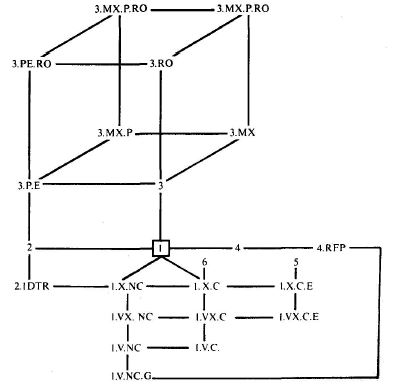
A radial network for the English preposition “over.”*
Judging by the often comically long entries for prepositions in Greek lexicons, you might think that these words are so polysemous that it’s barely worth the effort to understand them. (I’ve often felt this way about German prepositions.) But very often, huge lexicon entries are the inevitable consequence of non-isometric semantic overlap between Greek and English. This requires traditional lexicographers to use a wide array of English prepositions – whose meanings do not everywhere overlap with the Greek preposition under discussion – to gloss the various meanings where they ostensibly do overlap.
Thankfully, combining cognitive linguistics and prototype theory can provide a principled and organized account of prepositional semantics without falling into this polysemy fallacy. Doing so, in turn, can help us understand and translate the New Testament (and Septuagint) texts, and fashion better lexicon entries for these words for non-specialists.[2]
Two Relevant Monographs
We will not be the first to attempt to apply cognitive linguistics to the study of Greek prepositions. At least two others have done so in the last fifteen years:
- Bortone, Pietro. Greek Prepositions from Antiquity to the Present. Oxford University Press, 2010 (Amazon)
- Luraghi, Silvia. On the Meaning of Prepositions and Cases: Semantic Roles in Ancient Greek. Studies in language companion series 67; John Benjamins, 2003 (Amazon)
These books have been deftly reviewed and compared by Mike Aubrey in several posts (start here). If you’re new to this conversation, I highly recommend reading these.
The Details of the Workshop

Steve Runge and I are motivated to make the complicated accessible, and to bring the best of linguistic theory into the service of biblical studies. So we have tried to invite the best on all sides of this cross-disciplinary topic. We are looking forward to participation by two cognitive linguists, two Classical Greek lexicographers, and several biblical scholars. Because of our tight topic and event time frame, we are not issuing a call for papers. But we want to facilitate participation, which is why we have done our best to make this event very affordable, with only a £50 registration fee.
So if you want to know more, or are convinced enough already, head over to our website:
http://www.greekprepositionworkshop.org
At the moment the event registration is not open. But you can sign up at the right to be notified by email as soon as it is.
And finally: spread the word! You can download a flyer to share here.
___________________
[1] For a recent exploration of just one relevant topic, see Con Campbell’s Paul and Union with Christ (Zondervan, 2012 [Amazon]), which explores the theological implications of the phrase ἐν Χριστῷ (interview here). Also see Campbell’s essay in ‘In Christ’ in Paul: Explorations in Paul’s Theology of Union and Participation (eds. M. Thate, C. Campbell, and K. Vanhoozer; Mohr Siebeck 2014 [Amazon]).
[2] But wouldn’t this mean the same problems and solutions would apply to Biblical Hebrew, you ask? Yes indeed. All good things in time.
* Claudia Brugman and George Lakoff, “Radial network,” in D. Geeraerts, D., ed., Cognitive Linguistics: Basic Readings. Berlin: DeGruyter, 2006, p. 129.
Photo credit Doug Robar
 This is a project that I have been working on with my friend and colleague, Gregory R. Lanier, who is a professor of New Testament at Reformed Theological Seminary in Orlando. Greg and I have worked on a number of projects together by now, all of them related to the Septuagint in some way or another.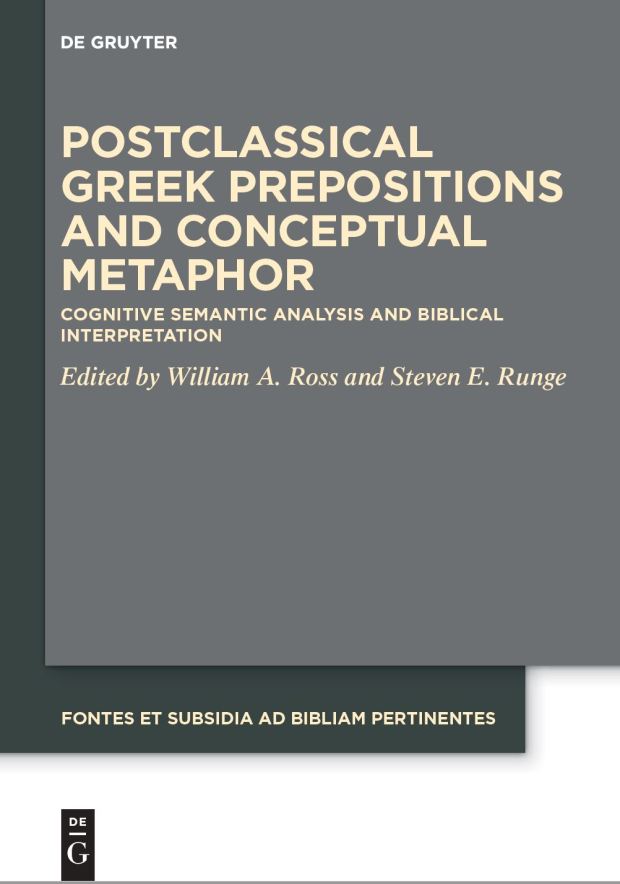



 Septuaginta &c.