 A new article of mine has been published in the first fascicle of Biblica 98.1 (2017): 25-36. It’s an honor to have some of my work included in this journal, which has been publishing material on all aspects of biblical studies since 1920 through the Pontifical Biblical Institute in Rome.
The article is called “Style and Familiarity in Judges 19,7 (Old Greek): Establishing Dependence within the Septuagint,” and it was a result of some of my research in the book of Judges. My dissertation is focused on the language of the Septuagint from a lexical semantic viewpoint, and evaluates a few case studies of systematic vocabulary change over the course of the textual history of the book in Greek. As I was working through one particular issue, I came across a striking phrase in chapter 19:
Μηδαμῶς, ἀδελφοί, μὴ πονηρεύεσθε (19:23)
Certainly not, brothers, you must not do evil!
Now, if you open up your copy of Rahlfs-Hanhart, you won’t see this phrase, but something else. In fact, you will see two different options, since when he compiled his Septuagint, Rahlfs believed the Alexandrinus and Vaticanus codices contained irreconcilable versions of Greek Judges, and thus included both (with various other witnesses) in his edition with the understanding that they reflected two separate original translations. Scholarly opinion is now almost completely contrary to to this view, and a particular group of witnesses is thought to represent the original translation (or “Old Greek”) with fair reliability. What you see above is my reconstruction of the OG using those witnesses.
I digress. When I read this text, it reminded me of the very similar narrative in Genesis 19, when Lot unwittingly hosts divine messengers and protects them from the wicked “men of the city” (Sodom). The intertextual influence between Genesis and Judges – likely deliberate on the part of the author of Judges – is very well acknowledged. And there is evidence that biblical interpreters as far back as the Early Church were aware of the parallels. So I began to wonder whether even the OG translator of Judges might have been aware of this as well, and possibly been familiar enough with the Greek translation of Genesis to be influenced by it in his translation of the Judges pericope.
The short answer is “apparently, yes.”
The longer answer is … you guessed it: in the article. I can’t post it here, but if you are interested I am permitted to distribute copies personally, so email me. In short, what I do in this article is establish four criteria for determining that a Septuagint translator knew and was influenced by a Greek translation done chronologically earlier of another text. This may sound fairly straightforward, but it’s actually something of a mind-bender (at least if you’re being cautious and evidence-based), particularly because it is difficult to say for certain whether influence on a later translator comes from another text in Greek or Hebrew. Hence the need for criteria.
I believe that is precisely what happened when the OG translator of Judges set out to render chapter 19 into Greek. He not only knew the parallel narrative in Genesis 19, but he knew it in Greek, and he knew it well enough that when it came to the climactic moment in the narrative, he chose to put the exact words of Lot (Gen. 19) into the mouth of the old man in Gibeah (Judg 19). In part this interesting because it shows that the OG translators were not robots incapable of doing anything but mechanically represent their Hebrew Vorlagen into pseudo-Greek code. There were literary influences involved in their decisions and use of the language that took advantage of more stylistic elements in conventional Greek.
Here’s the abstract:
This article develops and applies criteria to determine intentional, inner-Greek dependence in the Septuagint, using the parallel narratives in Genesis 19 and Judges 19 as an example. The OG translator of Judges is familiar with and imitates a Greek rendering from OG Genesis 19,7 at the point where the narratives converge. The Genesis translator demonstrates both his occasional preference for Greek idiom over word-for-word translation, as well as competency in Greek style. In turn, the Judges translator demonstrates how the language of the Greek Pentateuch occasionally exerts greater influence than that of his Hebrew Vorlage.
______________________
N.B. In a final draft I had changed each instance of the word “tone” in the article to “modality” to be more linguistically accurate. Unfortunately, only the first instance of “tone” was changed in the published version, so please read “modality” wherever “tone” remains.
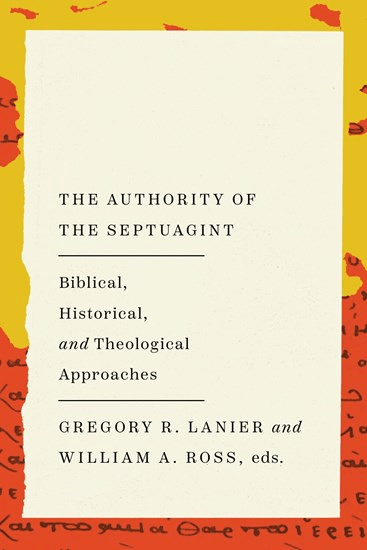 This is a project that I have been working on with my friend and colleague, Gregory R. Lanier, who is a professor of New Testament at Reformed Theological Seminary in Orlando. Greg and I have worked on a number of projects together by now, all of them related to the Septuagint in some way or another.
 Septuaginta &c.