Karen Jobes Discusses Her Two New Books on the Septuagint

Those who read this blog regularly or who have some acquaintance with Septuagint scholarship already will know Karen Jobes. She was kind enough to be the subject of my first Septuagint Scholar Interview series, which you can read here (also see here). Outside her work in the Greek Old Testament, Karen is respected in New Testament circles as well, with many publications in that field to boot.

As for her work in Septuagint, Karen is best known for her Invitation to the Septuagint (Baker 2005) coauthored with Moisés Silva. If you are interested in Septuagint research but new to the field, this resource is an excellent place to start, as you will read more about below. That was why I was excited when she told me last year that she was in the process of creating a second revised edition, which can be pre-ordered and will be available at the upcoming ETS and SBL conferences at the Baker Academic booth.

More than that, she is also publishing a second book on Septuagint, Discovering the Septuagint, also available to pre-order, that functions something like a graded reader. I thought it would be best to let Karen describe the books for herself. Enjoy!

Invitation to the Septuagint, 2nd Edition

Can you describe the purpose of Invitation for those who may not be familiar with it?

 Invitation to the Septuagint is intended to be a comprehensive introduction to the ancient Greek version of the Hebrew Bible known as the Septuagint and to the modern scholarship that focuses on it.  It presumes no previous knowledge of the Septuagint.  The Septuagint was the Greek Scripture of diaspora Judaism in the Hellenistic period and is one essential element in understanding the Judaisms of that time.  Christianity emerged from this period of history and the early church largely adopted the Septuagint as its biblical text.  The New Testament writers use it extensively, so study of the Septuagint and other early Greek versions help us to better exegete the New Testament.  Beyond that the Septuagint provides a vast corpus of material for linguistic and translation studies.  Because of the important place of the Septuagint in both Judaism and Christianity, anyone interested in religious or biblical studies will find Invitation to the Septuagint a helpful first step toward learning about it.  

Why did Invitation require a second edition? What’s different?

The first edition appeared in 2000, and there has been significant developments in Septuagint studies since that time.  Every chapter of the first edition has been revised and recent bibliography added.  The appendices have been expanded to include additional helpful aids, including an English translation of the symbols and abbreviations used by the Göttingen critical apparatus.

What are the most important developments in Septuagint scholarship since the first edition?

There has been much discussion about the hermeneutical issues involved in understanding a translated text.  The interlinear paradigm as a model for understanding the relationship of the original translation to its source text has also received much attention by scholars in the last fifteen years.  Because there are now two commentary series on the books of the Septuagint,  individual books of the Septuagint have enjoyed focused work by scholars.  And there is the ongoing discussion about the theology of the Septuagint.

Discovering the Septuagint

Can you describe your Discovering the Septuagint volume?Discovering the Septuagint
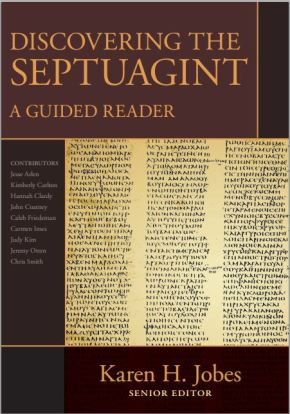
Discovering the Septuagint: A Guided Reader is forthcoming from Kregel.  It is intended for readers who have had at least three semesters of New Testament Greek and who wish to dip into the Septuagint and continue to develop their proficiency in Greek.  The book includes a selection of texts of various books and genres and provides notes on parsing and syntax as well as additional bibliography.

How did this volume come about? 

The book is the collaborative effort of several of my graduate students who took my Septuagint reading course and some of my former teaching assistants.  It is based on my classroom notes and their own studies of the texts.

What are your hopes for the book? 

I hope the book will be a helpful resource that motivates instructors to offer courses on Septuagint reading, and will influence student readers to further work in Septuagint studies.

When can we anticipate it sitting on our bookshelves? 

Hopefully in early 2016.

Wrapping Up

If you’re like me then you’ll be picking up these books as soon as you can scrape together the dollars. They will certainly be well worth it.


Inaugural Lecture by Prof. Jan Joosten (Oxford)

470215_10150940745254410_837526454_oOn October 27th Professor Jan Joosten gave his inaugural lecture as the newly appointed Regius Professor of Hebrew at the University of Oxford. Until recently he was on faculty at the University of Strasbourg (France), but in 2014 transitioned to his new post at Oxford.

Jan is a very prolific scholar to say the least. If you are interested in Old Testament textual studies, you will have almost certainly run into his work. If you are a graduate student interested in Old Testament and/or Septuagint studies, you should strongly consider getting in touch with Jan about supervising. Aside from being a top scholar in his field, he is very intentional about sharing his work freely. His Academia.edu webpage, where you can even access a full PDF of his Verbal System of Biblical Hebrew and Septuagint Vocabulary volumes, is a fine example of open-access scholarship. Although I was not able to make it to his inaugural lecture, I was very glad to see that a colleague, Marieke Dhont, did attend and recorded it. After obtaining Jan’s permission to publicize it here on the blog, I thought I would present a brief preview of the talk here, and also provide the link.

Click here to listen to the Lecture

Lecture Preview: “Hebrew: A Holy Tongue?”

The sum and substance of Joosten’s argument is that, although Hebrew did not start out as a “holy tongue,” it became one over time and may still rightly be considered as such.

The importance of Hebrew to Judaism and Christianity keeps the study of Hebrew a vibrant and ongoing discipline in universities the world over. In religious tradition, it is the language of God himself, and of all humanity prior to the confusion of Babel. Few interpreters throughout the middle ages contested this notion – on exception being Gregory of Nyssa (4th c.), who considered it unnecessary literalism. Even through the 18th c. many biblical scholars considered Hebrew to be humanity’s original language.

Certainly in today’s world of biblical scholarship things have changed significantly. Views of Hebrew have changed for many reasons. First, Hebrew is again, now for nearly seventy years, a national and living language in the modern state of Israel. It is now a language of the street once more. This makes considering it a “holy” language somewhat difficult. Secondly, previous Regius Professor of Hebrew S. R. Driver (19th c.), major contributor to the development of the historical critical approach to the OT, showed how Hebrew had changed over time. It was not some ineffable heavenly dialect, but one subject to normal linguistic change in space and time. Later, Regius Professor of Hebrew James Barr (late 20th c.) approached Hebrew from a philological perspective, showing how obscure passages could be illuminated by means of Ancient Near Eastern cognate languages. He also destroyed the notion that the “thought” of the OT was somehow inherently bound up with Hebrew per se. Thus once more, Hebrew is not uniquely equipped to express divine truths.

Thus, over the past half-millennium, study of ancient Hebrew has moved away from the idea that Hebrew is “holy.” Nevertheless, says Joosten, Hebrew may yet be reasonably considered a holy tongue that, though originally an ordinary human language, is became fit for religious purposes, and “ever so slightly unfit for everything else” (14:40-15:04 in audio recording).

The Paper in Full

I won’t summarize the entire talk, because then you wouldn’t listen to it yourself. Hopefully the taster above is just enough to make you spend the time doing the rest of the work yourself. But why listen to it when you can get the entire thing in PDF Form? If you can’t think of a reason, then you can read Jan’s lecture in full here.

LXX Scholar Interview: Dr. W. Edward Glenny

It has become one of my favorite tasks for this site to put together a post for my Septuagint Scholar Interview series. It’s always a pleasure to learn more about others who have been active in the field for some time. We are now on the fourth installment, and if you pop over to the interview page using that link up there, you’ll see that I have a few others lined up that should be interesting reading.

Dr. W. Edward Glenny

Dr. W. Edward Glenny

But today we have a great interview with a real, live Septuagint scholar, Dr. W. Edward Glenny. I met Ed several years ago at an IOSCS session at the SBL national meeting, and we have gotten to know each other through that venue ever since. Ed and his wife also spent several months at Tyndale House, Cambridge, where I conduct my research, so he has become a good friend. He is also a fellow member of the steering committee for the brand new Septuagint Studies session at the annual ETS national conference.

For the past four years Ed has been the endowed professor of New Testament Studies and Greek at the University of Northwestern, St. Paul. He is one of those rare breeds that holds not one, but two doctoral degrees, both Th.D. from Dallas Theological Seminary and Ph.D. from the University of Minnesota (as you’ll read about below). As you can see by flipping over to his faculty page, Ed has a long list of academic publications, many of which are related to the Septuagint, especially his focus area, the Twelve.

The Interview

Without further delays, let’s hear from Ed.

1) Can you describe how you first became interested in LXX studies, and your training in the discipline?

My first contact with the LXX was through a class on the LXX with Allen Ross during my doctoral program at Dallas Seminary. I audited the course with Dr. Ross, and it was partly because of that course that I wanted to write a dissertation on the use of the OT in the NT for my doctoral program at Dallas. I began to use the LXX in my dissertation at Dallas on the use of the OT in 1 Peter. After I finished that project I felt like I wanted to learn more and improve my language skills further, so I enrolled in a graduate program in classics at the University of Minnesota. I majored in Greek, and my second ancient language was Hebrew. So, with my emphasis on those two languages the LXX was a natural topic for my dissertation at Minnesota, and I wrote on the translation technique in LXX-Amos. That dissertation was published in Brill’s Supplement to Vetus Testamentum series (Finding Meaning in the Text: Translation Technique and Theology in the Septuagint of Amos), and it was really my entry into LXX studies. I was able to spend time at Tyndale House at Cambridge University while I was researching and writing my dissertation on the LXX, and Robert Gordon and some of his students who were working in the LXX were a great encouragement and help to me in my work.

2) How have you participated in the discipline over the course of your teaching and writing career?

I have presented papers in the IOSCS section at the annual SBL meetings, and I have also presented at the triennial international meetings of the IOSCS. I have also had the privilege to write several book reviews, articles, and books on the LXX. In addition to my dissertation I have published three commentaries in Brill’s Septuagint Commentary series, the commentaries on Hosea, Amos, and Micah. Among other articles, I contributed the article on the Introduction to the Twelve in the LXX in Brill’s forthcoming work The Textual History of the Bible. In the days ahead I am looking forward to writing several other volumes for Brill’s Septuagint Commentary series, as well as a handbook on the LXX of Amos for Baylor University Press.

4) How has the field changed since you’ve been involved?

I think that I can give a general answer to this question. The field is becoming more sophisticated and complex, and scholars continue to build on the work of previous generations and go to greater levels of depth in the study of the LXX text. Continued study has resulted in more comparison of the LXX with other contemporary literature and with more detailed studies of the Septuagint itself.

5) For the benefit of graduate students who are potentially interested in

LXX studies in doctoral work, what in your opinion are underworked areas and topics in need of further research? I think that the area of translation technique is one of the most important areas of research that will continue to provide opportunities for work in the LXX for years to come. This is because the study of translation technique is wide-ranging and complex and can be applied to a LXX text in many different ways.

6) What current projects in Septuagint are you working on?

My main LXX project right now is a review of the T&T Clark Companion to the Septuagint, edited by James K. Aitken. I published a commentary on LXX-Micah in early 2015, and now my main project is a New Testament commentary (1 Peter). But as I mentioned above I am looking forward to working in earnest on the LXX again in a year or so.

7) What is the future of Septuagint studies?

The future of Septuagint studies is very bright! There are many young scholars working in this area, and previous generations of scholars have provided them with some excellent tools to use in their studies and more LXX resources and studies are being published every year. I anticipate that the field will continue to grow and flourish.

Wrapping Up

Thanks to Ed for being willing to answer these questions! As I mentioned, stay tuned for further interviews in the near future. If you have a suggestion for a later interviewee, or a question you’d like to see added, please let me know in the comments.