I am once more thrilled to proclaim that today is International Septuagint Day! Let the festivities begin! Here’s a list of links to previous years’ celebrations:
ISD 2024
ISD 2023 | ISD 2022 | ISD 2021 | ISD 2020 | ISD 2019
ISD 2018 | ISD 2017 | ISD 2016 | ISD 2015 | ISD 2014
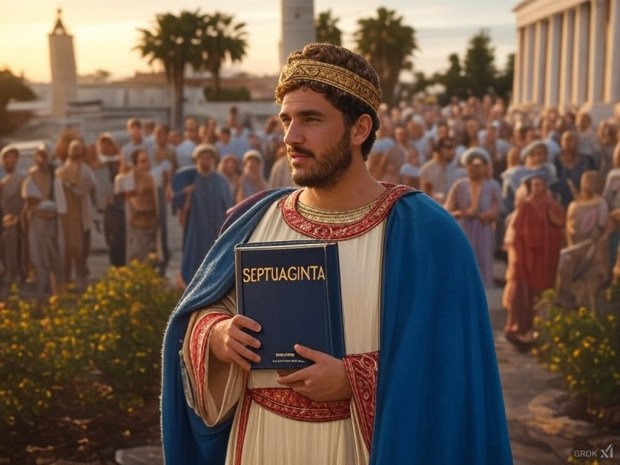
True Septuagint enthusiasts will be amazed to see the remarkable discovery I made recently: I real, live, definitely not AI-generated image of King Ptolemy II himself, holding a physical copy of Rahlfs-Hanhart while strolling past the Library of Alexandria. Incredible.
There are many ways to celebrate. One good way would be to pick up a copy of my new abridged reader’s edition of the Septuagint, or perhaps purchase one for your valentine. More information here.
Other than that, I thought I would simply provide a list of some of my newer publications in the discipline. If any of these are of interest to you, drop me a message and I’d be happy to send you a copy.
- “Donkey Words and Dating the Greek Pentateuch.” Journal of Septuagint and Cognate Studies (2023) 56: 131–149.
- I wrote this essay for the 2022 IOSOT Congress in Zurich. Like several other papers presented there, mine was funneled into the JSCS for reasons of space, which in my view is just fine since it may get more readership in the journal than the conference volume (which won’t be in print for a while still). The upshot of this article is to test and build on John Lee’s scholarship from fifty years ago to solidify and refine the case for dating the Greek Pentateuch in the third century based on language change in Greek and papyrological evidence.
- “Some Problems with Talking about ‘Septuagint Greek’.” Journal for the Study of Judaism (2023) 54.4-5: 451–493.
- I wrote about this article before, but at that point this article was only available digitally. It’s now in print in the 2023 issue of JSJ. This piece makes the case that most of our scholarly discourse about the language of the Septuagint is (unconsciously) colored by a long history of linguistic prescriptivism and negative value judgments. I go through a large swath of intellectual history to show this, moving into recent Septuagint scholarship as well. I suggest sociolinguistics as a path forward, a framework I’m working on elaborating through various other pieces I’m still writing (see below).
- “Sidney Jellicoe and the Formation of the IOSCS (1967–1969).” Journal for Septuagint and Cognate Studies (2022) 55: 9–30.
- I wrote this article quite a while ago actually, but it came out about a year ago now in the JSCS so I figured I might as well highlight it here. This project was something I did during covid lockdowns, since I had lousy access to physical books but a huge library of digitally scanned correspondence among Sidney Jellicoe and Harry Orlinsky. It was actually a lot of fun to read through it all and recreate the story of how the IOSCS was established.
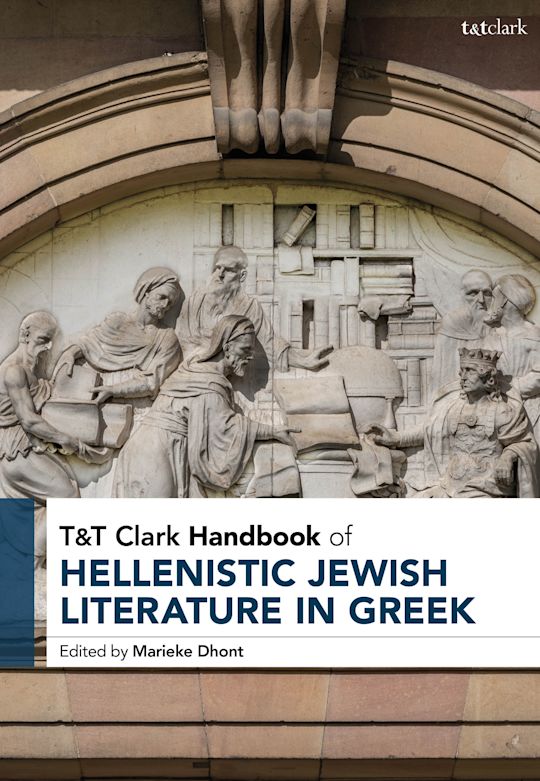
 Septuaginta &c.