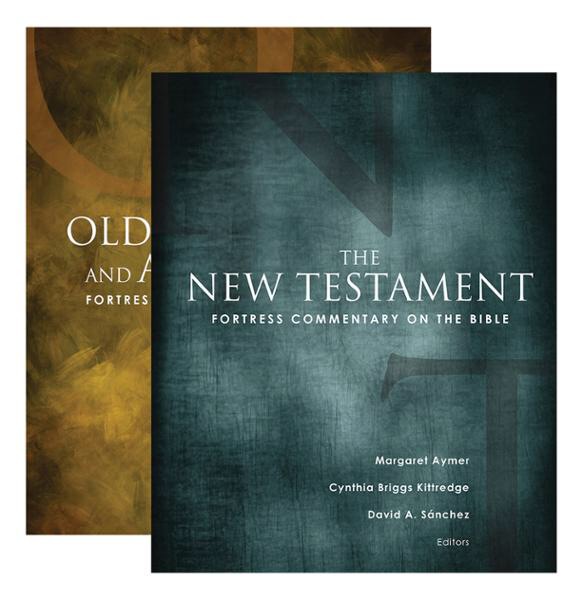
 Back in late October I received a copy of the recently published Fortress Commentary on the Bible, (2014) published in two volumes, and I want to finally offer some thoughts on this massive work. I’ll make some observations about the project generally, but my comments will mostly focus on the OT volume (over 1000 pages). Apologies for the vague quote citation – I am working from a Kindle version of the book.
The interesting aspect of this opportunity was that at the SBL/AAR conference in San Diego the publisher held a reception for reviewers, which I attended. A recording of the SBL/AAR roundtable about the Commentary can be found here.
A Commentary on the Bible
Any time a project of this scale is undertaken there are kudos to be doled out. And that is true in this case as well. I was impressed with the scope of these volumes right off the bat. That the OT volume also includes the Apocrypha is, in my opinion, certainly increases the value of this set. Although not canonical, the Apocryphal writings form a significant part of the literary and religious world of the Second Temple period (including the thought-world of the New Testament) that is indispensable to scriptural interpretation. If thoroughness is the goal when it comes to understanding Scripture, this feature of the Fortress set is a step in the right direction.
Reception History, Plurality and Relevance
Due to its significant length, I have not read the OT volume cover to cover, but only select portions to get an idea of the book’s prevailing concerns. The most prominent of these is reception history, as the OT volume in large part discusses interpretive history of a given book. Many times in reception-historical scholarship no hermeneutical stance is made explicit, but rather a straight-forward account of interpretive options is presented. This is not the case with the Fortress volume. At the outset, the editors note that the Commentary is aimed at helping students of the Bible gain respect for “the antiquity and cultural remoteness of the biblical texts and to grapple for themselves with the variety of their possible meanings” (Introduction, emphasis mine). One of the goals of this project is thus to allow students to become “responsible interpreters, aware of their own social locations in relationships of privilege and power” (ibid).
Interestingly, the Fortress Commentary is unlike other reception-historical works in at least one other way, namely that each contributor is pressed into practical service. That is to say, there is a distinct focus on the “texts’ relevance for today’s globalized world” (Introduction). I appreciate the desire to understand the cultural setting of the texts’ production and interpretive trajectory in order to discern Scripture’s application. Although there are other indispensable steps along the way to fruitful interpretation, these are no doubt important.
The Issue of Authority
Given the attention to scriptural relevance and application, this Commentary is evidently aimed at a faith-based audience. Yet as I read through portions of the OT volume, what struck me about this resource was its intentional avoidance of offering “a single answer – ‘what the text means’ – to the contemporary reader” (Introduction). Rather, the volume is more interested in highlighting “unique challenges and interpretive questions … to empower the reader to reach his or her own judgments about the text” (Ibid, also 25:40 in the audio). Again, I can appreciate the impulse behind this aspect of the Commentary. To be sure, Scripture is inexhaustible in terms of its applicational “payoff.” The circumstances of the Church will never deplete or outstrip Scripture’s ability to speak relevantly. And as we apply Scripture we must read and interpret responsibly, with care for the text and our neighbor, which calls for a real degree of humility in making claims about Scripture’s meaning.
However, it seems that the Fortress Commentary focuses upon interpretive plurality due more to postmodern impulses to avoid power claims. It is, I believe, also due to the reader-oriented hermeneutical stance operative throughout the volume. Now, there is legitimacy to the notion that readers can project their own culture and expectations onto a text, and that it is impossible to “escape” such an ideological situation as a knowing subject. But there are countermeasures, one of the most significant being, ironically, concord through interpretive history (there are others).
These issues are where in my view the Fortress Commentary will be of limited value to those whose hermeneutic is author- or text-oriented instead, taking the locus of meaning as more fixed and at least to some extent, determinable, if not exhaustively, as I mentioned. The Fortress Commentary also suffers from a distinct lack of acknowledgment of Scripture’s authority and unity in general. Rather, it is viewed as an “ark” of quasi-authoritative and potentially conflicting micronarratives, stitched together over time, each with its own “voice” that, like a partner in a dance, “complement each other’s work, even if tempers can flare sometimes when partners step on one another’s toes” (Reading the OT in Ancient and Contemporary Contexts).
Conclusion
I commend Fortress Press for producing this Commentary. It was no doubt a worthwhile project that will provide the academy a useful tool in understanding the “trajectory” of interpretation over the centuries and how that intersects with our global times. I do have certain concerns, however, with the hermeneutical methodology operative throughout the volume. Of course, these methodological issues flow from differing understandings of what (and how) Scripture is as the word of God. (For interesting comments from some of the editors in this respect, refer to min. 52, 55-57 in the audio, and 59-1:00:00).
Thanks to Fortress Press for providing a review copy, which has not influenced my opinions here.

 What I like most about this book is its practicality. Although it would not serve well as a text for an advanced college-level or graduate course (precisely because of its lack of detail in critical matters), I do think What the Old Testament Authors Really Cared About provides a helpful theological overview of the OT. DeRouchie has done an admirable job making the book usable for laymen, students and teachers alike with his KINGDOM acronym (see right). By breaking Old and New Testaments into distinct historical and thematic sections, the book makes the content of Scripture much more managable and cogently presented.


