I’ve said it before, but I repeat. Papyri.info is an amazing resource. In preparation to provide a Resource Review for it, I ended up writing a primer post (here). Now, I should say up front that Papyri.info is useful for a very specific niche within LXX research, and that is lexicography. So if you are not interested in lexicography, you can probably skip this review. Otherwise, read on.
To reiterate a point from my primer post, there is debate still going on as to whether the meaning of the Greek words in the LXX are to be determined primarily by reference to their Hebrew counterpart in the source text, or primarily by reference to their contemporary Hellenistic usage.

Eleazar Killing a War Elephant in the Maccabean War (1 Macc. 6:42-47), by B. Picart Broen, 1728
Generally speaking, the debate is not a neat either/or matter, but rather one of primacy. There are many good reasons to take the Hebrew parent text as primary in a number of cases. These tend to be words that have become a terminus technicus. Still, although a Greek word may come to mean something more or different than it did prior to its use in the LXX (e.g. διαθήκη, εἰρήνη), this is not particularly unique. Lexicographers have recognized for some time that word meaning is not static. What this amounts to, then, is that the new uses of Koine words in the LXX is not necessarily due to its status as a translated text. It may rather be attributable to the new socio-political-(religious) context(s).
So, as promised, I shall punt on this issue (for now), and press on.
Background to Papyri.info
As discussed on the homepage, this LXX resource consists of the papyrological navigator and the papyrological editor. Since I have no business dealing with the latter, I won’t (most likely, neither should you). The former, however, “supports searching, browsing, and aggregation of ancient papyrological documents and related materials.” The wonderful thing about papyri.info is that it is a one-stop resource for material that quite recently was scattered hither and yon. As the homepage says, the site collates material from the Advanced Papyrological Information System (APIS), Duke Databank of Documentary Papyri (DDbDP), Heidelberger Gesamtverzeichnis der griechischen Papyrusurkunden Ägyptens (HGV), Bibliographie Papyrologique (BP).
Most of this information was accessible by CD-Rom prior to the mid-2000s, but now it’s all free and constantly updated. To force you to appreciate how wonderful this is, consider this quote:
“Not just hours or weeks, but months were spent searching for [Greek] words in the indexes of documentary volumes and confirming occurrences. Every text had to be laboriously copied by hand in the library, then recopied into the manuscript when written, before finally being handed over for typing… Photocopying was only just beginning to be possible” (J. A. L. Lee, “A Lexical Study Thirty Years On,” 515).
So count yourself lucky to be a part of the age of xerox, email, and open-source internet. The “how-to” I’ve written up below walks through some material laid out on the papyri.info site already, and some of my own additions as well.
Using Papyri.info
Considering that this is a freely accessible website, the functionality of papyri.info/search is remarkable. The first thing you’ll notice is the main search window:

I will usually tick the “Convert from betacode as you type” button so that your keystrokes enter Greek directly. Otherwise, you have to cut-and-paste unicode Greek font from somewhere else. A good guide to betacode typing can be found here (also pdf). The other toggle buttons are self-evident: if capitalization is relevant to your search (e.g. proper nouns), you may want to un-tick “Ignore Capitalization,” and the same for diacritics/accents.
The most simple type of search is a “string” search, meaning “string” of characters. Simply entering καί into the search bar, for example, will turn up 31,604 hits. Note how the site conveniently highlights your word(s) when you click on a particular text. Moreover, you can link to that text and have the highlighting remain (see p.worp 16, below). But back to the search on καί. It is important to know that included in the massive search result number is any word in which the characters κ-α-ί occur in sequence, such as καῖσαρ or καιρός. This is where the ‘#’ code is crucial, as it breaks off a string from surrounding characters. If you wanted only καί, then, you would enter #καί#, which would return 28,138 hits.
Further, you can search for phrases using quotes. So if you were looking for instances of μὴ φοβοῦ, you’d enter “‘μὴ φοβοῦ'” and get just a single hit (p.worp 16). You’ll notice that in p.worp 16 there is a translation of the papyrus provided. This is a major boon when it happens, although in my experience that is rarely. Of course, in this case, the translation is into Italian, but it is helpful nevertheless.
You’ll also notice the group of buttons below the search bar. 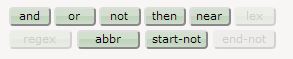 These buttons really amplify the capacity of the engine, so they’re worth learning to use. I will spend some time walking through the more basic button functions here, and then wait until a third (!) post to treat the more sophisticated ones… partly because I’m still figuring them out.
Firstly, the “and” “or” and “not” buttons do exactly what you would expect. When you enter any Greek word in the search window, then hit one of those three buttons, a second search window will appear below for your second criterion (or third, etc.). This allows you to include, alternate, or exclude certain words.
The following two buttons, “then” and “near,” deal more with sequencing of words. For example, if we wanted to see if the prepositional phrase εἰς ἀπάντησιν occurs in any papyri, we’d type, εἰς and click the “then” button and add ἀπάντησιν. The “within ___” window will become active automatically, and we’ll enter 3, for example, and then select “words” from the drop-down to the right, although you can also search by character for more refined quests. So our sample search is “εἰς THEN ἀπάντησιν within 3 words.” We get two results:

Eureka!
Note that the “then” button sets up the search for terms in the order in which they were entered (εἰς followed by ἀπάντησιν), while the “near” button searches in either direction within the limits you set, whether by word or character.
This is one of innumerable possible searches just with these first few buttons. As mentioned, I will reserve comment on the following buttons for a third installment. The last few are the most powerful (and finicky), and so take space to treat well. Disclaimer: It may take me some time to produce this final post.
 Greek fans are sure to love this. Coming this October is An Interpretive Lexicon of New Testament Greek by G. K. Beale with William A. Ross and Daniel J. Brendsel.
“This revolutionary new aid for students of New Testament Greek functions both as a lexicon and as an interpretive handbook. It lists the vast majority of Greek prepositions, adverbs, particles, relative pronouns, conjunctions, and other connecting words that are notorious for being some of the most difficult words to translate. For each word included, page references are given for several major lexical resources where the user can quickly go to examine the nuances and parameters of the word for translation options, saving the translator considerable time.”
“This lexicon adds an interpretive element for each word by categorizing its semantic range into defined logical relationships. This interpretive feature of the book is tremendously helpful for the exegetical process, allowing for the translator to closely follow the logical flow of the text with greater efficiency. An Interpretive Lexicon of New Testament Greek is thus a remarkable resource for student, pastor, and scholar alike.”
An Interpretive Lexicon of New Testament Greek is from Zondervan. It will be a paperback with 96 pages and sell for $15.99.
Greek fans are sure to love this. Coming this October is An Interpretive Lexicon of New Testament Greek by G. K. Beale with William A. Ross and Daniel J. Brendsel.
“This revolutionary new aid for students of New Testament Greek functions both as a lexicon and as an interpretive handbook. It lists the vast majority of Greek prepositions, adverbs, particles, relative pronouns, conjunctions, and other connecting words that are notorious for being some of the most difficult words to translate. For each word included, page references are given for several major lexical resources where the user can quickly go to examine the nuances and parameters of the word for translation options, saving the translator considerable time.”
“This lexicon adds an interpretive element for each word by categorizing its semantic range into defined logical relationships. This interpretive feature of the book is tremendously helpful for the exegetical process, allowing for the translator to closely follow the logical flow of the text with greater efficiency. An Interpretive Lexicon of New Testament Greek is thus a remarkable resource for student, pastor, and scholar alike.”
An Interpretive Lexicon of New Testament Greek is from Zondervan. It will be a paperback with 96 pages and sell for $15.99.