Not too long ago I posted an interview with Dr. Karen Jobes of Wheaton College in honor of International Septuagint Day. Obviously since Karen is such a wonderful person, the post was received very well. With the idea of hearing from active scholars in the field of Septuagint in mind, then, I thought I would carry on with other interviews.
 One of the first people I thought of was Dr. Rob Hiebert. He is one of the fellows of The John William Wevers Institute for Septuagint Studies, which operates under the auspices of Trinity Western University just outside Vancouver, B.C. I’ve written about it a bit in this post, and some details about its history are in the interview below. Rob and his colleagues at TWU are also conducting a seminar in Septuagint exegesis this coming May that would be well worth the time (I attended one of these seminars in 2013).
The questions below are the same that I posed to Karen, more or less. If you have any particular questions you’d like to see asked of others in the future (or suggestions for particular scholars you’d like to hear from), then leave me a comment below. These are supposed to be helpful to newcomers!
And now, to hear from Dr. Hiebert.
The Interview
1) Can you describe how you first became interested in LXX studies, and your training in the discipline?
 My interest in LXX studies began during my undergrad studies at the University of Toronto. At that time, the U of T had the only PhD program in this field, and it was headed up by John Wevers and Albert Pietersma who were leading specialists in that discipline. I began to see that LXX studies afforded the possibility of becoming equipped to do work that involved both the Hebrew Bible / Old Testament and the New Testament, and that was appealing to me.
2) How have you participated in the discipline over the course of your teaching and writing career?
Teaching in this discipline began for me when I was still a grad student at U of T, as I had the opportunity to teach undergrad courses in which we read both Greek New Testament and LXX texts. Later, when I joined the faculty at what is now called Tyndale University College in Toronto, I taught some Greek New Testament and LXX courses. Finally, after coming to Trinity Western University (TWU), where I now teach, I came to realize that the presence of four LXX specialists (Larry Perkins, Peter Flint, Dirk Büchner, and myself) represented a wealth of expertise that should be exploited. So we founded the Septuagint Institute, which we renamed the John William Wevers Institute for Septuagint Studies after Prof. Wevers’ family made a generous donation in his memory.
 The Wevers Institute took the initiative to advocate for the establishment of a specialization in LXX studies in a number of our graduate degree programs at TWU, and so now our Master of Theology and Master of Theological Studies programs do have such a specialization. In addition, the Master of Arts in Biblical Studies program has seen a number of students write theses in the area of LXX studies. The Wevers Institute has sponsored a number of international conferences and serves as a hub for a number of research initiatives.
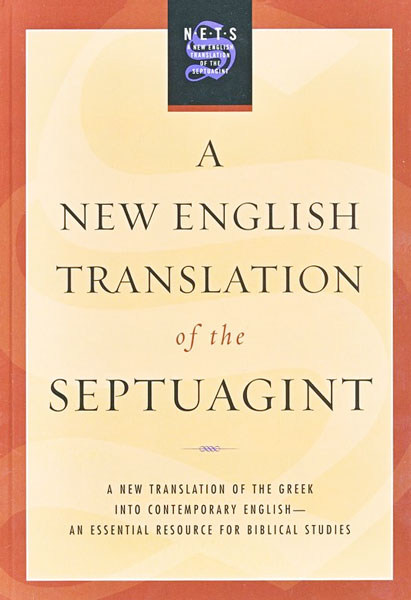
The Wevers Institute fellows have been awarded research and conference grants, have produced numerous publications, and continue to be active in a variety of research and publication projects. These include collaboration with an international team of scholars to produce A New English Translation of the Septuagint (Oxford University Press, 2007) also known as NETS, and the forthcoming Society of Biblical Literature Commentary on the Septuagint series also know as SBLCS, for which I serve as co-editor. The four of us were responsible for translating the first four books of the Pentateuch for NETS and have been assigned the task of writing the SBLCS commentary volumes for those same books.
 My publications include The “Syrohexaplaric” Psalter (Scholars Press, 1989); The Old Greek Psalter: Studies in Honour of Albert Pietersma (Sheffield Academic Press, 2001), which I co-edited; and “Translation Is Required”: The Septuagint in Retrospect and Prospect (Society of Biblical Literature, 2010), which I edited; as well as numerous book chapters, articles, and reviews. I am also currently preparing the critical edition of Greek IV Maccabees for the Göttingen Septuaginta series.
I should add that in the past few years TWU has established a collaborative agreement with the Green Scholars Initiative that affords TWU scholars and students the opportunity to work with papyri and manuscripts that are part of the Green collection of antiquities.
3) How have you integrated LXX studies into your work as a seminary professor?
I teach a number of graduate level LXX courses, and I have hired a number of grad students as research assistants to work with me on my research projects. Funding for these hires has come from the research grants that I have been awarded as well as from a budget line at the seminary that allows for such opportunities. One of my research assistants, who has now graduated, collaborated with me to present papers at conferences in various parts of North America and Europe and to publish articles and book chapters. His thesis project grew out of his work with me on my IV Maccabees project. My current research assistant has similar opportunities and is doing the same type of work.
 4) How has the field changed since you’ve been involved?
I think the emergence of LXX translation and commentary projects in various languages during the past number of years has opened up many opportunities for study and research. Many younger scholars have also entered into the field of LXX studies in recent years, which bodes well for the future of the discipline.
5) What issues do you focus on in your graduate courses in LXX studies?
I teach courses in “Exploring Septuagint Origins and Texts” and “The Septuagint in Early Jewish and Christian Traditions” as well as various special topics courses that relate to our work on our SBLCS volumes, sometimes in tandem with my Wevers Institute fellows. My colleagues also teach LXX courses. So we focus both on an introduction to the field of LXX studies and on specific textual, translation, and hermeneutical issues. We distinguish carefully between the meaning of the text-as-produced and the text-as-received.
6) For the benefit of graduate students who are potentially interested in LXX studies in doctoral work, what in your opinion are under-worked areas and topics in need of further research?
The production of commentaries on the text-as-produced is one area that will provide probably decades of work for those involved in the SBLCS series. But there will also be many opportunities for those interested in the reception history of the LXX.
8) What current projects in Septuagint are you working on?
 1. The critical edition of Greek IV Maccabees for the Göttingen Septuaginta series.
2. A commentary on Genesis for the SBLCS series.
3. Serving as joint-editor-in-chief of the SBLCS series.
4. A project in collaboration with the Green Scholars Initiative focused on Papyrus Bodmer XXIV, a very important LXX Psalms manuscript that dates to about the fourth century.
9) What is the future of Septuagint studies?
It is a bright one, with much more work to be done. More academic institutions do, however, need to appreciate the significance of this discipline and to foster its development.
I’m grateful for Rob’s willingness to interact with my questions. Stay tuned for interviews with other LXX scholars in the future!
 I have been using the Olivetree Bible Study app on my tablet for reading instead, but I was eager to get my hands on a real book again to study the original languages.
 As I have been thinking about preparing a post for BdA, it struck me that I will need to discuss the fact that it is not merely a translation into French, but also a commentary. So when it is time for that post I will most likely make it two parts, one treating the translational approach into French, the other dealing with principles underlying the commentary, although they are of course inseparable.
 To this end, the BSC aims to provide “a commentary on the Septuagint in its own right,” and therefore makes reference to the Hebrew text “only when necessary” (Brayford 2007, 25). As far as I can tell, making reference is “necessary” in order to discuss features of the Hebrew that agree with the Greek version to provide coherence, and also to understand occasional differences. While there are points at which the BSC deals with text critical issues, commentators never claim one text tradition is “better” than another. Rather, “the Commentary examines the text as it is and interprets it in its own right from literary, historical, social, and theological points of view” (ibid, 26). One of the primary stated goals of the BSC series in this sense is to determine how that Greek text of the Septuagint functioned in its literary and religious community, although drawing such conclusions is often quite speculative since it is difficult to know the details of a given textual community.
 Septuaginta &c.