Professional Societies

The 2015 Annual Conferences in Review

It’s been a few weeks now, but the annual conferences of the major biblical studies societies have come and gone. Legions of scholars from around the world spent untold dollars and lost entire time zones of sleep to make it there, and are only now recovering. This year’s melee was held in Atlanta, a lovely city whose downtown area is apparently constituted only of gigantic hotels. And they all seemed to be full of the scholarly hordes for about a week in late November.

Some Highlights

20151118_131217669_iOSI mentioned in a previous post that I would not only attend both the ETS and SBL conferences (plus the IBR meetings squished in the middle), but I also presented three papers. In retrospect, that amount of preparation and participation was probably overly ambitious. I’m glad to have done it, but I’ll likely keep it to two papers at most from now on.

One major event for me at ETS was participating in our newly formed Septuagint Studies session, where I presented one of my papers. It was a pleasure to help pull this session together with the work of many colleagues, and I think the session went quite well. We had about a dozen attendees who were very engaging and interested. Most exciting, though, was having our proposal for consultation status approved by the powers-that-be, which means Septuagint Studies will be a session at ETS for at least the next three years. For next year, it is the hope of the steering committee to put together a great session of invited papers from top evangelical scholars to address key issues in the study of the Septuagint. Stay tuned for more developments here.

20151118_173438000_iOS

The steering committee for the ETS Septuagint Studies consultation (yes, I shaved my head)

My two other papers were for SBL. For the second year in a row I was able to participate in one of the IOSCS sessions. These are an excellent venue for me to present work drawn directly from my dissertation, since almost every scholar active in Septuagint studies turns up. It makes for a time of very profitable interaction and feedback. My paper dealt with the changes in “meeting” vocabulary within the textual history of LXX-Judges, attempting to account for shifting trends in terms of changing stylistic aims or chronological situation.

I also presented at the Greek Bible section this year. The paper dealt with the well-known narrative echo in Judges 19 of Genesis 19, where in both texts travelers find shelter in a strange city only to have their host intercede for their safety from hostile “men of the city.” I reconstructed the OG translation of this passage in Judges and examined whether and how the translator receives the OG narrative from Genesis. 20151121_144729067_iOSIt sounds boring, but I believe I can show quite conclusively that the Judges translator knew and consciously re-employed features of the OG Genesis text in his version of Judges. In effect, he amplifies the relationship between the narratives, but also shows good (if intermittent) Greek style, and reveals something of the status and familiarity of the Greek Pentateuch in later eras.
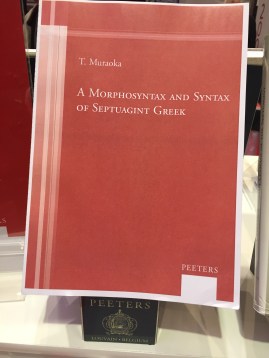
Of course, between the presentations were many meetings with people of all sorts – both intentional and incidental – plus sessions, banquets, receptions, happy hours, seminars, and the expansive book exhibit. As for the last, I was most excited to see T. Muraoka’s new A Morphosyntax and Syntax of Septuagint Greek (Peeters). Although it’s not quite ready yet, a sample was there to thumb through. Let me just say that it’s about 800 pages as it is, and there are no indexes yet. It should ship in a month or two.

Another really wonderful highlight was the small festschrift party (ein Festschriftfest?) held for John A. L. Lee. 20151121_234901746_iOSIn case you don’t know, John is one of the top scholars of Koine Greek at the moment and has contributed extensively to lexicography. His work in the Greek Pentateuch is what spurred my own interest in Septuagint vocabulary and has provided much of the methodology for my doctoral research. Trevor Evans and Jim Aitken teamed up to put together an edited volume of essays in John’s honor, Biblical Greek in Context (Brill). This looks like an excellent resource that will hopefully get wide attention.

Wrapping Up

As usual, the conferences are chaotic, exhausting, and expensive, but always worth the investment. The conversations and connections one can make are invaluable. If you missed this year and are disappointed, never fear: the proposal period for the 2016 conferences in San Antonio opens in about three months!

Announcing a New ETS Session Devoted to Septuagint Studies

Just a short post this time to convey some exciting news for those interested in Old Testament and Septuagint studies like I am. Beginning at this year’s annual conference of the Evangelical Theological Society (ETS) there will be an entire session dedicated to “Septuagint Studies.”

The ETS Annual Conference

I have posted in the past about the annual biblical studies societies conferences. You can view my Guide to the Societies, and also read my two-part series on how and why you should consider attending even as a graduate student (one and two). This year’s conference will take place from 17-19 November at the Hilton in downtown Atlanta. Of course, ETS occurs alongside its big brother conference on the 21st-24th of the Society of Biblical Literature (SBL). I will be presenting two papers at the SBL conference as well as participating in the new ETS Septuagint Studies session (I know, I know). You can see the full details of the ETS conference online here.

The Septuagint Studies Session

As a member of its steering committee, I am delighted with the kick-off program for the new Septuagint Studies session. Our  mastermind and chairman, James Mulroney, is a good friend and recent graduate from Edinburgh. I got to know James during my master’s program at Westminster Theological Seminary, so it is a joy to continue research along with him even years after. The others presenting at this inaugural session meeting are newer colleagues, but certainly friends and allies in all things Septuagintal.

Here is the session outline, which will occur on Wednesday, November 18th from 8:30am-11:40am:

Septuagint Studies
Hilton — 401
Moderator
James A. E. Mulroney – New College, University of Edinburgh

8:30 AM—9:10 AM
W. Edward Glenny
University of Northwestern – St. Paul, MN
The Septuagint and the Christian Old Testament

For those interested, there will be a field trip to the Library of Alexandria after the session

9:20 AM—10:00 AM
Aaron W. White
Trinity College, University of Bristol
Is Luke Intentionally Constructing an Inclusio by Quoting Amos?: “The Creative Use of Amos by the Author of Acts” Re-examined

10:10 AM—10:50 AM
William A. Ross
Fitzwilliam College, University of Cambridge
Transformations in the Septuagint in the New Testament: The Figure of Samson

11:00 AM—11:40 AM
James A. E. Mulroney
New College, University of Edinburgh
Another Look at Hab 2:4 and Its Place in the NT Eschatological Vision

See You There

Hopefully if you are able to make it to ETS you can also swing by this new session. It is our hope that this session, as it continues through the years, will be a first step towards more comprehensively making the study of the Septuagint a meaningful and useful part of faithful biblical exegesis for the Church.

The 2014 Conference Season: A Review

San Diego was Awesome

It probably goes without saying, but this year’s biblical studies conference location is the best I’ve yet experienced. This was only my third year participating in these events, but 70 degrees and sunny every day sure beats the dreary, sub-freezing temperatures I was met with in both Chicago (’12) and Baltimore (’13).

That being said, it was about a 20-hour journey there from Cambridge, all told, so it did not come without pain on my part. Nevertheless, I did have the opportunity to present at both the ETS and SBL conferences, as I wrote about here.

A Study in Contrast

It should go without saying that not everyone who participates in the one conference participates in the other. Indeed, ETS, being as it is evangelical (‘E’), is quite a bit smaller than SBL. The latter tends to throw conferences that are dumbfoundingly well-organized and impressive, fueled by the huge amounts of members and funding poured into the society year after year. On the other hand, ETS is – well – poor. As a result, ETS is rarely in the same venue as SBL for these conferences, and this year the difference was particularly humorous. Both sites were nice, don’t get me wrong. But that was due largely to the fact that they were both in sunny San Diego where palm trees grow like dandelions.

I’ll let you puzzle out which conference center was the venue for which society.

Option A:

Option B:

20141121_183027009_iOS

The Papers

Naturally, I benefited equally from both conferences, however. Just because ETS is poor does not mean it’s not worth your time. Just the opposite! It’s the perfect reason to become involved. The smaller group makes it actually a bit more fun than SBL, where one tends to float anonymously through seas of scholars of all stripes.

“‘There is No Spoon’: Text-Critical Question-Begging in the So-Called ‘Acrostic’ of Nahum 1

To briefly overview the topics I presented on, at ETS I discussed the acrostic of Nahum 1, which in truth is really only a partial acrostic. If you don’t know what an acrostic is, it only gets more obscure from here. The partial acrostic in the first eight verses of the book has a few “problematic” lines, which do not begin with the “right” letters. It is fairly common, therefore, for commentators to “fix” or “emend” the text in one way or another to “restore” it. To attempt to do so is fine as far as it goes. But the problem is that most commentators go too far.

One of the challenges of OT studies is the scant textual evidence at hand. Basically, we have the Masoretic text, the versions (the Latin Vulgate, the Septuagint, and other translations), and the Qumran scrolls. This makes arguments for changing the MT very challenging to make well. In short, in this paper I go through the common arguments for changing the MT to “restore” this acrostic on the basis of the LXX as a text-critical witness, and pick them apart one at a time. Mostly, the arguments are poorly founded or misuse the evidence, especially when the LXX version is understood in light of its translational character.

I am hoping to get this paper turned into a published article.

The Divergent Battle Language in LXX-Judges: ΠΟΛΕΜΕΩ and ΠΑΡΑΤΑΣΣΩ

This paper is directly related to my dissertation research. I have realized that the most straightforward way to explain what I am doing here at Cambridge is to say “Greek lexicography.” Now, that may not help some people, but it is accurate. And I am using the Greek texts of LXX-Judges as a “heuristic environment” of sorts. Basically this means I’m looking at the ways in which the two Greek translations of the one Hebrew book phrase things in different ways, and then investigating why that might be the case.

The way I do that is to dive into Greek documentary evidence for better understanding of the word or words in question. Believe it or not, there is a vast body of Greek writing out there that is mostly ignored by Greek scholars. The reason (simply put) is because it is koine Greek, and not the high-flying and academically respectable Classical Greek that has been so popular for, oh, two thousand years. There is a bit of an academic tradition of snubbing koine Greek, although a major reason for that is because we didn’t quite know that koine Greek was a thing until about a century ago. Until then, the Greek Bible was about the only existing koine document, which is why scholars though it was “Holy Ghost Greek” or a special Jewish-Greek dialect.

But when huge amounts of papyri and inscriptions written in the same kind of Greek were literally dug up about a century ago, all that changed, although there is still lots of work to be done. That’s where I fit in. My paper focused on the differing terminology used for “to battle” or “battle” in both translations. I found that in the B-text, the less common and seemingly unlikely words were chosen in most places. As I investigated the data, I uncovered what I believe is a previously unnoticed semantic change in the words in question: παρατάσσω and παράταξις. These words are used in ways similar to the B-text of Judges as in koine historical literature, and so I suggest that the B-text has literary or specialized terminology in it.

Other Points of Interest

There is too much else to say about these conferences. Suffice it to say that I truly enjoyed my involvement in the Institute for Biblical Research (or IBR, here), and the Scripture and Hermeneutics sub-group (through the Paidaia Centre, here). It was also a great pleasure to meet and talk with many senior scholars in various fields. I’ve said before that attending these conferences pays for itself in terms of the conversations that are available there. The feedback on one’s work and the chance to learn about initiatives and opportunities you did not and would not otherwise know about are invaluable.

I’m already looking forward to next year! As a teaser, there are rumblings of a new Septuagint section at the next ETS conference. But we will have to wait and see what happens.