Presentations

Article Contribution to SBL Volume

I was glad to finally receive proofs last week of a piece I wrote nearly three years ago. Over the summer of 2013 I conducted research for a paper that I presented in Munich at the triennial IOSOT congress, in the IOSCS Section. This work was aimed at preparing myself for the sort of research I am currently involved in with my dissertation, namely Septuagint lexicography and the textual history of the book of Judges. You can read a bit about my preparations and reflections on the congress if you want.

The paper, which is entitled “Lexical Possibilities in Septuagint Research: Revision and Expansion,” picks up the lexicographical torch from John A. L. Lee’s dissertation by reinvestigating Koine documentary evidence contemporary with the translation of the Septuagint (~3rd c. BCE – 1st c. CE) for occurrances of ὁράω and βλέπω. Lee found a semantic shift and replacement between the former and latter in his own work, and I basically set out to find new instances of the words in the evidence since Lee to see if his conclusions hold up. Spoiler: they do.

Here’s the paper abstract:

This paper reviews the findings of John A. L. Lee regarding historical linguistic investigation of Koine Greek documentary evidence in his published dissertation. With the passage of over three decades since Lee’s work, much more papyrological and inscriptional evidence has surfaced. Moreover, a significant amount of the data is now digitized and searchable. Therefore, this paper begins to pursue the course set out by Lee himself in the introduction to the published version of his dissertation where he suggests it could surely “benefit from revision or expansion” in light of new data. To do so, here the digital databases of documentary evidence are investigated for occurrences of ὁράω and βλέπω that are additional to those found by Lee. After assessing the use of the two words in new evidence, a “revision” of Lee’s conclusions is offered. Even in light of new data, Lee’s conclusions prove remarkably accurate, suggesting the potential of his methodology for further application and even “expansion.” Accordingly, this paper also discusses the difficulties inherent in documentary evidence research and possible ways forward, with particular attention to the double text of LXX-Judges.

Me right between some schnitzel and a stein of Munich’s finest

If you’re really interested, you can read the paper on Academia.edu. Seeing as I just got proofs this week, it will hopefully be published before the SBL conference in November. It will appear in XV Congress of the International Organization for Septuagint and Cognate Studies (IOSCS), Munich, 2013. Edited by Wolfgang Kraus, Martin Meiser, and Michaël van der Meer. SBLSCS 64. Atlanta, Ga., SBL Press, 2016.

Upcoming Presentations at SBL 2016

Remember the Alamo! (And the book exhibit. Never forget the book exhibit)

It’s still six months away, but there’s increasing buzz already about the 2016 Biblical Studies conference season. This year, ETS, IBR, and SBL will be held in San Antonio, Texas, between the 15th-22nd of November. I’ve said this many times before, but the annual conferences are a great experience, if completely exhausting. If you are a poor graduate student interested in going, you should definitely consider it (something I’ve posted about here and here). I have repeatedly benefited from joining and participating in the biblical studies societies ever since I was in my master’s degree program, so I always recommend it to others.

Each year I attend, these conferences get more enjoyable. This is due mostly to the fact that I have gotten to know more and more people, and attending the conferences is sometimes the only place I will see them and get to catch up. Another reason they get better over time is by participating. I’ll be presenting at ETS and/or SBL for my third year now (here and here) and I have found that it’s always worth the time for useful feedback from colleagues.

Upcoming Presentations

As I mentioned in my last post, this year’s Septuagint Studies session at ETS will be an exciting event. Since I am on the steering committee and presented at the inaugural panel for this session in 2015, I won’t be presenting anything at ETS this year. However, I am really jazzed to see what kind of crowd shows up for what is a stellar lineup of biblical scholars talking about one of my favorite subjects.

Although I wasn’t sure it would work out this way, I have two presentations scheduled for the SBL conference. “How unwise,” you may think, “You’ll never get two quality papers written.” Well, yes that may be true, but it is just slightly more feasible than my predicament last year, when I had three presentations. So writing two papers seems quite manageable to me at this point.

The IOSCS Session

As someone involved in Septuagint studies, I’ve been a member of IOSCS for several years, and I’m looking forward to presenting at this session at SBL for the third time. Because of a family health crisis that began in summer of 2015, I have had to step away from my dissertation for this academic year and focus on other important things. Thankfully, however, I have been able to stay active in various personal projects, one of which is the paper I’ll be presenting at the IOSCS session (and which is an outgrowth of part of my dissertation research).
The title of this paper is “The Lexical Value of the Septuagint for the Koine: The Use of ΠΑΡΑΤΑΞΙΣ in Marcus Aurelius,” and it will focus on one particular use of παράταξις in the Confessions. In the midst of discussing valorous ways to die as a devout Stoic, Aurelius uses Christians as a counter-example, stating that their manner of martyrdom is disdainful. The phrase where the reference occurs is disputed as a late scribal insertion, however, in part because it is one of the earliest references to Christians in ancient secular literature. But another reason is because the use of παράταξις in the phrase is difficult to construe. My paper will look at contemporaneous usage of the word (a considerable amount of which occurs in the LXX) and engage with the arguments for and against the phrase’s meaning and originality. This will also demonstrate the value of the Septuagint as a legitimate kind of lexical “database” for standard Greek usage (hence the paper title).

The Cognitive Linguistics in Biblical Interpretation Session

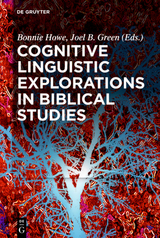
My second paper will be in a session that I’ve never participated in before, Cognitive Linguistics in Biblical Interpretation. This may seem like a random juke in terms of the general focus of my research. But I’ve been interested in cognitive linguistics for several years now, and a lot of my research requires that I read in theoretical linguistics anyway. The fascinating book featured right (which I’ll be reviewing for BBR in time) is just one example of the growth of this approach in biblical studies.

The paper I’ll be presenting here is called “‘Build Up the Walls of Jerusalem’: The Cognitive Unity of Psalm 51.” In sum, it’s common to read in commentary upon Ps. 51 that the last “chunk” of the psalm (usually vv. 15ff) was a later addition. The reason often given is that the sudden “topic” shift in v. 15 and mention of (what sounds like) a destroyed Jerusalem in v. 18 exhibits a second and later (i.e., postexilic) hand. My paper will examine this psalm from a “cognitive” perspective and demonstrate its unity and coherence in the face of the typical redaction critical conclusions.

Plenty of Time … Right?

Of course, these papers don’t exist yet. I’ll need to write them at some point. The challenge, I often find, is translating a proposal into a full-blown paper that is worthwhile and constructive … oh, and doing it on time for the conferences. Hopefully the next six months will allow just that to happen!

The 2016 ETS Septuagint Studies Consultation

San Antonio, TX

As you may know if you read my blog regularly, a brand new Septuagint Studies consultation was launched last year at ETS. Even better, we were also approved with “consultation status,” which means we’re sticking around each year through 2019. It’s an exciting new academic pathway for the Society, one that I hope will encourage greater numbers of evangelicals to engage with this fascinating and important discipline. We had a good turnout last year for the presentations, which were given by each of the members of our steering committee. I’m hopeful that this year we’ll see even greater numbers at the session.

Building Interest in Septuagint Scholarship

In order to generate as much interest and draw as many people as possible to this year’s Septuagint Studies session, we decided to make it an invited session. This allowed us to pursue a “dream team” of presenters who are well-known in ETS circles. For the most part, this year’s panelists are not known primarily as “Septuagint scholars,” but each of them is active in the discipline at some level. In the process, some turned us down for this year, but expressed interest, which means that we will have a great panel next year too.

One concern that we occasionally heard while recruiting presenters was that ETS did not need to launch a new venue for Septuagint studies. “There are few enough of us as it is,” went the response, “Why disperse things even more?” And there’s some merit to this criticism. If you want to be part of “the guild” in Septuagint studies, look no further than the IOSCS, which is and will continue to be the premier venue for the study of the Greek Old Testament and other versions. So to be clear, we are not attempting to become a “new” IOSCS. In fact, every member of the steering committee (and most or all of our presenters thus far) are current and active members in IOSCS and have contributed to the JSCS.

But what we do want is to draw more people within the evangelical world towards study of the Septuagint. The ETS Septuagint Studies session is meant to be a kind of funnel towards the IOSCS by hosting evangelicalism’s finest biblical scholars engaging with the discipline in constructive and responsible ways. With that end in mind, we have also decided that alongside of the top scholars invited this year (and, possibly, next year also) we would accept a current doctoral candidate whose work in LXX demonstrates the rigor and caliber we’re interested in fostering.

So with that, here is the current lineup for this year:

The 2016 Septuagint Studies Panel

Thursday, 1:00-4:10pm | Marriott-Rivercenter Room 2

Moderator: William A. Ross (University of Cambridge)


1:00-1:40pm | Dr. Stanley E. Porter (President & Dean, McMaster Divinity School)
Paper: “Why a Greek-text Oriented Commentary Series is Necessary”


1:50-2:30pm | Dr. Karen H. Jobes (Professor Emerita, Wheaton College)
Paper: “‘It Is Written’ The Septuagint and Evangelical Doctrine of Scripture”


2:40-3:20pm | Dr. Peter J. Williams (Warden, Tyndale House, Cambridge)
Paper: “On the Invention and Problem of the Term ‘Septuagint’”


3:3aaeaaqaaaaaaaaemaaaajgq4ndllyzi5lwy3mjmtngnknc1hmja5ltvjn2ixmzaymtm4nq0-4:10pm | Mrs. Jennifer B. Jones (Doctoral Student, McMaster Divinity
School)
Paper: “Theme Variation in Zechariah 2:10-17 (6-13): A Comparative Analysis of Two Textual Traditions”

Join Us!

Again, we’re hoping this lineup does nothing but attract people to the session. Please share this post with anyone who might be interested. I’ll be sure to post a more detailed schedule for the session once it is available.