Mostly as a way to take a break from grading, I’m taking some time today to write about the fifth of five essays that went to press in 2025. I posted about four others here, here, here, and here.
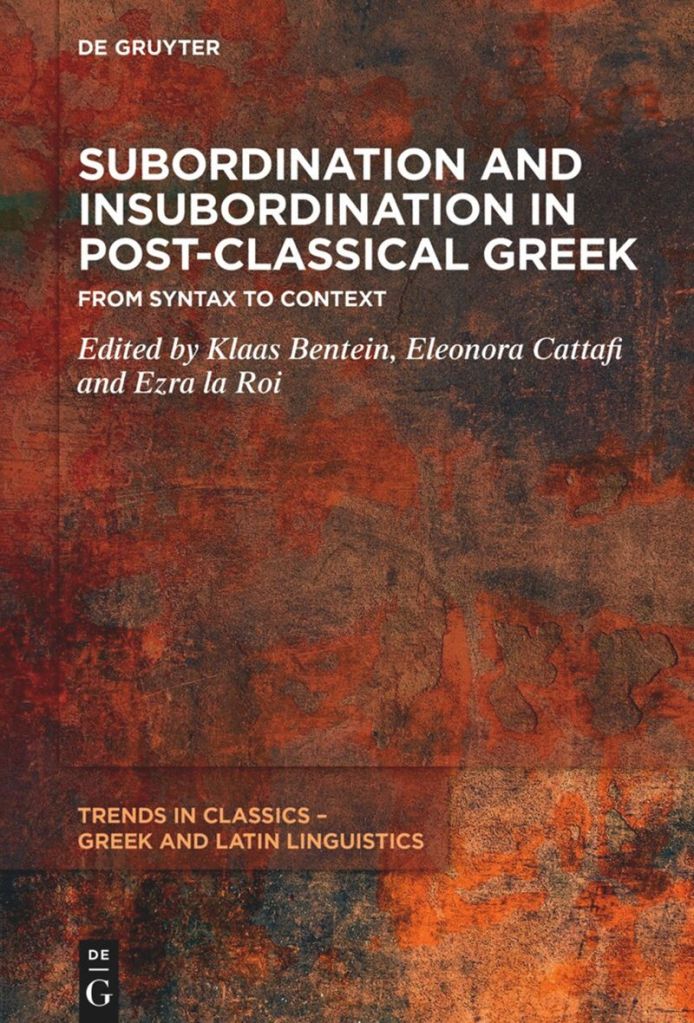
This fifth essay is entitled “Reevaluating Parataxis in the Septuagint.” It appears in Subordination and Insubordination in Post-Classical Greek: From Syntax to Context, edited by Klaas Bentein, Eleonora Cattafi, and Ezra La Roi (De Gruyter Brill, 2025). This edited volume originated in a conference held way back in May 2022 at Ghent University. Although I was unable to attend in person, my friend and colleague Andrew Keenan read an early version of this paper for me.
My essay is “available” here (paywall) or via email for those who ask nicely. Since one of the major themes of the conference was grammatical insubordination, it seemed like a good opportunity to have another look at parataxis in the Septuagint corpus.
Part of the essay catalogues the generally negative things that Septuagint scholars tend to say about paratactic syntax. That habit goes back well over a century and coincides with disapproving value judgments about the quality of the Greek in the corpus, as well as those who produced it. That is why I wrote that “certainly the time has come for dispensing with the antiquated (and frankly somewhat bigoted) notion that more clause coordination is correlated with less mental sophistication or cultural value” (p. 115).
I also have a look at the Aqedah narrative in Genesis 22 via Neo-Gricean pragmatic theory to show how parataxis is contextually meaningful through implicature.
One of my major aims in this essay is to cast doubt on the validity of “Semitism” as a valid analytical term within Septuagint scholarship. It’s a term that is built into our metalanguage. And parataxis is often cited as Exhibit A to illustrate whatever Semitism is. Upon reading Septuagint scholarship on this topic, I write, “one comes away with the impression that, although parataxis is of course possible in Greek, it also threatens to make Greek into something else entirely if it happens too much or in unapproved ways” (p. 125).
If I succeeded in showing that parataxis as Exhibit A for Semitism is not in fact a Semitism by any reasonable definition, then it stands to reason that the term Semitism itself deserves greater scrutiny for the sorts of assumptions it may smuggle into our discipline.
 Septuaginta &c.
Dear Will, Thanks for this note (and I’d love to read your paper/chapter, if I may). I often felt that the term “Semitism” was a cop-out, a way to avoid the admittedly challenging discourse-level question “Why use this construction to say that at this point in the . . .?” It is rather like the term “emphasis”, another empty term used to cover a multitude of bewildering morphosyntax. It’s good to hear from you–congratulations on another publication! Pax Christi. fred
Dear Will.Thank you for information. As a (wanna-be) Semitist, your article would be of interest, when dealing with Semitisms. Parataxis in the Septuagint was the title of Anneli Aejmelaeus’s doctoral study supervised by Ilmari Soinsalon-Soininen. It is not perhaps the best opportunity to give your two cents, as she passed away late autumn (I did not know her personally, but many who knew her well), could you (without having opportunity to read your contribution) elaborate shortly what agreements and disagreements you have with her take?
Yes, I knew Professor Aejmelaeus and was sad to receive news of her passing. Her work on parataxis comes fairly close to my view. I do differ from her in how I view the issue of token frequency. She viewed high frequency as constituting Semitism of a sort, whereas I do not.