As I mentioned in a previous post, there are a handful of new publications that I’m highlighting here one at a time.
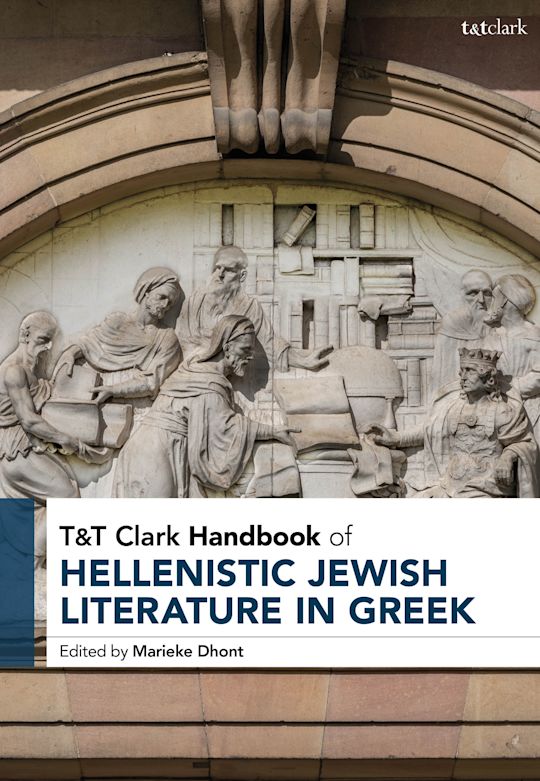
The second is a chapter I wrote in the brand new T&T Clark Handbook of Hellenistic Jewish Literature in Greek, edited by my friend Marieke Dhont. This volume will be quite large and has a sweeping scope. It’s set to become available in just a few weeks from now.
Despite its impending publication, there are a few details on the product page that are incorrect. One of them happens to be the title of my essay. Although it is currently listed as “Septuagint (incl. Deuterocanon.),” the actual title of my chapter is “Jewish Greek Translations.”
Obviously, there is a lot of overlap between those two titles, but there are also important distinctions. Most Greek translations known to us that were produced by ancient Jews are also included within the traditional canonical boundaries of the Septuagint. However, not everything in those boundaries is a translation, and not every translation is in those boundaries.
For example, certain works like the Additions to Esther or the Wisdom of Solomon, among others, were composed originally in Greek. Yet these non-translation texts are nevertheless included within most modern editions of the Septuagint. For that reason, this Handbook has a separate chapter on such Greek compositions. On the other hand, there are a few works that are not included in editions of the Septuagint that are known to be Jewish translations. That group group usually goes by the label “Jewish Pseudepigrapha,” and includes works like Jubilees or 4 Ezra.
Given the slightly unusual way of looking at this collection of translations across traditional boundaries, this was a challenging and fascinating essay to write. Here is a small excerpt from the section on Language (p. 112):
“Although different translation traditions developed over time within Hellenistic Judaism, their differing methods are only the correlate, not the cause, of the distinctives in language and style that tend to accompany them, to which there are often exceptions. That is because translation method is not a procedural algorithm from which particular kinds of language and style are the inevitable outputs. It is a set of defeasible parameters and constraints within which language and style are selectively deployed in response to various conditions and stimuli, only one of which is the source text itself. Taking account of others—such as Greek linguistic conventions, the social location of the translators, and the ongoing diversification of the Jewish Greek literary tradition at large—is essential to understanding how the language and style of these Greek translations became a vehicle for expressing Jewish sociocultural identity in the late Second Temple period.”
 Septuaginta &c.
Now this looks interesting; I will buy and read!
I think it will be a great volume!