La Bible d’Alexandrie – Post 1 of 2
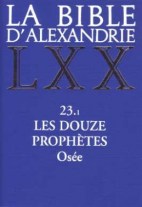 Quite a while back I began writing about modern Septuagint translation projects. As I explained there, my aim is to overview the methodologies of the four major modern language translations of the LXX, one of which I already discussed. These are:
1) NETS, 2) BdA, 3) LXX.D, and 4) LBG.
Today, we focus on number two, La Bible d’Alexandrie, which I will treat in two separate posts. I decided to cover BdA in a more extended format since BdA and NETS are best understood when set in contrast. With a brief intro to NETS in my former post, we are in a better position to understand it and BdA as well.
[As an aside, I’m pleased to announce that Cameron Boyd-Taylor, who was involved with the NETS project and is an advocate of the Interlinearity model, will be in the hotseat of one of my upcoming LXX Scholar Interviews.]
Textual Commentary
BdA is a French publication by Éditions du Cerf and is an ongoing project, although it has been in process for almost thirty years already. One of the reasons that it has taken so long – aside from maintaining a high standard of scholarly rigor and the dearth of qualified LXX specialists – is the inclusion of extended running commentary on the text throughout, both on the French translation and the Greek. Indeed, this is a primary difference from NETS, which only presents an English translation (although the IOSCS Septuagint Commentary Series will have a similar role in that respect, and NETS has a brief introduction to each biblical book).
Through the mechanism of the translation principles, discussed below, BdA aims in its commentary give three types of notes. Firstly, linguistic notes, dealing with text-criticism and their translation rationale. Secondly, exegetical notes, studying the divergences from the Hebrew and possible reasons for them. And thirdly, historical notes, discussing the later reception of the LXX text and its interpretation, particularly in the Apostolic Church and in early Jewish literature.
Furthermore, each volume includes a valuable introduction that discusses a given book’s composition, themes, and relationship to its source text.
Purpose and Translation Principles
Marguerite Harl states that the purpose of BdA is “to offer as exact a translation of the Greek text of the LXX as possible [in French],” which is driven by the conviction that the Septuagint has “importance and interest in its own right: it is a part of the Hellenistic Jewish literature” (Harl 2001, 181-82).
As such, BdA has four major guidelines/steps in producing its translation, the first two of which I will discuss below. I’ll treat the other two in a successive post.
1. Translation “according to the Greek”
This first principle is the most far-reaching, and is the primary foil to the NETS approach in two ways. Firstly, BdA aims for a translation that is “as literary as possible on the basis of syntactical and lexical usages of the Greek language current at the translators’ epoch” (ibid., 183). In other words, the (1) French translation of the (2) Greek translation of the (3) Hebrew text is done with reference to (2) the Greek language. This differs from NETS in that the NETS translation is done with attention primarily to (3) the Hebrew source text, at least in terms of syntax and semantics. Harl states baldly: “At this point we disregard the Hebrew source-text,” which is studied in the second stage of translation (ibid., emphasis mine).

Certainly not what the LXX translators looked like
Similarly, she states that “a text written in any language should be read and analysed only in the context of [its own] language” (ibid., 184). BdA sees the target language of a translation as a sort of window into the world of the translator and how he perceived his Hebrew source text when he translated it.
This approach contrasts distinctly with the Interlinear approach of NETS in a second important way. Whereas NETS perceives the LXX as a dependent text, intended to rely on the Hebrew source text for comprehensibility, BdA perceives the LXX as an independent text, meant from the start to be read as a free-standing text without the Hebrew as an aid to understanding. (Recall the distinction between text production and text reception, whereby the NETS group claims that the LXX only later came to be read as an independent text in the communities that received it.) From the BdA perspective, later revision and recension of “the” LXX was aimed to bring the Greek translation closer to the Hebrew source text, to make the Greek “sound” more like the Hebrew original. If that was in fact the case, they say, then it follows that the original translations were not necessarily concerned with (or perhaps successful in) representing the Hebrew in Greek, as NETS understands it.
Thus BdA assumes that the Greek of the Septuagint “makes sense” within its contemporary literary context despite its oddities, while on the other hand NETS begins with an assumption of “unintelligibility” of the Greek precisely because of its oddities (Boyd-Taylor 2011, 91). Both translation approaches identify the same characteristic of the LXX generally: it is not “typical” Greek (this depends on how one understands “typical” of course). But two of the modern translations – NETS and BdA – go very different directions as a result of that single observation. Favoring one approach over the other has to do with determining what deserves the weight of emphasis: the oddities or the conventionality of the Greek of the LXX within its linguistic context.
Connected with this alternative is the assumption of the relative competence or incompetence of the LXX translators – were their translational decisions driven by a lack of knowledge of Greek, or made deliberately (for whatever reason) from a position of language competence? BdA asumes that “they were competent and conscientious” translators who produced a text “if not easy to read, in any case, almost always of good ‘greekness'” (Harl 2001, 187).
Connection with Lexicography

This book was not available to the LXX translators
The question at hand is quite relevant to the issue of Septuagint lexicography. Should a word in the LXX be defined in terms of the meaning of the Hebrew word it represents, or in terms of its textual and linguistic context in Greek generally? Which meaning should be given preference if these options disagree, even if slightly? My research is concerned with determining the meaning of LXX words within the context of contemporary, non-literary Koine Greek. As such, I do not assume at the outset that a given Greek word is perfectly semantically aligned with the Hebrew word it translates. Instead, I take it that word meaning is determined by (1) that word’s usage in the language generally in extrabiblical Greek documents, by (2) its context in the LXX, and (3) by its use in other places within the LXX.
In other words, I tend to agree with BdA’s approach to the language of the LXX in general. Septuagint Greek is best understood with reference to Greek in general: first understand the Greek, then you can understand the Septuagint, and then you can investigate how it renders the Hebrew (and then you can approach the LXX as a text-critical witness … another topic for another day).
2. Establishing Divergencies
This is the second principle of BdA, which is really more of a second “step.” BdA does not assume that the Hebrew text from which the LXX was translated was identical with the Masoretic text in BHS. Rather, the LXX source text was a “proto-MT,” which “makes any comparison very difficult” (ibid. 190). The textual “plus” or “minus” in the Septuagint in comparison with the MT can be explained in any number of ways not necessarily related to translation technique and virtually impossible to substantiate. As Harl puts it (somewhat mind-bendingly), “A ‘plus’ of the LXX could be a word present in its Vorlage but omitted in the MT; a ‘minus’ in the LXX may be explained as an addition of the masorites” (ibid.).
Of course, it is precisely these differences between the LXX and the MT that have driven textual criticism for centuries, all the way back to Jerome himself. And the work is far from over. While “practically everywhere the Greek version attests the consonants of the MT,” the scriptio continua and unpointed text that was translated could have had several reading traditions, which may explain some of the differences (ibid.). Other times, however, as the Dead Sea Scrolls attest, there were legitimate points of difference in the Hebrew source text compared with what we have in BHS; points where the LXX and a Qumran scroll agree against the MT in a particular reading.
The payoff here for BdA is that they “do not speak a priori of the mistakes of the LXX but rather of exegetical options” (ibid., 191). In sum, the meaning of the MT is often obscure, and for that reason does not serve BdA as an arbiter of semantic divergences of the Greek text.
To be continued
This post being as long as it is, I’ll discuss the final two translation principles/steps of BdA in a second post.
________________________________
Boyd-Taylor, Cameron. Reading Between the Lines. Biblical Tools and Studies 8; Leuven: Peeters, 2011.
Harl, Marguerite. “La Bible d’Alexandrie I. The Translation Principles.” Pages 181-97 in X Congress of the International Organization for Septuagint and Cognate Studies. Edited by B. A. Taylor. Society of Biblical Literature Septuagint and Cognate Series 51. Atlanta, Ga.: Society of Biblical Literature, 2001.

 As far as I am aware, no new PhD student shows up at Cambridge as a “real” PhD student. Instead, you are officially registered as a “probationary” candidate for the degree. At the end of your first year, each student must submit a portfolio of your work thus far. This includes a chunky writing sample, a bibliography, a summary of your dissertation, and a table of contents with prospective timeline for completion. It’s a big project, and it took up quite a bit of my time. In early May I submitted the portfolio, which included a fuller version of the paper I presented at the last SBL conference in San Diego as the writing sample.
 As outrageous as it is considering it is still over six months away, planning has commenced for the annual Society of Biblical Literature conference. This year it will go down in Atlanta, and so you can count on a lot of biblical scholars making very forced and embarrassing references to various aspects hip-hop culture. That notwithstanding, the conference is a great opportunity – I’ve written about the value of attending one of these even as a graduate student (here and here).
 Much like an eager younger brother, ETS unabashedly follows SBL around every year, but usually turns out to be a lot more fun. I will write more about it as I find out details of this year’s conference. I may have yet another presentation, but I have not heard one way or another at this point.
 Not too long ago I posted about the Septuagint “summer school” that happens through the University of Göttingen each summer. As it turns out I have the opportunity to participate, which I am greatly anticipating. I don’t really have any more details about it than what I wrote up in the earlier post, but I’ll be sure to provide them as I find out more.
 I had an article accepted for publication in the Zeitschrift für die alttestamentliche Wissenschaft, known to anglophones as simply ZAW. As this is my first peer reviewed publication in a journal, I am especially pleased. The ZAW is an excellent resource of high end biblical studies research, so it is an honor to be included. The article is a culmination of an investigation that I began back in seminary into the so-called “broken acrostic” of Nahum 1. I examine the Septuagint translation and then interact with scholars who attempt to emend (i.e. alter) the Hebrew text to square with what they think it should be to sync up with the perceived acrostic. In the end, I find this approach untenable, and of course make a totally bulletproof case. It should come out in the fall.
 I am excited to draw more attention to a great new resource for Septuagintalists, the T&T Clark Companion to the Septuagint, edited by James K. Aitken. This volume is a wonderful addition to the growing number of tools available to scholars of the (Greek) Old Testament and, as as John J. Collins rightly puts it, “Nothing like this has hitherto existed.”
 Some helpful reviews of this volume have already been posted (see
  Septuaginta &c.