Papyri.info is an amazing resource. I chose it for one of my first few Resource Reviews since I have used it for a good deal of my recent research in LXX. But as I set out to write a review of it, I ended up writing enough to break the post in half (at least). In an effort to provide background to why this resource is valuable, it seemed necessary to provide the following primer post.
The Linguistic Setting of the Septuagint
Perhaps it goes without saying, but the Septuagint is (mostly) a work of translation. That is to say, it is not an “original” composition, but a derivative text. It is a translation made by Second Temple Jews of their Hebrew Scriptures into the then current lingua franca. The Second Temple Period began after the restoration of Israel to their land by Cyrus II (“the Great”) of Persia (cf. Ezra 1:2-4; 6:3-5), and it continued under the Macedonian general Alexander (also “the Great”) whose military campaign unified the Mediterranean world under a single language: Greek. Even before Alexander’s conquest, however, Greek language and culture had come to some prominence as a result of the 5th century B.C.E. Grecian victory at Thermopylae, after which trade routes opened to the Palestinian region (Law, When God Spoke Greek, ch. 2).
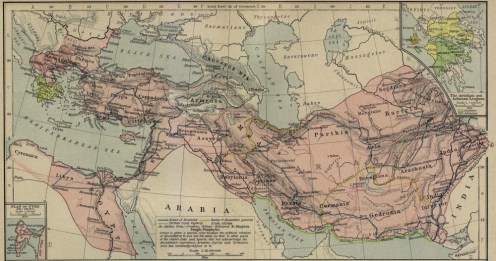
The Macedonian Empire
As Greek became the common language, even the Jews apparently felt a need for their own literature to be available in that language. Just what that need was, precisely, is a matter of some debate, the answer to which influences how issues discussed below are dealt with. But I digress. The Greek spoken around the Empire was not Classical Greek any longer, but Koine (“common”) Greek. Koine was a different form of the language that made commerce and cultural interaction possible among many people groups, and it was used right through the New Testament and Patristic eras. Notably, the task of translation was not novel in the 3rd century B.C.E., since in the multilingual ancient world governmental documents changed hands and languages between rulers (cf. Isa 36:11ff). Still, the magnitude of the task of translating the Hebrew Scriptures was unprecedented at that point in human history. Scholars are largely agreed that the job was done in Alexandria, Egypt, although some scholars still argue for Palestinian origins, amongst other possibilities.

The Pharos of Ptolemy in Alexandria, Egypt
All this to say that the linguistic setting of the LXX translation is primarily that of Alexandrian, Koine Greek. Still, there has been debate among LXX scholars, now settled with near certainty, as to what kind of Greek appears in the LXX. Some scholars (Winer, Hatch, Swete, Turner, etc.) thought the LXX was composed of a kind of Jewish-Greek dialect (“Jüdengriechisch”), a conclusion they came to by correctly observing that the LXX includes Greek phrases whose syntax could be categorized (rightly or wrongly) as Semitic. That frequent phenomenon is what LXX scholars call “Hebrew interference,” or a “Hebraism,” meaning “a Greek word, phrase, or syntagma which transfers certain characteristic Hebrew elements into Greek in an un-Greek fashion” (E. Tov, “The Septuagint,” in Mikra, 179). Others thought the LXX was written in Classical Greek, or was even “Holy Spirit” Greek. Later scholarship, however, (Deissmann, Thumb, Thackeray, Lee, etc.) showed that Hebraisms were in fact not a product of a supposed Jewish-Greek dialect. Again at the risk of oversimplification, the LXX is instead composed of “regular old” Koine Greek – the same Koine that was used by everyone in Alexandria at that time. The reason for the apparent Semitic syntax in the LXX is (in part) that it is, as mentioned, a translated text. Where LXX Greek appears with Hebrew syntactical characteristics rather than conventional Greek syntax, it is ordinarily due to the translator’s choice to preserve the word order of his source text (for whatever reason, and there are many possibilities!). Back to papyri.info. One great way to confirm that LXX Greek is identical to the “regular old” Koine Greek of Alexandria (and elsewhere) is to compare the two. This is what Deissmann and, later, John A. L. Lee did, and it is the first purpose I will mention for which this LXX resource can be used. The second purpose is to help determine the semantic range, or meaning, of a given Koine word.  At this point we bump into yet another debate in LXX scholarship, however, namely whether the meaning of the Greek words in the LXX are to be determined primarily by reference to their Hebrew counterpart, or primarily by reference to their contemporary Hellenistic usage (cf. Tov’s discussion on εἰρήνη as a stereotyped equivalent for שׁלום [“Three Dimensions of Words in the Septuagint,” in The Greek and Hebrew Bible, 88-9]). Answering this question is complex, and requires some concept of the purpose of the LXX overall (which again runs into another controversy over the so-called Interlinear Model). But to stay on task, I will come to a stop here to anticipate a fuller discussion in my next post of how to utilize the site papyri.info (pictured above). In that post, I’ll punt on all these debates I’ve mentioned tantalizingly – a discussion for another day! – to focus on the search power of this excellent LXX resource.
 When I saw the sign the other day, I thought “How true.” As I’ve thought about it more since then, I have realized just how remarkably profound and thoroughly Christian the statement is. Naturally, Chesterton puts it best:
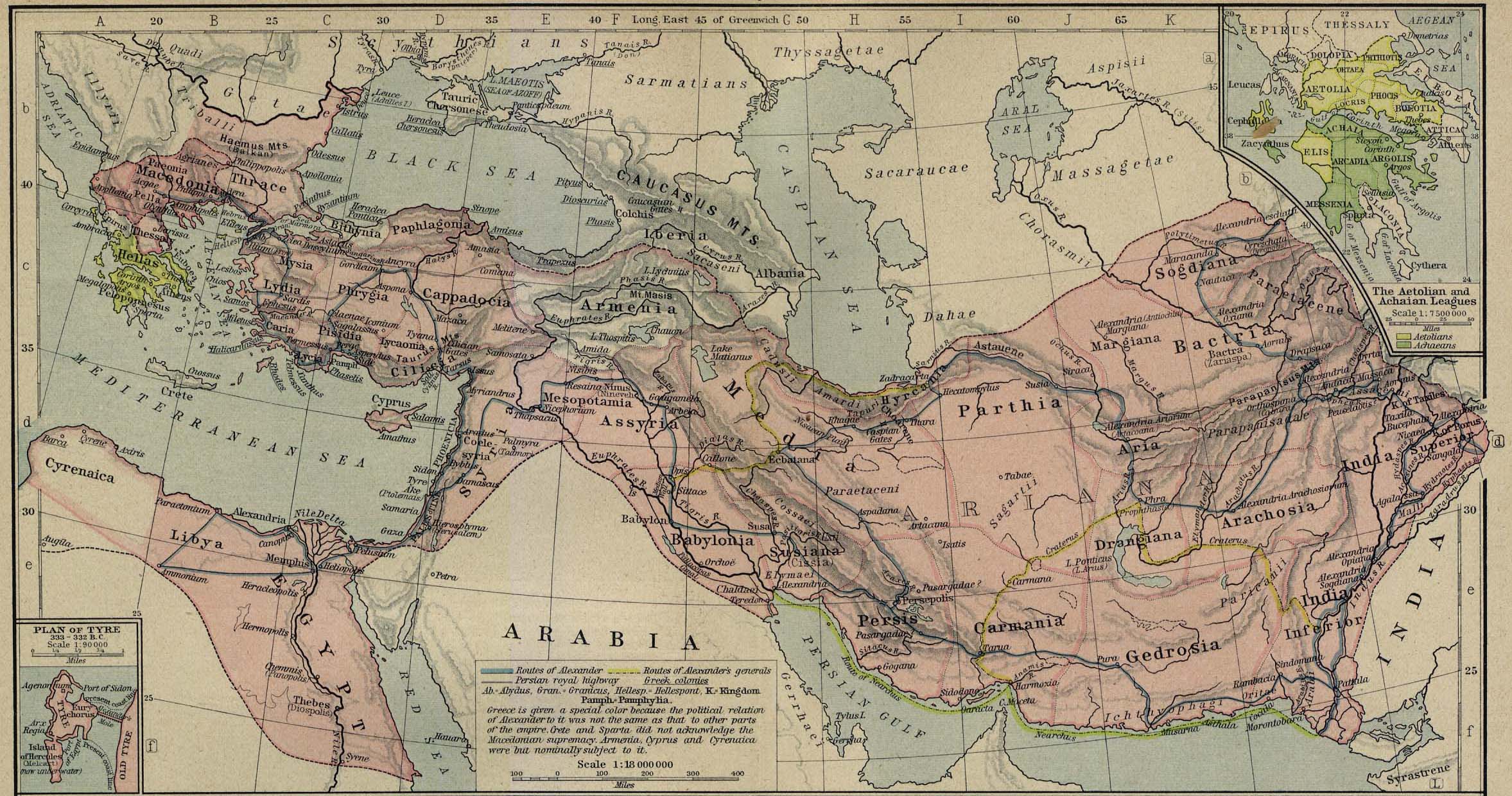


 Septuaginta &c.