 The time has finally rolled around for my last installment of the series I have been working on for quite a while now covering the major modern translations of the Septuagint. While there are other translations in progress (e.g., Japanese and I believe also modern Hebrew), there are four translations currently dominating scholarly discussion. These are the translations into English (NETS), French (BdA – Part I and Part II), Spanish (LBG), and German. So far we have discussed three out of the four with a view to understanding the differing methodologies involved in each project. At last, we have come to the German translation, known as the Septuaginta Deutsch, or LXX.D.
The Modern German Project
 The Septuaginta Deutsch is published in three volumes by the German Bible Society (which, by the way, has a wonderful selection of online biblical texts freely available, including BHS, NA28, and Rahlfs-Hanhart). It is billed as the first complete German translation of the Septuagint, and was completed in 2009 after nine years of labor by eighty-seven scholars. The LXX.D is edited by Prof. Dr. Wolfgang Kraus (Koblenz) and Prof. Dr. Martin Karrer (Wuppertal), along with nine further co-editors. Like NETS, LXX.D is based upon the Göttingen Septuagint where available, otherwise defaulting to Rahlfs.
The actual translation comprises two volumes, where there is also an apparatus detailing significant divergences from the Masoretic text, Greek variants, and alternative translation possibilities (into German). A third volume provides a commentary of the scholars who translated the Greek into German discussing their work.  There is also an entire series of secondary literature volumes, referred to as LXX.E (here), compiling essays by scholars who were involved with the production of LXX.D. As if that were not enough secondary literature, there is also Das Septuaginta-Handbuch (LXX.H) forthcoming, which will furnish the scholarly world with a companion text parallel to the recent T&T Clark volume. With no fewer than eight volumes planned, however, the first of which is available this month, it is safe to say that the German handbook will go into somewhat more depth, more like a dictionary.
Suffice it to say that the Germans have produced a lot of literature to get your head around. Unfortunately, unlike NETS or LBG, the LXX.D is quite expensive and best left to library acquisitions managers unless you are full-time into Septuagint scholarship.
The LXX.D Approach to Translation
As Martin Karrer notes, since there was no precedent to a German translation of the LXX, the scholars involved were free to come up with their own principles (Karrer, 2008, 106). Consequently, Karrer points out the following characteristics of the German approach that guided their work.
1. Priority of the Greek Text
LXX.D understands itself first of all as a translation of a translation, thus gives priority to its own source text, i.e. the Septuagint itself. The translators “handed over their work to the readers … The available Greek became a source text in its own right” (ibid., 107). Because of its influence in lexicon and syntax, the Hebrew text is taken into consideration in the German translation, yet without giving it priority. Thus, LXX.D “allows strange and peculiar trends in German style (for example the foreign parataxis ‘und… und… und’) while real mistakes in the target language are not accepted” (ibid.). In sum, while most of the attention is paid to the Greek text in LXX.D, at least some weight is given to the Hebrew text as the translation was produced.
2. Use of the Best Editions of the Greek Text
Subservient to the previous goal, LXX.D employs the best critical editions of the reconstructed Old Greek version, rather than adopting the readings of a given later manuscript tradition (as does the Brill LXX commentary series). The obvious option here is the Göttingen Septuagint, although it is unfinished and therefore Rahlfs-Hanhart must fill in the gaps. Wherever the two differ, Rahlfs is rendered in a footnote, occasionally with commentary. Notably, LXX.D has declined to use Rahlfs’ in the Historical Books and instead adopts Fernández Marcos’ reconstructed Antiochene text. The rationale here is the highly complex textual history of the Historical Books due and the developments since Rahlfs put together his edition.
3. Translation + Research
In good German fashion, the LXX.D had strict protocols for work flow to produce “scientific reliability” in their translation (ibid., 109). Other features of the translation process included a team of researchers from multiple disciplines outside biblical studies, the addition of inner-Septuagintal cross references and general introductions to each book, and two full-blown conferences to discuss issues.
4. Translation Technique
Karrer summarizes the LXX.D approach to representing translation technique by pointing to the use of a concordance for translation equivalents between Greek and German for consistency, particularly where there are points of intertextuality within the Septuagint. Secondly, for readability LXX.D used a “system of reduced transcription” for transliterated words in Greek, normalizing the most common proper nouns (ibid., 112). Also, LXX.D has refrained from capitulating in its translation to contemporary cultural issues such as social justice or gender concerns, because of its devotion to the Greek rendering. That is not to say, however, that the exegetical realizations of Hellenistic culture within the Greek text are not conveyed into German.
5. Intended Readers
LXX.D is aimed primarily at researchers and graduate students and aimed at religious neutrality, while presuming readers to be biblically well-educated (ibid., 114). This certainly comprises German-speaking Eastern Orthodox Christians, although there are often textual differences with liturgical materials employed in (often differing) Orthodox rites.
The Spectrum of Modern Translations (Part II)
Both NETS and BdA existed prior to LXX.D, and thus the latter was developed with the benefit of preexisting methodological reflection upon translation translation, so to speak. However, there are a few key differences. LXX.D, unlike NETS, does not use an existing translation of the Hebrew OT as a base text that is changed wherever the Septuagint diverges from it (ibid., 117). In part this is because NETS takes the Hebrew text as its point of departure in important ways that legitimate such a decision. LXX.D is not interested in interlinearity. LXX.D is also less interested in reception history than BdA, although it is not completely disregarded in producing the German version in difficult texts.
In my post on LBG I included a spectrum of the modern translations surveyed thus far. Having reviewed the German project, we can now update that spectrum to look like this, with the horizontal axis signifying the degree to which the Septuagint is conceived of as independent from the Hebrew text. NETS understands the LXX as the least independent from (i.e., most dependent upon) its source text in terms of form and meaning:
NETS –> LXX.D –> LBG –> BdA
It is arguable that the middle two could swap places, but in my reading of LBG I see more discussion of the legitimacy of the Greek Septuagint as an independent text than LXX.D. As far as I can tell, LBG will consult the Hebrew text to clarify where “necessary,” while LXX.D consults the Hebrew text as long as it does not have priority. Thus the differences, I think, is in degree.
Wrapping Up
This series has been a long time in the making, and no doubt much more could be said. Accordingly, for those interested, I presented a bulked-up version of this series in paper format at the ETS National conference in Atlanta, GA, which I hope to publish eventually. While the paper won’t be “more” in length than this blog series, it will include more comprehensive notes to secondary literature that will hopefully be a guide through these important issues in the discipline.
__________________________
Karrer, Martin. “Septuaginta Deutsch (LXX.D). Characteristics of the German Translation Project.” Pages 105-18 in Translating a Translation. Edited by H. Ausloos, J. Cook, F. García Martínez, B. Lemmelijn and M. Vervenne. Bibliotheca Ephemeridum Theologicarum Lovaniensium 213. Leuven: Peeters, 2008.

 It’s been a few weeks now, but the annual conferences of the major biblical studies societies have come and gone. Legions of scholars from around the world spent untold dollars and lost entire time zones of sleep to make it there, and are only now recovering. This year’s melee was held in Atlanta, a lovely city whose downtown area is apparently constituted only of gigantic hotels. And they all seemed to be full of the scholarly hordes for about a week in late November.
 I mentioned in a previous post that I would not only attend both the
 It sounds boring, but I believe I can show quite conclusively that the Judges translator knew and consciously re-employed features of the OG Genesis text in his version of Judges. In effect, he amplifies the relationship between the narratives, but also shows good (if intermittent) Greek style, and reveals something of the status and familiarity of the Greek Pentateuch in later eras.
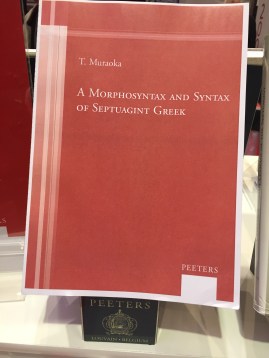
 In case you don’t know, John is one of the top scholars of Koine Greek at the moment and has contributed extensively to lexicography. His work in the Greek Pentateuch is what spurred my own interest in Septuagint vocabulary and has provided much of the methodology for my doctoral research. Trevor Evans and Jim Aitken teamed up to put together an edited volume of essays in John’s honor, Biblical Greek in Context (Brill). This looks like an excellent resource that will hopefully get wide attention.
 Septuaginta &c.