Resource Reviews

North American Graduate Programs in Septuagint

Finding a LXX Intro course can be this difficult…

Occasionally someone will ask me what the best way is to get an introduction to Septuagint studies. Most of the time my response is something like “Here are five books to read.” The reason is that there are very few institutions where LXX features in the curriculum in any meaningful way. As a result, there are very few places to go to take an actual course in LXX studies, much less an introductory course. Another reason is the small number of scholars specifically trained in LXX to offer courses in the first place!

In this post, then, I will review the few exceptions to this rule in North America. Think of it as a Resource Review of graduate programs. Hopefully this will help those interested save some time scouring the internet at random (which is what I did).

Septuagint Studies in the States

There are two programs to mention, which feature prominently because of the people at the helm of each. If you are reading this and know of others I have overlooked, please let me know or post to the comments.

1) Peter Gentry – Southern Baptist Theological Seminary


southern_baptist_theological_seminary_logoFirstly, there is a community of Septuagint scholarship at SBTS under the leadership of Dr. Peter Gentry. Gentry was the last student to study under John W. Wevers at the former bastion of LXX studies in North America, the University of Toronto. When both Pietersma and Wevers were at that institution, they produced a number of now senior scholars in LXX studies, and Gentry is among them. (Some others will feature below.)

Gentry’s interests are wide-ranging and extend well beyond the Septuagint. He is involved in the Göttingen Septuagint Series (Ecclesiasties, Proverbs), and takes particular interest in Hexapla studies. If you thought the Septuagint was obscure, the Hexapla is even more so. It is a terribly interesting, and terribly complex, aspect of LXX history, and for that reason the discipline benefits greatly from competent scholars like Gentry. 

He and others are currently involved in the Hexapla Project of the IOSCS, and for that reason many of his doctoral students also work in all things hexaplaric. Gentry also teaches graduate level courses in LXX, such as his Septuagint Seminar. So although SBTS does not offer a full graduate degree in LXX studies per se, it is certainly an option for focusing in a ThM or PhD.

2) Karen Jobes – Wheaton College Graduate School

photoSecondly, there is Dr. Karen Jobes at Wheaton College Graduate School. Jobes is a product of my own institution in days gone by, Westminster Theological Seminary, where she completed her doctorate under Moisés Silva. She keeps a website here.

Her primary professional interests focus upon New Testament, particularly the General Epistles. In conversation with her, she once told me that Septuagint was her “night job.” Considering she’s so productive in her NT day job, it’s remarkable how active she also is in LXX studies. Her and Silva’s Invitation to the Septuagint is always one of those five books I recommend for introduction to the discipline. Rumor has it there is a revision of this volume underway.

Like SBTS, there is no full-fledged LXX degree at Wheaton. However, Jobes offers a course on Greek Exegesis in the Septuagint. So Wheaton is another option for tailoring your focus on LXX studies in either an MA or a PhD program.

[Update: Dr. Jobes has now retired from teaching as of 2016]

3) Other Scholars of Note

There are other North American scholars who are doing excellent work in Septuagint as well. Some of them include J. Ross Wagner at Duke Divinity School, Benjamin G. Wright at Lehigh University, and W. Edward Glenny at University of Northwestern. I did not feature these scholars as prominently since they do not offer actual courses in Septuagint, as far as I know. Wagner, however, takes doctoral students focusing in LXX studies.

Canada, Eh?

1) [Update: PhD Program in Septuagint at McMaster Divinity College]

As of early 2017, McMaster Divinity college is launching a full-fledged PhD program in Septuagint. You can read about that here.

2) The J. W. W. Institute for Septuagint Studies

There is one other excellent place to mention, namely The John William Wevers Institute for Septuagint Studies. The Institute is located under the auspices of Trinity Western University in Vancouver, B.C. In the post-Wevers-Pietersma era at the University of Toronto, this is the single most LXX-concentrated faculty that I can think of, with four highly qualified scholars. Better still, both Wevers and Pietersma have donated their extensive personal libraries (and a large endowment) to further LXX studies at TWU. 

The Institute’s scholars include Drs. Robert Hiebert (director), Larry PerkinsDirk Büchner, and Peter Flint. You’ll also have valuable access to Cameron Boyd-Taylor, currently a research assistant at the Institute. Hiebert, incidentally, is also the joint-editor-in-chief of the SBL Commentary on the Septuagint. Each of these professors’ research interests can be viewed on their respective faculty pages. The unique aspect of the Institute is that it is the only place in North America where a full-fledged Septuagint degree is offered, as both a Master of Theological Studies and the shorter Master of Theology. [Update: Dr. Flint passed away in late 2016]

Furthermore, the Institute for Septuagint Studies typically offers a week-long Septuagint seminar in May or June each year. I participated in the first such seminar in May 2013 (read about it here) and again in 2016. This is a wonderful opportunity to study LXX in taught format under some excellent scholars. I hope for others’ sake they continue with this seminar in the future. Speaking of which, there have been efforts, unsuccessful so far, to offer a PhD through TWU as well, which could be a great opportunity if it ever comes to fruition.

Part of what I especially like about the Institute is that it is literally surrounded by seminaries. TWU is part of the ACTS coalition of seminaries in Canada, and hosts a number of them in one building where the Institute is also located. Where the Septuagint is, the Church (rightly) is also.

Stay tuned for further Resource Reviews as they come…


Biblical Studies Societies – A Guide for Students

In this Resource Review, I will offer an overview of the world of professional biblical and religious studies organizations. I had no idea what they were at first – or that they existed – so hopefully this will be helpful. The information I have here is particularly targeted at helping current students of biblical studies hoping to enter a doctoral program understand the kind of parallel universe they’re approaching.

The Societies

No gauntlets required.

The first thing you need to know, if you don’t already, is that like many communities in higher academics, biblical studies as a discipline has a variety of professional organizations that are by and large called “societies” or “organizations.” While this may sound medieval, the only rites of passage you will have to endure are membership fees and the sudden feeling of insignificance.

In large part, the whole point of these societies is the refined, scholarly version of what anyone else would call networking. The point is to share ideas, compare work and conclusions, argue about minutiae, and (naturally) catch up with old friends. As a result, it’s an invaluable opportunity for younger scholars to learn and get to know the discipline and its community. But, when you first join, and for years afterwards, you’ll be a mere newcomer who knows nothing and no one. (This is my current status, by the way.) So settle in, get ready to listen, and try not to bother anyone.

The societies I deal with in this post are the main ones you want to be aware of, although there are innumerably more if you search around. In each, I try to discuss how and why to join the organization, and what is required to present at one of their conferences.

Who’s Who in Biblical Studies Societies

The main societies you want to know about are as follows, listed roughly by largest membership and broadest in range, to more narrow either in terms of religious outlook or technical discipline.

American Academy of Religion

AAR is about as broad as you can get. Limited only to anything called “religion,” this group offers a venue for “ongoing reflection upon and understanding of religious traditions, issues, questions, and values.” For the last number of years, AAR has joined with SBL (below) for its annual national conference, usually in November (brochure here). Also, like SBL, AAR has a number of annual regional conferences: Eastern InternationalNew England-Maritimes, and Pacific Northwest. The wonderful thing about both AAR and SBL is that they are remarkably organized, and have meetings planned for the next handful of years already. Students can become a member of AAR for $55, which has a number of benefits, which include faculty position postings. I am not personally a member of AAR, and am not entirely sure what goes into qualifying to present at the conferences, but my guess would be that it is the same as SBL.

Society of Biblical Literature

The big kahuna for biblical studies is the Society of Biblical Literature (SBL), whose mission statement is simply: “Foster biblical scholarship.” Anyone can join, and there are many benefits of doing so, not least of which include online access to the society’s Journal of Biblical Literature and Handbook of Style. More importantly, there is a student discount to join for $60 a year. As the oldest society for biblical studies (founded in 1880), it is the most reputable and respected.

Every year SBL throws a conference that is eagerly attended by thousands upon thousands of scholars from around the world. The conference booklet listing presentations is fatter than most college textbooks. Since the annual SBL conference is combined with the AAR conference, the event is even more massive. It’s an exciting experience, made only more exhilarating by the coffee stampede that occurs when the only Starbucks in the entire facility closes down at 2pm. Best of all, this coming year’s conference, held from Nov. 22nd-25th, will be in sunny California. 

SBL also has an international conference each year, as well as numerous regional conferences that are usually held in the spring. These include CentralEastern Great LakesMid AtlanticMidwestNew EnglandPacific CoastPacific NorthwestRocky Mountains – Great PlainsSoutheasternSouthwestern, and Upper Midwest regions. It is possible, but not typical, for pre-doctoral students to present at the regional conferences (I did it). But the national conference requires presenters to be current doctoral candidates. Moreover, the SBL website is valuable in and of itself, with career and educational resources to boot. 

The International Organization for the Study of the Old Testament

IOSOT (pronounced “YO-sot” or “EYE-oh-sot”) is the biggest, specifically Old Testament-focused society. It’s so large, it doesn’t have “conferences,” but “congresses.” And it doesn’t meet except for every three years at a given location around the world. The last meeting was in Munich 2013, which I attended and presented a paper (see here). Some prior meetings were Basel 2001, Leiden 2004, Ljubljana 2007, and Helsinki 2010. As far as I know, there is no way to “join” IOSOT, as much as attend and possibly participate in the congresses. The next one is slated to be in Stellenbosch, South Africa in 2016, so mark your calendars. Nor is there an IOSOT website, but only sites for the next congress. I’m not totally clear on whether you must be a current doctoral candidate to present at one of these congresses. I presented when I was in my masters program, so theoretically the answer is “no,” but it may have only been because it was assumed that I was a doctoral student!

When IOSOT meets, a number of other, more specialized organizations also meet, such as the International Organization for Septuagint and Cognate Studies (IOSCS, see below), of the International Organization for Masoretic Studies (IOMS), of the International Organization for Qumran Studies (IOQS), the International Organization for Targumic Studies (IOTS), and the International Syriac Language Project (ISLP).

International Organization for Septuagint and Cognate Studies

One of my favorite organizations is the IOSCS, which is among the organizations that meets under the auspices of the IOSOT congresses. This group is “a nonprofit, learned society formed to promote international research in and study of the Septuagint and related texts,” the latter of which include the apocryphal and pseudepigraphical literature contemporary to the turn of the era. The main page of this organization includes lots of announcements that are regularly updated.

The IOSCS also publishes the Journal of Septuagint Studies (JSCS), which can be slow in coming but is usually worth the wait. The group meets at the triennial IOSOT congress, but also every year at the SBL national conference as well, which means you cannot present a paper unless you are accepted through SBL’s call for papers. It’s easy and quite affordable to become a member ($15 for students), which subscribes you to the Journal.

Evangelical Theological Society

Another group you may consider becoming involved with is ETS. Founded in 1949 with the purpose statement: “To foster conservative Biblical scholarship by providing a medium for the oral exchange and written expression of thought and research in the general field of the theological disciplines as centered in the Scriptures.” (Constitution, Article II.). ETS requires members to subscribe to a doctrinal statement, which says: “The Bible alone, and the Bible in its entirety, is the Word of God written and is therefore inerrant in the autographs. God is a Trinity, Father, Son, and Holy Spirit, each an uncreated person, one in essence, equal in power and glory.”

Membership is $15 for students, and includes a subscription to the Journal of the Evangelical Theological Society (JETS). Somewhat frustratingly, the process of joining is a bit complex. Only those with a completed ThM or equivalent can become full members, and students can join only by applying with a recommendation from a full member. As a result, you’ll have to pester one of your professors to fill out a form when you apply to join.

ETS also has a national conference that follows SBL around each year. Like SBL and AAR, there are yearly regional meetings as well. It is possible, but not typical, for pre-doctoral students to present in the regional conferences (at least, I did it), but you must be a current doctoral candidate to present at the national conference.

Institute for Biblical Research

IBR is still another organization that may be worth your time, particularly if you wish to or have joined ETS. The group’s vision is to “to foster excellence in the pursuit of Biblical Studies within a faith environment,” which occurs primarily through conferences, seminars, workshops, and publications. One of the primary forms of the latter is the Bulletin for Biblical Research (BBR).

Like the IOSCS meeting at the SBL conference, IBR generally has their annual meeting during the ETS national conference, where they will hold a number of sessions for general attendance (see this schedule from 2013). Membership is somewhat confusing in this group also. One can only be a “fellow” after completing a research doctoral degree and requires two letters of recommendation from current fellows. You can become an “associate” member only if you are currently in a doctoral program, and get a letter of recommendation from a full fellow. Finally, “friends” of IBR covers everyone else, but still requires nomination by a full fellow. Fellows’ and Friends’ memberships are $62.00 per year.  Associates’ memberships are $42.00 per year.  If you also wish to subscribe to the Tyndale Bulletin, IBR’s journal, you may do so for $35.00 per year.

As a historical point, IBR was begun as a result of the scholarly community at the Tyndale House, in Cambridge, England. Also, the site includes a job posting page.

The Conference Scene

Part and parcel with joining any of these societies and organizations is participation in the life of the community. This means, at least, keeping up with the journals and publications either in print or online (or listed in newsletters). Ideally, however, you will also be able to attend the conferences. Doing so is a major project and can be very expensive, but is extremely beneficial for aspiring doctoral students. I will be posting a similar “Guide for Students” for attending these conferences – why you should, how to go about it, what to do when you’re there, etc.

It’s great if you can also begin participating in these conferences by actually presenting your own work. This can be difficult to do, and at the pre-doctoral level is generally limited to regional conferences or the odd coincidental vacancy that you providentially fill at a more significant conference. More difficult still, even if you meet requirements for presenters, it can be intensely competitive to get accepted. I’ll cover these topics a bit more in the next post.


A User’s Guide to Papyri.info (Part II) – Text

I’ve said it before, but I repeat. Papyri.info is an amazing resource. In preparation to provide a Resource Review for it, I ended up writing a primer post (here). Now, I should say up front that Papyri.info is useful for a very specific niche within LXX research, and that is lexicography. So if you are not interested in lexicography, you can probably skip this review. Otherwise, read on.

To reiterate a point from my primer post, there is debate still going on as to whether the meaning of the Greek words in the LXX are to be determined primarily by reference to their Hebrew counterpart in the source text, or primarily by reference to their contemporary Hellenistic usage.

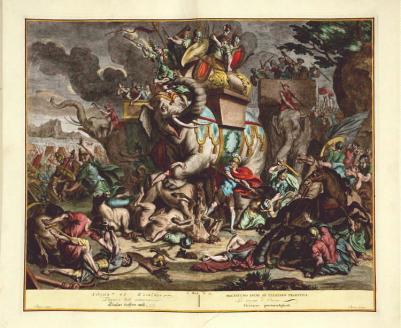
Eleazar Killing a War Elephant in the Maccabean War (1 Macc. 6:42-47), by B. Picart Broen, 1728

Generally speaking, the debate is not a neat either/or matter, but rather one of primacy. There are many good reasons to take the Hebrew parent text as primary in a number of cases. These tend to be words that have become a terminus technicus. Still, although a Greek word may come to mean something more or different than it did prior to its use in the LXX (e.g. διαθήκη, εἰρήνη), this is not particularly unique. Lexicographers have recognized for some time that word meaning is not static. What this amounts to, then, is that the new uses of Koine words in the LXX is not necessarily due to its status as a translated text. It may rather be attributable to the new socio-political-(religious) context(s).

So, as promised, I shall punt on this issue (for now), and press on.

Background to Papyri.info

As discussed on the homepage, this LXX resource consists of the papyrological navigator and the papyrological editor. Since I have no business dealing with the latter, I won’t (most likely, neither should you). The former, however, “supports searching, browsing, and aggregation of ancient papyrological documents and related materials.” The wonderful thing about papyri.info is that it is a one-stop resource for material that quite recently was scattered hither and yon. As the homepage says, the site collates material from the Advanced Papyrological Information System (APIS), Duke Databank of Documentary Papyri (DDbDP), Heidelberger Gesamtverzeichnis der griechischen Papyrusurkunden Ägyptens (HGV), Bibliographie Papyrologique (BP). 

Most of this information was accessible by CD-Rom prior to the mid-2000s, but now it’s all free and constantly updated. To force you to appreciate how wonderful this is, consider this quote:

“Not just hours or weeks, but months were spent searching for [Greek] words in the indexes of documentary volumes and confirming occurrences. Every text had to be laboriously copied by hand in the library, then recopied into the manuscript when written, before finally being handed over for typing… Photocopying was only just beginning to be possible” (J. A. L. Lee, “A Lexical Study Thirty Years On,” 515).

 So count yourself lucky to be a part of the age of xerox, email, and open-source internet. The “how-to” I’ve written up below walks through some material laid out on the papyri.info site already, and some of my own additions as well.

Using Papyri.info

Considering that this is a freely accessible website, the functionality of papyri.info/search is remarkable. The first thing you’ll notice is the main search window:

search

I will usually tick the “Convert from betacode as you type” button so that your keystrokes enter Greek directly. Otherwise, you have to cut-and-paste unicode Greek font from somewhere else. A good guide to betacode typing can be found here (also pdf). The other toggle buttons are self-evident: if capitalization is relevant to your search (e.g. proper nouns), you may want to un-tick “Ignore Capitalization,” and the same for diacritics/accents.

The most simple type of search is a “string” search, meaning “string” of characters. Simply entering καί into the search bar, for example, will turn up 31,604 hits. Note how the site conveniently highlights your word(s) when you click on a particular text. Moreover, you can link to that text and have the highlighting remain (see p.worp 16, below). But back to the search on καί. It is important to know that included in the massive search result number is any word in which the characters κ-α-ί occur in sequence, such as καῖσαρ or καιρός. This is where the ‘#’ code is crucial, as it breaks off a string from surrounding characters. If you wanted only καί, then, you would enter #καί#, which would return 28,138 hits.  

Further, you can search for phrases using quotes. So if you were looking for instances of μὴ φοβοῦ, you’d enter “‘μὴ φοβοῦ'” and get just a single hit (p.worp 16). You’ll notice that in p.worp 16 there is a translation of the papyrus provided. This is a major boon when it happens, although in my experience that is rarely. Of course, in this case, the translation is into Italian, but it is helpful nevertheless.

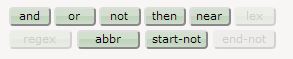
You’ll also notice the group of buttons below the search bar. buttonsThese buttons really amplify the capacity of the engine, so they’re worth learning to use. I will spend some time walking through the more basic button functions here, and then wait until a third (!) post to treat the more sophisticated ones… partly because I’m still figuring them out.

Firstly, the “and” “or” and “not” buttons do exactly what you would expect. When you enter any Greek word in the search window, then hit one of those three buttons, a second search window will appear below for your second criterion (or third, etc.).comboThis allows you to include, alternate, or exclude certain words.

The following two buttons, “then” and “near,” deal more with sequencing of words. For example, if we wanted to see if the prepositional phrase εἰς ἀπάντησιν occurs in any papyri, we’d type, εἰς and click the “then” button and add ἀπάντησιν. The “within ___” window will become active automatically, and we’ll enter 3, for example, and then select “words” from the drop-down to the right, although you can also search by character for more refined quests. So our sample search is “εἰς THEN ἀπάντησιν within 3 words.” We get two results:

Eureka!

Eureka!

Note that the “then” button sets up the search for terms in the order in which they were entered (εἰς followed by ἀπάντησιν), while the “near” button searches in either direction within the limits you set, whether by word or character.

This is one of innumerable possible searches just with these first few buttons. As mentioned, I will reserve comment on the following buttons for a third installment. The last few are the most powerful (and finicky), and so take space to treat well. Disclaimer: It may take me some time to produce this final post.