Research

The 2015 Annual Conferences in Review

It’s been a few weeks now, but the annual conferences of the major biblical studies societies have come and gone. Legions of scholars from around the world spent untold dollars and lost entire time zones of sleep to make it there, and are only now recovering. This year’s melee was held in Atlanta, a lovely city whose downtown area is apparently constituted only of gigantic hotels. And they all seemed to be full of the scholarly hordes for about a week in late November.

Some Highlights

20151118_131217669_iOSI mentioned in a previous post that I would not only attend both the ETS and SBL conferences (plus the IBR meetings squished in the middle), but I also presented three papers. In retrospect, that amount of preparation and participation was probably overly ambitious. I’m glad to have done it, but I’ll likely keep it to two papers at most from now on.

One major event for me at ETS was participating in our newly formed Septuagint Studies session, where I presented one of my papers. It was a pleasure to help pull this session together with the work of many colleagues, and I think the session went quite well. We had about a dozen attendees who were very engaging and interested. Most exciting, though, was having our proposal for consultation status approved by the powers-that-be, which means Septuagint Studies will be a session at ETS for at least the next three years. For next year, it is the hope of the steering committee to put together a great session of invited papers from top evangelical scholars to address key issues in the study of the Septuagint. Stay tuned for more developments here.

20151118_173438000_iOS

The steering committee for the ETS Septuagint Studies consultation (yes, I shaved my head)

My two other papers were for SBL. For the second year in a row I was able to participate in one of the IOSCS sessions. These are an excellent venue for me to present work drawn directly from my dissertation, since almost every scholar active in Septuagint studies turns up. It makes for a time of very profitable interaction and feedback. My paper dealt with the changes in “meeting” vocabulary within the textual history of LXX-Judges, attempting to account for shifting trends in terms of changing stylistic aims or chronological situation.

I also presented at the Greek Bible section this year. The paper dealt with the well-known narrative echo in Judges 19 of Genesis 19, where in both texts travelers find shelter in a strange city only to have their host intercede for their safety from hostile “men of the city.” I reconstructed the OG translation of this passage in Judges and examined whether and how the translator receives the OG narrative from Genesis. 20151121_144729067_iOSIt sounds boring, but I believe I can show quite conclusively that the Judges translator knew and consciously re-employed features of the OG Genesis text in his version of Judges. In effect, he amplifies the relationship between the narratives, but also shows good (if intermittent) Greek style, and reveals something of the status and familiarity of the Greek Pentateuch in later eras.
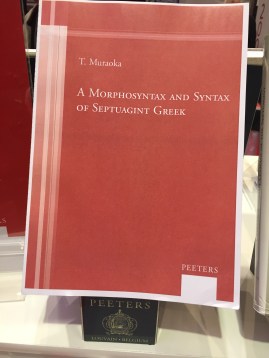
Of course, between the presentations were many meetings with people of all sorts – both intentional and incidental – plus sessions, banquets, receptions, happy hours, seminars, and the expansive book exhibit. As for the last, I was most excited to see T. Muraoka’s new A Morphosyntax and Syntax of Septuagint Greek (Peeters). Although it’s not quite ready yet, a sample was there to thumb through. Let me just say that it’s about 800 pages as it is, and there are no indexes yet. It should ship in a month or two.

Another really wonderful highlight was the small festschrift party (ein Festschriftfest?) held for John A. L. Lee. 20151121_234901746_iOSIn case you don’t know, John is one of the top scholars of Koine Greek at the moment and has contributed extensively to lexicography. His work in the Greek Pentateuch is what spurred my own interest in Septuagint vocabulary and has provided much of the methodology for my doctoral research. Trevor Evans and Jim Aitken teamed up to put together an edited volume of essays in John’s honor, Biblical Greek in Context (Brill). This looks like an excellent resource that will hopefully get wide attention.

Wrapping Up

As usual, the conferences are chaotic, exhausting, and expensive, but always worth the investment. The conversations and connections one can make are invaluable. If you missed this year and are disappointed, never fear: the proposal period for the 2016 conferences in San Antonio opens in about three months!

New Article on Old Testament Textual Criticism in ZAW

Today I wanted to focus on something that I mentioned back in my Spring Update post quite a while back. (If you’ve published in academic journals then you know how long it can take for these things to finally surface in print.) I am pleased to have had an article accepted in Zeitschrift für die alttestamentliche Wissenschaft, or simply ZAW for those less inclined to pronounce long German phrases. The journal is published quarterly, and my piece will be in the upcoming September issue (127/3). According to their website, ZAW “has been the leading international and interconfessional periodical in the field of research in the Old Testament and Early Judaism for over one hundred years.” Needless to say, it is an honor to have my own work included in this journal.

The Main Points of Argument

My article is entitled “Text-Critical Question Begging in Nahum 1,2-8: Re-evaluating the Evidence and Arguments.” In it, I examine the text of Nahum 1, where many scholars have drawn attention to what is almost an acrostic (in the Hebrew text). There are a few letters missing, namely daleth, zayin, and yod lines, and so it is fairly common in critical commentaries for scholars to suggest various ways of emending the Hebrew text in order to “restore” the acrostic to its supposed proto-form. While this may sound somewhat reasonable, this near acrostic is also, admittedly, a partial acrostic. This means that it only spans part of the alphabet (just the first half) even in its theoretical “original” form. In my view, that makes the whole assumption that it is, in fact, supposed to be an acrostic, much more speculative and therefore suspect.

So what I do is examine each of the three places where there is a “wrong” letter and where emendations are usually proposed. I summarize common arguments for altering the Hebrew text in a way that “restores” the acrostic. For the most part these must build on versional information (mainly the Septuagint, but also Latin and the Peshitta), since there are no proper variants in the extant Hebrew manuscript tradition. Then, I examine the text of the acrostic in the Old Greek version of Nahum (Zeigler’s text) to evaluate the translation technique that characterizes that unit of the book (1:2-8). I show that the divergences in the Greek version from the Hebrew MT are better accounted for as features resulting from the process of translation rather than a different Vorlage, namely one that contained the theoretical “acrostic.” Finally, I martial the results of other scholars’ studies conducted in the LXX-Twelve Prophets, which is thought to have been translated by a single individual, to demonstrate how their characterization of the translation technique of the entire Twelve further corroborates the translational and textual trends present in LXX-Nahum 1:2-8 (and therefore my argument against a different Hebrew Vorlage).

Why Bother?

I don’t see any acrostic on that scroll, do you?

In the end, the “payoff” of my paper is to seriously challenge what has become a tradition of messing with the Masoretic text of the Hebrew Bible unnecessarily. While it is certainly true that the MT does occasionally need emending (based as it is upon a 10th century codex), making the decision to actually alter the Hebrew text is one that must be preceded by much careful investigation, constantly reevaluated in light of further textual evidence. One of the reasons for my interest in Septuagint studies stems from my concern for the Hebrew text of Scripture. When examined from a text-critical standpoint, scholars of the Hebrew Bible must reckon with the Septuagint. Yet so often this does not happen, or does not happen very convincingly because of the technical nature of many aspects of Septuagint scholarship. (Hence, in part, this blog!)

When it comes to the so-called “acrostic” of Nahum 1:2-8, I find it much more interesting and exegetically rewarding to reckon with the possible reasons that the text is, in fact, nearly an acrostic … but not quite. I believe Tremper Longman’s view is fairly satisfactory here as he takes a literary critical approach: in the context, the judgement and wrath of the Lord brings upheaval upon all of creation to such a massive extent that even the very text involved in describing it is jarred and disrupted.* To me this approach to the text of Nahum 1 rightly expects much of the literary capabilities of biblical authors, and of the competence and meticulousness of later scribes.

Unfortunately, I can’t distribute the article itself in PDF form. But you can find it shortly in the forthcoming ZAW.

________________

*Tremper Longman, “Nahum,” in The Minor Prophets: An Exegetical and Expository Commentary, ed. Thomas E. McComiskey (Grand Rapids: Baker Academic, 2009): 765–830.

June 2015 Biblical Studies Carnival

BS CarnivalGet your party hats on, it’s time for the Biblical Studies carnival. For those not familiar with it, the Carnival is a monthly review of all things biblical studies going down in the known blogosphere. If you’ve never read one before (see Claude Mariottini’s May edition), but like what you see, be sure to keep an eye on Lindsay Kennedy’s blog in a month’s time for the next one, followed by Bob MacDonald in August. If you’re interested in hosting one yourself, Phil Long at plong42@gmail.com and ask about it.

Like previous editions, I’ll attempt to subdivide interesting materials into discipline.

The Carnival

General Biblical Studies and Linguistics

Another installment of the Scholars in Press series over at Old School Script, interviewing Tania Notarius

Although the latest post was more culturally focused, it’s worth keeping your eye on Secundum Scripturas

Mike Aubrey discusses “fun data points in Greek

Peter Kirby gives a detailed treatment of stylometry in Biblical Studies

Jonathan Homrighausen reviews Molly Whittaker’s Jews and Christians: Graeco-Roman Views

A brief note over at What’s New in Papyrology about a newly (digitally) republished papyrus

The University of Cambridge has digitized Ben Sira, Tobit, Enoch, and many others from the Genizah archive for public access on a stand-alone website

I note with sadness that you can read of the recent passing of Zondervan editor Verlyn Verbrugge, who worked with me and my co-authors on the Greek Interpretive Lexicon.

Exegetical Tools is a new-ish site, loaded with goodies for biblical studies, including book reviews, annotated bibliographies, and a new program for learning and refreshing your Greek. You can subscribe to their email Greek for the Week to get regular review materials. Everything is free. A recent post was a roundup of deals on resources for Kindle and new publications in Biblical Studies.

New Testament

Among many other things, Larry Hurtado has blogged in defense of good old fashion Biblical Studies, in response to a forthcoming critique of his JNTS article “Fashions, Fallacies and Future Prospects in New Testament Studies.”

Michael Kok continues his series on the Synoptic Problem

Wayne Coppins discusses (the German of ) Annette Merz’s treatment of gender and Historical Jesus studies

On Steve Walton’s blog I found a link to Beverly Gaventa’s obituary for J. Louis Martyn

Daniel Gullotta drew attention to a Kickstarter campaign to get Ehrman and Price to debate the existence of Jesus

Dan Wallace updates us on the progress made in Athens where he is digitizing Greek manuscripts

David Lincicum tells of a recent trip to examine P72 at 2 Peter 3:13

Phil Long discusses 2 Cor 12:1-10 and Paul’s Vision

David Gowler writes on the reception history of the parables

James McGrath explores the real issue at stake in 1 Cor. 11 and one of Jesus’ more enigmatic statements

Old Testament

Jim West discusses BibleWorks 10 and their addition of NETS (finally!)

Claude Mariottini explores the differences between Genesis 1 and 2

George Athas critiques recent reports of a Canaanite coin discovery

At the Biblical Review you can read observations on interpretation of Leviticus 10 by William Hart Brown

Irene Rossi notes two newly released monographs dealing with Near Eastern epigraphy

Stephen Campbell posted two installments on the hermeneutic of John Goldingay

More discussion of 2 Kings continues on Carpe Scriptura

Dean Galbraith expands upon the versions of the David and Goliath story

Bob MacDonald discusses the structure of Bildad’s speech in Job 8

James Pate discusses the reception history of Genesis 3:3 and the Sibylline Oracles in NT studies

You can read the obituary for Suzanne E. McCarthy, long-time scholar of Bible translation (HT the gang at BLT)

I have reviewed Nicholas King’s The Bible, and Goldingay’s Do We Need the New Testament?

Jim Gordon discusses the state of commentary upon the book of Ruth

Wrapping Up

Still haven’t had enough? Check out the Christian Origins digest from last week in June. If I missed anything good, please leave a link in the comments below. Thanks!