 Old Testament scholarship is pretty obscure stuff for most people on the street. But mention the word “Septuagint” and you’ll usually get even more muddled looks and occasionally a “God bless you” in puzzled response. Well, things don’t get any better from there as you get into sub-fields of this sub-discipline.
Even within the small, fascinating world of Septuagint scholarship, the biannual Tagung held Wuppertal, Germany, is not terribly well known. Certainly not among casual “septuagintal hobbyists.” That is not to say that it isn’t very influential. To the contrary, in fact, this conference is one of the most important “think-tank” events in the discipline. Every two years it takes place at the Kirchliche Hochschule and attracts specialists in Septuagint scholarship from around the globe. The connection to that institution is the highly regarded Dr. Seigfreid Kreuzer, emeritus professor at the Hochschule and also (among other things) current editor-in-chief of the discipline’s own Journal of Septuagint and Cognate Studies.
The 6th LXX.D Conference
 Although the page is sadly out of date, you can read (in German) about some of the previous Tagungen that have been part of the outrageously productive Septuaginta Deutsch research project over the years. I have written previously about their Septuagintaübersetzung (LXX.D, 2 volumes), which is also accompanied by their commentary volume (LXX.E). I’ve also mentioned the ongoing Handbuch project (LXX.H), which is slated to be a massive eight volumes – Volume 1, edited by Dr. Kreuzer, is already available.
In addition to this (quite literally) voluminous output from scholars associated with this research initiative, there has also been a steady flow of edited volumes containing the essays presented at each LXX.D biannual conference in Wuppertal. Thus far, these have been published by Mohr Siebeck, and can be obtained for somewhere between €140-215 if you have extra pocket change.
Die Septuaginta – Texte, Kontexte, Lebenswelten (2006)
Die Septuaginta – Texte, Theologien, Einflüsse (2008)
Die Septuaginta – Entstehung, Sprache, Geschichte (2010)
Die Septuaginta – Text, Wirkung, Rezeption (2012)
Die Septuaginta – Orte und Intentionen (2014)
This year is the 6th international conference to be held in Wuppertal, from 21-24 July. This year’s theme and, presumably, the subsequent volume’s title is:
Die Septuaginta. Geschichte – Wirkung – Relevanz
(The Septuagint: History – Impact/Effect – Relevance)
My Contribution
 I was pleased to get the opportunity to participate in this year’s conference.
When something like this comes along in the life of a young scholar, you scrape every penny of funding together that you can to make it happen. And make sure your wife is okay with it. Oh, and double check that you also have something worthwhile to say.
Thankfully, I have managed to coordinate all three (I love you, Kelli). I think the “have something worthwhile to say” criteria will be put to the test at the actual conference, but at least in theory my paper should fit in quite nicely with this year’s theme.
My abstract is as follows:
Title: “The Septuagint as Catalyst for Language Change in the Koine: A Usage-Based Approach”
Ever since Deissmann, scholars of Greek have increasingly recognized that the Septuagint embodies a corpus of language rightly categorized as the non-literary Koine of its time. Even now, current research efforts that take account of the documentary evidence continue to improve our understanding of Koine Greek per se, and precisely how the Septuagint fits within it. However, it is important also to evaluate how the Septuagint does not only embody the new linguistic features of Koine Greek, but also prompted and proliferated them. This paper adopts a linguistic perspective that recognizes how language as a system changes in response to the new uses to which it is put. The first section of this paper overviews the usage-based linguistic approach, focusing on the theory of language change put forward by William Croft (2000). In a second section, this theory is applied to a conventional Greek grammatical construction that was significantly propagated in the Septuagint, and which therefore became more entrenched in the language in general. The concluding section gives general comments on the social mechanisms of the translation of the Septuagint that made it a catalyst for language change
This paper comes partly out of previous research I had done for my dissertation. The grammatical construction I refer to in the abstract is what I call the “meeting construction” in the paper, which can be represented:
[Verb] + εἰς + [‘Meeting’ Noun] + [Modifier]
I had noticed some interesting trends in the use of this phrase in LXX-Judges, so this paper explores the construction in broader Greek sources, both biblical and nonbiblical. Much of the reading I have been doing in the past eight months or so is more methodology-oriented. My topic is primarily lexical semantics, so I have been digging more deeply into theoretical approaches to this area that could benefit my work (and Septuagint scholarship more generally, I hope).
If you’re interested in the paper in its draft form, let me know.
 Just a quick post today to publicize the 2016 course at Trinity Western University’s
 It’s been a few weeks now, but the annual conferences of the major biblical studies societies have come and gone. Legions of scholars from around the world spent untold dollars and lost entire time zones of sleep to make it there, and are only now recovering. This year’s melee was held in Atlanta, a lovely city whose downtown area is apparently constituted only of gigantic hotels. And they all seemed to be full of the scholarly hordes for about a week in late November.
 I mentioned in a previous post that I would not only attend both the
 It sounds boring, but I believe I can show quite conclusively that the Judges translator knew and consciously re-employed features of the OG Genesis text in his version of Judges. In effect, he amplifies the relationship between the narratives, but also shows good (if intermittent) Greek style, and reveals something of the status and familiarity of the Greek Pentateuch in later eras.
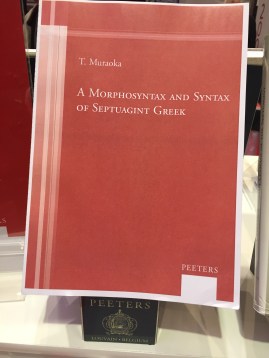
 In case you don’t know, John is one of the top scholars of Koine Greek at the moment and has contributed extensively to lexicography. His work in the Greek Pentateuch is what spurred my own interest in Septuagint vocabulary and has provided much of the methodology for my doctoral research. Trevor Evans and Jim Aitken teamed up to put together an edited volume of essays in John’s honor, Biblical Greek in Context (Brill). This looks like an excellent resource that will hopefully get wide attention.
 Septuaginta &c.