Miscellaneous

The 2015 Annual Conferences in Review

It’s been a few weeks now, but the annual conferences of the major biblical studies societies have come and gone. Legions of scholars from around the world spent untold dollars and lost entire time zones of sleep to make it there, and are only now recovering. This year’s melee was held in Atlanta, a lovely city whose downtown area is apparently constituted only of gigantic hotels. And they all seemed to be full of the scholarly hordes for about a week in late November.

Some Highlights

20151118_131217669_iOSI mentioned in a previous post that I would not only attend both the ETS and SBL conferences (plus the IBR meetings squished in the middle), but I also presented three papers. In retrospect, that amount of preparation and participation was probably overly ambitious. I’m glad to have done it, but I’ll likely keep it to two papers at most from now on.

One major event for me at ETS was participating in our newly formed Septuagint Studies session, where I presented one of my papers. It was a pleasure to help pull this session together with the work of many colleagues, and I think the session went quite well. We had about a dozen attendees who were very engaging and interested. Most exciting, though, was having our proposal for consultation status approved by the powers-that-be, which means Septuagint Studies will be a session at ETS for at least the next three years. For next year, it is the hope of the steering committee to put together a great session of invited papers from top evangelical scholars to address key issues in the study of the Septuagint. Stay tuned for more developments here.

20151118_173438000_iOS

The steering committee for the ETS Septuagint Studies consultation (yes, I shaved my head)

My two other papers were for SBL. For the second year in a row I was able to participate in one of the IOSCS sessions. These are an excellent venue for me to present work drawn directly from my dissertation, since almost every scholar active in Septuagint studies turns up. It makes for a time of very profitable interaction and feedback. My paper dealt with the changes in “meeting” vocabulary within the textual history of LXX-Judges, attempting to account for shifting trends in terms of changing stylistic aims or chronological situation.

I also presented at the Greek Bible section this year. The paper dealt with the well-known narrative echo in Judges 19 of Genesis 19, where in both texts travelers find shelter in a strange city only to have their host intercede for their safety from hostile “men of the city.” I reconstructed the OG translation of this passage in Judges and examined whether and how the translator receives the OG narrative from Genesis. 20151121_144729067_iOSIt sounds boring, but I believe I can show quite conclusively that the Judges translator knew and consciously re-employed features of the OG Genesis text in his version of Judges. In effect, he amplifies the relationship between the narratives, but also shows good (if intermittent) Greek style, and reveals something of the status and familiarity of the Greek Pentateuch in later eras.
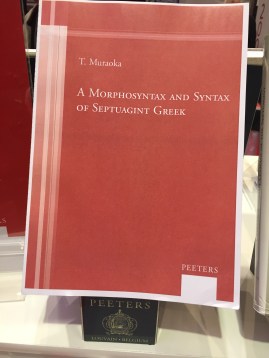
Of course, between the presentations were many meetings with people of all sorts – both intentional and incidental – plus sessions, banquets, receptions, happy hours, seminars, and the expansive book exhibit. As for the last, I was most excited to see T. Muraoka’s new A Morphosyntax and Syntax of Septuagint Greek (Peeters). Although it’s not quite ready yet, a sample was there to thumb through. Let me just say that it’s about 800 pages as it is, and there are no indexes yet. It should ship in a month or two.

Another really wonderful highlight was the small festschrift party (ein Festschriftfest?) held for John A. L. Lee. 20151121_234901746_iOSIn case you don’t know, John is one of the top scholars of Koine Greek at the moment and has contributed extensively to lexicography. His work in the Greek Pentateuch is what spurred my own interest in Septuagint vocabulary and has provided much of the methodology for my doctoral research. Trevor Evans and Jim Aitken teamed up to put together an edited volume of essays in John’s honor, Biblical Greek in Context (Brill). This looks like an excellent resource that will hopefully get wide attention.

Wrapping Up

As usual, the conferences are chaotic, exhausting, and expensive, but always worth the investment. The conversations and connections one can make are invaluable. If you missed this year and are disappointed, never fear: the proposal period for the 2016 conferences in San Antonio opens in about three months!

LXX Scholar Interview: Dr. W. Edward Glenny

It has become one of my favorite tasks for this site to put together a post for my Septuagint Scholar Interview series. It’s always a pleasure to learn more about others who have been active in the field for some time. We are now on the fourth installment, and if you pop over to the interview page using that link up there, you’ll see that I have a few others lined up that should be interesting reading.

Dr. W. Edward Glenny

Dr. W. Edward Glenny

But today we have a great interview with a real, live Septuagint scholar, Dr. W. Edward Glenny. I met Ed several years ago at an IOSCS session at the SBL national meeting, and we have gotten to know each other through that venue ever since. Ed and his wife also spent several months at Tyndale House, Cambridge, where I conduct my research, so he has become a good friend. He is also a fellow member of the steering committee for the brand new Septuagint Studies session at the annual ETS national conference.

For the past four years Ed has been the endowed professor of New Testament Studies and Greek at the University of Northwestern, St. Paul. He is one of those rare breeds that holds not one, but two doctoral degrees, both Th.D. from Dallas Theological Seminary and Ph.D. from the University of Minnesota (as you’ll read about below). As you can see by flipping over to his faculty page, Ed has a long list of academic publications, many of which are related to the Septuagint, especially his focus area, the Twelve.

The Interview

Without further delays, let’s hear from Ed.

1) Can you describe how you first became interested in LXX studies, and your training in the discipline?

My first contact with the LXX was through a class on the LXX with Allen Ross during my doctoral program at Dallas Seminary. I audited the course with Dr. Ross, and it was partly because of that course that I wanted to write a dissertation on the use of the OT in the NT for my doctoral program at Dallas. I began to use the LXX in my dissertation at Dallas on the use of the OT in 1 Peter. After I finished that project I felt like I wanted to learn more and improve my language skills further, so I enrolled in a graduate program in classics at the University of Minnesota. I majored in Greek, and my second ancient language was Hebrew. So, with my emphasis on those two languages the LXX was a natural topic for my dissertation at Minnesota, and I wrote on the translation technique in LXX-Amos. That dissertation was published in Brill’s Supplement to Vetus Testamentum series (Finding Meaning in the Text: Translation Technique and Theology in the Septuagint of Amos), and it was really my entry into LXX studies. I was able to spend time at Tyndale House at Cambridge University while I was researching and writing my dissertation on the LXX, and Robert Gordon and some of his students who were working in the LXX were a great encouragement and help to me in my work.

2) How have you participated in the discipline over the course of your teaching and writing career?

I have presented papers in the IOSCS section at the annual SBL meetings, and I have also presented at the triennial international meetings of the IOSCS. I have also had the privilege to write several book reviews, articles, and books on the LXX. In addition to my dissertation I have published three commentaries in Brill’s Septuagint Commentary series, the commentaries on Hosea, Amos, and Micah. Among other articles, I contributed the article on the Introduction to the Twelve in the LXX in Brill’s forthcoming work The Textual History of the Bible. In the days ahead I am looking forward to writing several other volumes for Brill’s Septuagint Commentary series, as well as a handbook on the LXX of Amos for Baylor University Press.

4) How has the field changed since you’ve been involved?

I think that I can give a general answer to this question. The field is becoming more sophisticated and complex, and scholars continue to build on the work of previous generations and go to greater levels of depth in the study of the LXX text. Continued study has resulted in more comparison of the LXX with other contemporary literature and with more detailed studies of the Septuagint itself.

5) For the benefit of graduate students who are potentially interested in

LXX studies in doctoral work, what in your opinion are underworked areas and topics in need of further research? I think that the area of translation technique is one of the most important areas of research that will continue to provide opportunities for work in the LXX for years to come. This is because the study of translation technique is wide-ranging and complex and can be applied to a LXX text in many different ways.

6) What current projects in Septuagint are you working on?

My main LXX project right now is a review of the T&T Clark Companion to the Septuagint, edited by James K. Aitken. I published a commentary on LXX-Micah in early 2015, and now my main project is a New Testament commentary (1 Peter). But as I mentioned above I am looking forward to working in earnest on the LXX again in a year or so.

7) What is the future of Septuagint studies?

The future of Septuagint studies is very bright! There are many young scholars working in this area, and previous generations of scholars have provided them with some excellent tools to use in their studies and more LXX resources and studies are being published every year. I anticipate that the field will continue to grow and flourish.

Wrapping Up

Thanks to Ed for being willing to answer these questions! As I mentioned, stay tuned for further interviews in the near future. If you have a suggestion for a later interviewee, or a question you’d like to see added, please let me know in the comments.

A Review of Comfort’s “A Commentary on the Manuscripts and Text of the New Testament”

While it may seem a little bit out of my usual strike zone on this blog, I was interested in having a look at the newest edition of Philip Comfort’s A Commentary on the Manuscripts and Text of the New Testament (Kregel Academic, 2015), pp. 448, hardback. My work and research interests are grounded in all things Old Testament, however much of my daily grind involves a fair bit of heavy-duty textual-criticism in the Greek versions of the Bible. Doing research in the Septuagint version of Judges requires that I dive into the manuscript evidence for that Greek translation, and one of the side-effects of doing so is that I am interested in New Testament textual-criticism as well.

This handy volume is billed as “an up-to-date commentary on all the significant manuscripts and textual variants of the New Testament,” and it certainly lives up to its description. It’s cleverly shaped just like your NA27 (or if you’re cutting-edge and nit-picky, your NA28), and so it sits nicely next to your Greek New Testament and, of course, your Rahlfs-Hanhart Septuaginta.

The essential purpose of this book is to provide a passage-by-passage guide to textual reliability, the variants, and specific translation issues that arise in the New Testament. Additionally, Comfort has commented upon the qualities of the manuscripts that make up the textual evidence for the New Testament in order to help the scholar and exegete evaluate significant textual issues. When you come across a variant in the NT text, deciding between readings must be based upon a number of factors. As the famous NT scholars Westcott and Hort stated, knowledge of the documents where the variants are found must precede decisions about the textual variants themselves. These external factors that influence text-critical decisions include the tendencies of the scribe of a particular manuscript (including scribal reception), textual purity (i.e., number of variants compared to other witnesses and/or the supposed autograph), approximate date, region of discovery, and so on. In turn, the internal factors for text-criticism rely upon the so-called “Canons” of the discipline, such as proclivi scriptoni praestat ardua (“the more difficult reading is preferred”). These are briefly but helpfully explained by Comfort on pp. 29-31.

If you have ever undertaken serious NT textual criticism – or even had to write a graduate paper that wades through this area of scholarship – then you already know how useful a tool like this book will be for doing much of this spadework for you and getting huge amounts of data into concise and centralized format.

What’s in the Book

Comfort spends the first two chapters of the book dealing with various textual issues in the NT, and providing his annotated list of NT manuscripts. In chapters 3-9, he then walks through the NT books in chunks as follows:

  • Ch. 3 – Synoptic Gospels
  • Ch. 4 – Gospel of John
  • Ch. 5 – Acts
  • Ch. 6 – Pauline Epistles
  • Ch. 7 – Hebrews
  • Ch. 8 – General Epistles
  • Ch. 9 – Revelation

I was quite pleased and surprised to find that Comfort has also included some interesting and useful material on the Nomina Sacra, and their relevance to textual-criticism (see pp. 31-41, Appendix II). Best of all is that this material is directed towards NT text-criticism and also aspects of the Greek Old Testament where the divine names are also a prominent textual issue.

Reflections

Not specializing in New Testament textual criticism per se, I do not have much negative feedback. However, from that perspective I must say that I found myself wishing there was a Glossary of Terms in this volume. No doubt, Old Testament and New Testament textual criticism operate on similar principles in some ways, but in other ways these tasks are quite different. I think the average reader would likely benefit from a clarification of terms used throughout a book like this. Nevertheless, this book is a must-have for students of New Testament, and considering the fair price it is a worthwhile investment.

___________________

Thanks to Kregel Publications for the complimentary review copy, which has not influenced my opinions.