 Today I have the pleasure of posting an interview with one of the most well-known and respected scholars in Septuagint scholarship. If you aren’t aware, I have been conducting LXX scholar interviews for a few years now and have compiled something of a library, with more additions to come.
Dr. Albert Pietersma (also see here) is Professor emeritus of Septuagint and Hellenistic Greek in the Department of Near and Middle East Civilizations at the University of Toronto‘s Faculty of Arts and Science.  Born in the Netherlands in 1935 and tenured in 1971, Dr. Pietersma has a very long list of publications, and is particularly well known (as you will read about below) for work producing the translation philosophy for the New English Translation of the Septuagint (NETS, also see here) known as the “interlinear paradigm,” its accompanying translator’s manual, and of course the actual published English translation (here). You can get a better appreciation for the scope of his work by looking at his Festschrift, The Old Greek Psalter: Studies in Honour of Albert Pietersma (T&T Clark 2009).
The Interview
1) Can you describe how you first became interested in LXX studies, and your training for the discipline?
 As an undergraduate at Calvin College, Grand Rapids, Mich., I fell in love with the Classics, especially Greek Classical literature, and in the seminary my study of biblical Hebrew and the Old Testament added to my fascination with the ancient world. Given that the Septuagint is a Greek translation of the Hebrew (and Aramaic) Bible, to become a Septuagintalist fed these two passions. My interest in the field was further piqued by Professor J. W. Wevers’s visit to Calvin where we could discuss both my academic interests and the realia of Grad School.
As a graduate student in the Department of Near Eastern Studies, University of Toronto, my major area of study was Hebrew Language and Literature, with a first minor in Septuagint (under the tutelage of Professor Wevers) and a second minor in Aramaic-Syriac. The research for my dissertation on the  Chester Beatty Biblical Papyri of Genesis (Ra 961 and 962) happily coincided with my Doktorvater’s work on his critical edition of Genesis for the Göttingen Septuagint (1974). Since he placed at my disposal the collation books composed at the Septuaginta Unternehmen (Göttingen), we could both reach beyond the era of the ‘Great Uncials’ (Alexandrinus, Sinaiticus, and Vaticanus) to a much broader range of textual witnesses, in an ongoing quest for the closest approximation to the pristine original.
My text-critical study of the two papyri, together with a new edition of the text, was published as Chester Beatty Biblical Papyri IV and V: A New Edition with Text-Critical Analysis (ASP 16; Samuel, Stevens, Hakkert and Company, Toronto and Sarasota, 1977).
2) How have you participated in the discipline over the course of your teaching and writing career?
 Administratively I have served the International Organization for Septuagint and Cognate Studies (IOSCS) as secretary and archivist (1972–1980), president (1980–1987) and honorary president (1993–). As representative of my published work, I would note here just two items.
 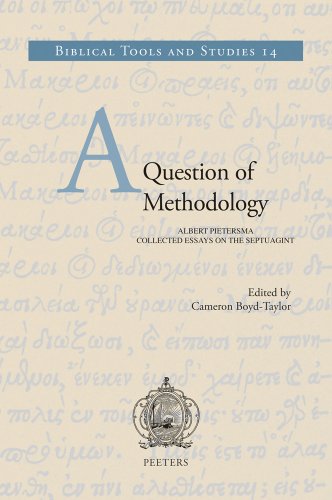 First, there is a volume of collected essays reflecting the trajectory of my career, edited (with introduction) by Cameron Boyd-Taylor, A Question of Methodology: Albert Pietersma, Collected Essays on the Septuagint (Peeters, 2013). As Cameron rightly notes, my preoccupation from the beginning of my scholarly career was methodological in nature, inspired and encouraged by my mentor. At the outset, I focused chiefly on the issue of how, on the basis of available evidence, one might work back systematically to the closest achievable approximation to the original text-form of the LXX. From there the center of my attention gradually began to include text-semantics, exegesis and translation theory, and then the broader issues of the hermeneutics of a translated text, particularly translations characterized by formal equivalence.
Secondly, and more concretely, I would highlight A New English Translation of the Septuagint, and the Other Greek Translations Traditionally Included under That Title (eds. Albert Pietersma and Benjamin G. Wright, Oxford University Press, 2007) (NETS). For this project I had the good fortune of working with the following graduate students: Cameron Boyd-Taylor, Paul McLean, Tony Michael, Marc Saunders, Jannes Smith, Wade White, and Tyler Williams. Without their input and the hard work of the translators, NETS would never have seen the light of day.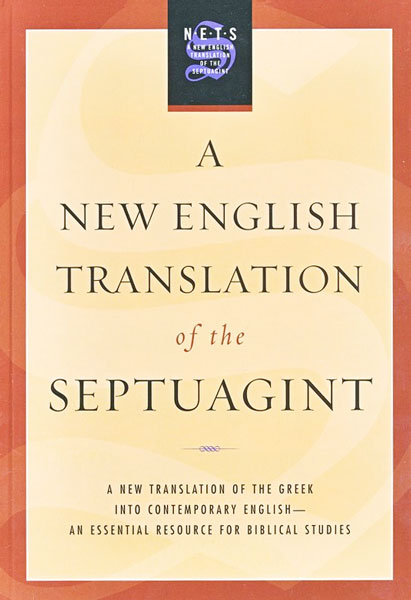
Since its inception, the IOSCS (1968) was interested in producing a new ‘Brenton’, an English translation of the LXX, published in 1844 and popular, in its diglot form, throughout the English speaking world, but deemed seriously outdated both textually and linguistically. Although the project remained a dream for many years, it reappeared on the IOSCS’s agenda in the early ’90s, promoted by David Aiken of Uncial Books. Under the joint editorship of Ben Wright and myself, work was formally begun with the publication of the Translation Manual for “A New English Translation of the Septuagint” (NETS) (Uncial Books, 1996). A propaedeutic set of guidelines appeared in BIOSCS 27 (1994): 15–17.
The Greek base text of NETS is the best critical editions, i.e. the Göttingen Septuagint where available and Rahlfs’s Septuagint for the rest. Odes, except for the Prayer of Manasses, was excluded for lack of authenticity as a book and its Christian origins. The English base of NETS is the New Revised Standard Version (NRSV), modified as dictated by the Greek critical text. Most importantly and most fundamentally, NETS is based on the Septuagint text-as-produced, i.e. the earliest retrievable text of any given book, in terms of both text-form and text-semantics. Opting to translate the closest approximation to the ‘original’ form of the text was understood to imply opting for the earliest meaning of that text as well. (For more evidence of my participation in the discipline see here)
3) How have you integrated LXX studies into your work as a professor?
Since my appointment to the Department of Near Eastern Studies (1969) was in “Septuagint and Hellenistic Jewish Literature,” and my role was, together with Professor Wevers, to develop a PhD program in Septuagint Studies — the only one of its kind in the world — , the Septuagint formed a constitutive part of both my teaching and research at both the undergraduate and graduate levels.
4) How has the field changed since you’ve been involved?
While the field has no doubt changed considerably during the past half century, arguably there is also much that has stayed the same (cf. 5. below), representing business as usual. Technological tools and aides such as databases and search engines are the obvious improvements, though scarcely in need of explication. Given that the Septuagint was written in Greek, the Thesaurus Linguae Graecae (TLG) happens to be one of my favorite tools, seeing that Septuagintal Greek must be understood in the context of conventional Greek usage in the Hellenistic world. And then there are new lexica and increasingly more critical editions. Unfortunately, our new lexica and new grammar, presuppose, by editors’ fiat, the Septuagint as an exemplar of conventional linguistic usage, as a result of which the discipline is, in principle, no better off than with Liddell-Scott- Jones.
On a more positive note, Septuagint scholars now have at their disposal whole new disciplines such as discourse analysis (text linguistics) and descriptive translation studies, a discipline that makes it its business to study translation as a cultural phenomenon and as such seeks to describe it in all its ordered complexity. Furthermore, a spate of new translations into modern languages is or is coming on stream, at present including NETS, LXX-Deutsch, La Bible d’Alexandrie, La Biblia Griega, and La Bibbia dei Settanta.
5) For the benefit of graduate students who are potentially interested in LXX studies in doctoral work, what in your opinion are underworked areas and topics in need of further research?
Above (see 2.) I touch on the axiomatic distinction, in the historical study of literature — including translation literature — between the text-as-produced, on the one hand, and the text-as-received, on the other, or between the text-as-configured and the text-as-refigured (Paul Ricoeur, “What is a Text”) in reception history. This distinction, rooted in the constitutive character of the translated text, has profound implications for the entire discipline, but, in particular, for the sub-disciplines of LXX grammaticography, lexicography, and hermeneutics.
As I see it, however, in all three of these sub-disciplines, Septuagint Studies continues to suffer from what might be called a schizophrenic approach to the Septuagint. In my view, the origin of this schizophrenia is an outgrowth of the discipline’s historical origins. In brief, one might consider the following. That these historical origins lie in the study of the New Testament (NT) and more particularly in the conceptualization of the LXX as the Christian Old Testament is scarcely open to controversy. Not only did Christians inherit and transmit the LXX, but, as well, both the Cambridge and the Göttingen editions bespeak, a patently Christian context. Thus the former speaks of “The Old Testament in Greek” and the latter subtitles the Septuagint as “Vetus Testamentum Graecum.” Between these two editions, however, a great gulf is fixed. Whereas the Cambridge LXX is a diplomatic edition, that is to say, a given Christian manuscript functions as the lemma text to which all other witnesses are collated, the Göttingen LXX, on the other hand, is a critical edition, in other words, a text critically recovered and reconstructed, as closely as possible to its pristine originality both in terms of its text-form and its text-semantics. To label this critically reconstructed, Jewish, text “The Old Testament” or “Vetus Testamentum” creates a methodological contradiction between title and contents. One might well ask how this text of pre-Christian Jewry can, in one and the same breath, also be spoken of as the Old Testament of Christianity or, for that matter, the Bible of Alexandrian Judaism. The answer is that it cannot possibly be so designated. In short, while Christianity re-conceptualized the LXX as its Old Testament at some point in its reception history, it cannot possibly lay claim to the event of its production.
A cursory look at Alfred Rahlfs’s Psalmi cum Odis (1932), the first volume in the Göttingen editio maior, may be instructive. That Rahlfs took the first and very courageous step to create a critical edition of a Septuagint book (against the pessimistic assessment of Brooke-McLean [1917], invoking insufficient evidence) and thus effectively launched the Göttingen text-critical enterprise will forever redound to his credit, despite the fact that his critical text was made to include not only the Odes (a patently Christian collection) but also bracketed items of admittedly dubious, and at times Christian, originality (cf. e.g. Psalm 13). Although one may sympathize with Rahlfs’s attempt at forging a compromise of sorts, he clearly failed to make systemic space for the text he critically delineated and re-introduced. In other words, what he should have done was to make an axiomatic distinction between this new, critically reconstructed, Jewish, text, on the one hand, and, on the other, the traditional perception of the Septuagint as the Vetus Testamentum of the Church. Unfortunately, not only was this confusion of texts perpetuated in the Göttingen Septuaginta but as well in modern translations — with the exception of NETS. Thus we have: Septuaginta deutsch, das griechische Alte Testament in deutscher Übersetzung, La Bible d’Alexandrie, La Bibbia dei Settanta, and La Biblia Griega. Therefore, according to their titles, all four profess themselves to be translations, not of the LXX as-produced but of the LXX as-received, an exemplar of reception history. Moreover, this confusion of texts exists irrespective of whether one holds that a translation of a sacred text automatically produces a sacred text or that a translation cannot possibly occupy the same systemic space as its source. What remains in either case is historical order and logical priority. Typically the confusion of texts takes the form of superimposing the text-as-received on the text-as-produced, i.e. treating the latter as though it were a freestanding entity. On the above see also, Pietersma, “Codex Sinaiticus and the Book of Psalms,” in Codex Sinaiticus: New Perspectives on the Ancient Biblical Manuscript (eds. Scot McKendrick, David Parker, Amy Myshrall and Cillian O’Hogan, The British Library and Hendrickson Publishers, 2010), 41–49.
So, yes, I do see at least one (large) underworked area and a central topic in need of further research: the hermeneutics of the Septuagint qua translation, in distinction from the Septuagint qua text, i.e. the Septuagint as an entity directly dependent on its source in distinction from the Septuagint as an independent entity, cut loose from its historical moorings and thus parallel to its erstwhile source. Moreover, not only is NETS based on the distinction of these two texts, but so is SBLCS (see here and here).
6) What current projects in Septuagint are you working on, if any?
While I have effectively put myself out to pasture academically, together with Cameron Boyd-Taylor and Ben Wright I am working on a second edition of NETS, which is currently under advisement by Oxford University Press. NETS was published in 2007, reprinted with corrections in 2009, and again reprinted in 2014. This time, however, corrections were made instead to the digital text online. The aim of the editors is to subject NETS to a comprehensive review in light of its guidelines as well as feedback from its readers we have received over the years.
Furthermore, for four books (1 Supplements, Routh, Ecclesiast and 4 Makkabees) new critical editions have either appeared or are pending. As work on the Society of Biblical Literature Commentary on the Septuagint (SBLCS) proceeds, feedback from commentators is anticipated. Not surprisingly, sometimes what seemed a good rendering when translating, proves to be less good when writing a commentary. I empathize! Further improvements are under advisement by the editors.
7) What is the future of Septuagint studies?
Increased interest, better tools, and bright young scholars should spell a bright future. Yet I am troubled by the fact that Septuagint Studies seems to be a discipline that continues to be divided against itself. Labels like “minimalist” and “maximalist” as applied to the interpretation of the Septuagint point to a deeper ambivalence or schizophrenia about just which Septuagint is at issue. First to be answered is that very question. As I see it, in principle we can speak of only two Septuagints, (1) the Septuagint-as-produced, a patently Jewish production, and (2) the Septuagint-as-received, accepted at some point in its reception history as the Vetus Testamentum of the Christian Church. (For another instance of the text-as-received cf. Letter of Aristeas §311.)
For our discipline to flourish and grow, the methodological contradiction at its core must be resolved.
Wrapping Up
There is a lot to glean from this interview, and from Dr. Pietersma’s expertise in the discipline. I hope this will serve readers well by providing food for thought, and encouragement to look more deeply into the issues mentioned.



 Septuaginta &c.