Graduate Studies

A Review of Comfort’s “A Commentary on the Manuscripts and Text of the New Testament”

While it may seem a little bit out of my usual strike zone on this blog, I was interested in having a look at the newest edition of Philip Comfort’s A Commentary on the Manuscripts and Text of the New Testament (Kregel Academic, 2015), pp. 448, hardback. My work and research interests are grounded in all things Old Testament, however much of my daily grind involves a fair bit of heavy-duty textual-criticism in the Greek versions of the Bible. Doing research in the Septuagint version of Judges requires that I dive into the manuscript evidence for that Greek translation, and one of the side-effects of doing so is that I am interested in New Testament textual-criticism as well.

This handy volume is billed as “an up-to-date commentary on all the significant manuscripts and textual variants of the New Testament,” and it certainly lives up to its description. It’s cleverly shaped just like your NA27 (or if you’re cutting-edge and nit-picky, your NA28), and so it sits nicely next to your Greek New Testament and, of course, your Rahlfs-Hanhart Septuaginta.

The essential purpose of this book is to provide a passage-by-passage guide to textual reliability, the variants, and specific translation issues that arise in the New Testament. Additionally, Comfort has commented upon the qualities of the manuscripts that make up the textual evidence for the New Testament in order to help the scholar and exegete evaluate significant textual issues. When you come across a variant in the NT text, deciding between readings must be based upon a number of factors. As the famous NT scholars Westcott and Hort stated, knowledge of the documents where the variants are found must precede decisions about the textual variants themselves. These external factors that influence text-critical decisions include the tendencies of the scribe of a particular manuscript (including scribal reception), textual purity (i.e., number of variants compared to other witnesses and/or the supposed autograph), approximate date, region of discovery, and so on. In turn, the internal factors for text-criticism rely upon the so-called “Canons” of the discipline, such as proclivi scriptoni praestat ardua (“the more difficult reading is preferred”). These are briefly but helpfully explained by Comfort on pp. 29-31.

If you have ever undertaken serious NT textual criticism – or even had to write a graduate paper that wades through this area of scholarship – then you already know how useful a tool like this book will be for doing much of this spadework for you and getting huge amounts of data into concise and centralized format.

What’s in the Book

Comfort spends the first two chapters of the book dealing with various textual issues in the NT, and providing his annotated list of NT manuscripts. In chapters 3-9, he then walks through the NT books in chunks as follows:

  • Ch. 3 – Synoptic Gospels
  • Ch. 4 – Gospel of John
  • Ch. 5 – Acts
  • Ch. 6 – Pauline Epistles
  • Ch. 7 – Hebrews
  • Ch. 8 – General Epistles
  • Ch. 9 – Revelation

I was quite pleased and surprised to find that Comfort has also included some interesting and useful material on the Nomina Sacra, and their relevance to textual-criticism (see pp. 31-41, Appendix II). Best of all is that this material is directed towards NT text-criticism and also aspects of the Greek Old Testament where the divine names are also a prominent textual issue.

Reflections

Not specializing in New Testament textual criticism per se, I do not have much negative feedback. However, from that perspective I must say that I found myself wishing there was a Glossary of Terms in this volume. No doubt, Old Testament and New Testament textual criticism operate on similar principles in some ways, but in other ways these tasks are quite different. I think the average reader would likely benefit from a clarification of terms used throughout a book like this. Nevertheless, this book is a must-have for students of New Testament, and considering the fair price it is a worthwhile investment.

___________________

Thanks to Kregel Publications for the complimentary review copy, which has not influenced my opinions.

LXX Scholar Interview: Dr. Rob Hiebert

Not too long ago I posted an interview with Dr. Karen Jobes of Wheaton College in honor of International Septuagint Day. Obviously since Karen is such a wonderful person, the post was received very well. With the idea of hearing from active scholars in the field of Septuagint in mind, then, I thought I would carry on with other interviews.

One of the first people I thought of was Dr. Rob Hiebert. He is one of the fellows of The John William Wevers Institute for Septuagint Studies, which operates under the auspices of Trinity Western University just outside Vancouver, B.C. I’ve written about it a bit in this post, and some details about its history are in the interview below. Rob and his colleagues at TWU are also conducting a seminar in Septuagint exegesis this coming May that would be well worth the time (I attended one of these seminars in 2013).

The questions below are the same that I posed to Karen, more or less. If you have any particular questions you’d like to see asked of others in the future (or suggestions for particular scholars you’d like to hear from), then leave me a comment below. These are supposed to be helpful to newcomers!

And now, to hear from Dr. Hiebert.

The Interview

1) Can you describe how you first became interested in LXX studies, and your training in the discipline?

My interest in LXX studies began during my undergrad studies at the University of Toronto. At that time, the U of T had the only PhD program in this field, and it was headed up by John Wevers and Albert Pietersma who were leading specialists in that discipline. I began to see that LXX studies afforded the possibility of becoming equipped to do work that involved both the Hebrew Bible / Old Testament and the New Testament, and that was appealing to me.

2) How have you participated in the discipline over the course of your teaching and writing career? 

Teaching in this discipline began for me when I was still a grad student at U of T, as I had the opportunity to teach undergrad courses in which we read both Greek New Testament and LXX texts. Later, when I joined the faculty at what is now called Tyndale University College in Toronto, I taught some Greek New Testament and LXX courses. Finally, after coming to Trinity Western University (TWU), where I now teach, I came to realize that the presence of four LXX specialists (Larry Perkins, Peter Flint, Dirk Büchner, and myself) represented a wealth of expertise that should be exploited. So we founded the Septuagint Institute, which we renamed the John William Wevers Institute for Septuagint Studies after Prof. Wevers’ family made a generous donation in his memory.

The Wevers Institute took the initiative to advocate for the establishment of a specialization in LXX studies in a number of our graduate degree programs at TWU, and so now our Master of Theology and Master of Theological Studies programs do have such a specialization. In addition, the Master of Arts in Biblical Studies program has seen a number of students write theses in the area of LXX studies. The Wevers Institute has sponsored a number of international conferences and serves as a hub for a number of research initiatives.
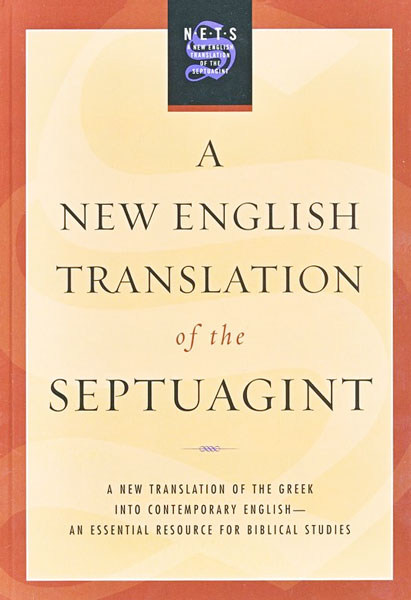
The Wevers Institute fellows have been awarded research and conference grants, have produced numerous publications, and continue to be active in a variety of research and publication projects. These include collaboration with an international team of scholars to produce A New English Translation of the Septuagint (Oxford University Press, 2007) also known as NETS, and the forthcoming Society of Biblical Literature Commentary on the Septuagint series also know as SBLCS, for which I serve as co-editor. The four of us were responsible for translating the first four books of the Pentateuch for NETS and have been assigned the task of writing the SBLCS commentary volumes for those same books.

My publications include The “Syrohexaplaric” Psalter (Scholars Press, 1989); The Old Greek Psalter: Studies in Honour of Albert Pietersma (Sheffield Academic Press, 2001), which I co-edited; and “Translation Is Required”: The Septuagint in Retrospect and Prospect (Society of Biblical Literature, 2010), which I edited; as well as numerous book chapters, articles, and reviews. I am also currently preparing the critical edition of Greek IV Maccabees for the Göttingen Septuaginta series.

I should add that in the past few years TWU has established a collaborative agreement with the Green Scholars Initiative that affords TWU scholars and students the opportunity to work with papyri and manuscripts that are part of the Green collection of antiquities. 

3) How have you integrated LXX studies into your work as a seminary professor?

I teach a number of graduate level LXX courses, and I have hired a number of grad students as research assistants to work with me on my research projects. Funding for these hires has come from the research grants that I have been awarded as well as from a budget line at the seminary that allows for such opportunities. One of my research assistants, who has now graduated, collaborated with me to present papers at conferences in various parts of North America and Europe and to publish articles and book chapters. His thesis project grew out of his work with me on my IV Maccabees project. My current research assistant has similar opportunities and is doing the same type of work.

4) How has the field changed since you’ve been involved?

I think the emergence of LXX translation and commentary projects in various languages during the past number of years has opened up many opportunities for study and research. Many younger scholars have also entered into the field of LXX studies in recent years, which bodes well for the future of the discipline.

5) What issues do you focus on in your graduate courses in LXX studies?

I teach courses in “Exploring Septuagint Origins and Texts” and “The Septuagint in Early Jewish and Christian Traditions” as well as various special topics courses that relate to our work on our SBLCS volumes, sometimes in tandem with my Wevers Institute fellows. My colleagues also teach LXX courses. So we focus both on an introduction to the field of LXX studies and on specific textual, translation, and hermeneutical issues. We distinguish carefully between the meaning of the text-as-produced and the text-as-received.

6) For the benefit of graduate students who are potentially interested in LXX studies in doctoral work, what in your opinion are under-worked areas and topics in need of further research?

The production of commentaries on the text-as-produced is one area that will provide probably decades of work for those involved in the SBLCS series. But there will also be many opportunities for those interested in the reception history of the LXX.

8) What current projects in Septuagint are you working on? 

1. The critical edition of Greek IV Maccabees for the Göttingen Septuaginta series.

2. A commentary on Genesis for the SBLCS series.

3. Serving as joint-editor-in-chief of the SBLCS series.

4. A project in collaboration with the Green Scholars Initiative focused on Papyrus Bodmer XXIV, a very important LXX Psalms manuscript that dates to about the fourth century.

9) What is the future of Septuagint studies? 

It is a bright one, with much more work to be done. More academic institutions do, however, need to appreciate the significance of this discipline and to foster its development.

I’m grateful for Rob’s willingness to interact with my questions. Stay tuned for interviews with other LXX scholars in the future!

Septuagint Day: An Interview with Karen Jobes

It’s hard to believe that it’s already upon us, but if you were not aware, today is the ninth annual International Septuagint Day. If you are interested, you can find out a bit more about what that means in my post from last year. In brief, in November of 2006 the IOSCS approved the institution of this grand day. Here is an excerpt from the General Business Meeting minutes:

A motion to establish February 8 annually as International Septuagint Day to promote the discipline on our various campuses and communities was moved by Karen Jobes, seconded by James Aitkin and carried. And there was much rejoicing.

Okay, I added that last part. But …

An Interview with Karen Jobes

In the spirit of “promoting the discipline” on Septuagint Day, I decided to interview one of the top American septuagintalists, Dr. Karen Jobes. Karen is the Gerald F. Hawthorne Professor of New Testament Greek & Exegesis at Wheaton College in Illinois, and was kind enough to entertain my questions.

1) Can you describe how you first became involved in LXX studies, and what drew you to it?

I was first introduced to the LXX at Westminster Theological Seminary where Dr. Moisés Silva taught a course that was rumored to be the most difficult course offered by the seminary.  Being a woman who enjoys a challenge, I couldn’t resist.  I was particularly drawn to the opportunity to work with both Hebrew and Greek.  I discovered that Septuagint Studies is beautifully complex.

2) How have you participated in the discipline over the course of your teaching and writing career?

Perhaps the most significant contribution I’ve made to the discipline is the book I co-authored with Dr. Silva, Invitation to the Septuagint (Baker Academic, 2000), which has become one of the standard textbooks in English for LXX studies.  That book actually grew out of the course I took with Dr. Silva, because as a beginning student I saw a need for an introductory book. My course notes became the initial outline for the book.  

I have also participated in the International Organization for Septuagint and Cognate Studies (IOSCS) in various roles.  I have been a member since 1990.  My first paper on LXX was presented at the IXth Congress of the IOSCS in July 1995 in Cambridge, England.  I served a term as the Secretary 2006–2008, on the Program Steering Committee since 2009, on the Editorial Advisory board of the SBLSCS since 2012, and a member-at-large on the Executive Committee since 2012.  I was awarded the IOSCS prize for an outstanding paper in 1995. (I believe that award has since morphed into the John W. Wevers prize.)

My publications have focused on methodologies in LXX studies, (e.g., “Quantitative Methods for Exploring the Relationship between Books of the Septuagint.” Pages 73–95 in The Bible as Book: The Transmission of the Greek Text. Edited by O. O’Connor. London: The British Library, 2003), and on the LXX as literary and theological background for NT exegesis (e.g., “The Minor Prophets in James, Peter, and Jude” pp. 135–153 in The Minor Prophets in the New Testament. Edited by Maarten J.J. Menken and Steve Moyise. Edinburgh: T&T Clark, 2009. And  “The Septuagint Textual Tradition in 1 Peter.” Pages 311–333 in Septuagint Research:  Issues and Challenges in the Study of the Greek Jewish Scriptures. Edited by Wolfgang Kraus and R. Glenn Wooden. Society of Biblical Literature Septuagint and Cognate Studies 53. Atlanta: Scholars Press, 2006.)

I am also pleased that since coming to Wheaton I have had the privilege of teaching a graduate level course in Exegesis of the Septuagint and an undergraduate Greek reading course in Septuagint.  I’m proud of my former students Myrto Theocharous, Seth Ehorn, and Jeremiah Coogan who went on to further graduate work in Septuagint Studies.  

3) How have you integrated LXX studies into your work as a professor of New Testament?

All of my NT courses have an emphasis on the importance of the LXX for proper NT exegesis, and the complexities of handling the Greek versions.

4) How has the field changed since you’ve been involved?

It seems to me the field has blossomed, judging from the number of texts and reference works that have become available in the last twenty-five years and from a growing interest among students to learn about the LXX. When I began, there was no recent LXX lexicon, and now we have two (Lust et al and Muraoka), as well as Taylor’s Analytical Lexicon of the Septuagint.  There was no recent English translation, and now we have NETS [on which see this post] as well as several other translations in modern languages.  There were no commentaries focused on the LXX, and now we have two (the Brill series and the IOSCS series).  There is also now the Wevers Institute of Septuagint Studies at Trinity Western University [on which see this post] that holds great promise for the future of the discipline. 

5) What issues do you focus on in your graduate course in LXX studies?

My course, Exegesis of the Septuagint, has to meet curricular requirements for the MA in Biblical Exegesis, and so we focus on exegeting the LXX text and the complexities of interpreting a translated text.  Of course, we also look at the Hebrew and discuss how the translator has exegeted and contextualized the biblical text for his audience.   

6) For the benefit of graduate students who are potentially interested in LXX studies in doctoral work, what in your opinion are underworked areas and topics in need of further research?

There is fresh ground in the books of the LXX that have received little scholarly attention.  Although it probably not prudent to speak of “a Septuagint theology” there are interesting questions toward better understanding how the translators contextualized their source text for their audience.  And the question of how the Greek versions developed and are related to one another is an extremely difficult question that needs some new energy and perhaps new methodologies.

7) In 2000 you published Invitation to the Septuagint (Baker) with Moisés Silva, which has a revised edition forthcoming later this year. What prompted the revision, and can you describe what changes you have made?

There have been many developments and new scholars entering the field in the fifteen years since Invitation first appeared.  We have revised every chapter, including new theories (e.g., the interlinear theory) and incorporating the work of younger scholars.  We have updated the bibliographies and added some hopefully helpful appendices, e.g., an English translation of the abbreviations used in the Göttingen apparatus.

8) What other projects in Septuagint are you working on?

I have just sent off the manuscript of Exploring the Septuagint: A Guided Reader to Kregel.  This was a collaborative effort with nine students.  The guide contains about 625 verses of Greek from nine books of the LXX, providing syntactical notes, vocabulary help, etc to aid students who have at least three semesters of Greek to start reading the LXX.  Given the structure of academic departments in Bible and theology, the LXX can be a topic of benign neglect, so just getting students to read it provides them an introduction to the field. 

9) Finally, what is the future of Septuagint studies?

The future of LXX studies is really the young people, like yourself, who are entering the field.  Because the LXX is caught between the division of academic departments into Old Testament/Jewish Scriptures and New Testament, it has a somewhat liminal position in the academy.  No one, or very few, are able to devote their full time to the LXX, and that hampers the field.  I don’t see that changing, but it would be a nice dream to see chairs funded in LXX studies.  We also need more doctoral programs in North America that allow students to focus their dissertations on LXX.

I hope you enjoyed and benefited from the interview with Dr. Jobes as much as I did. Hopefully in the future I will be able to conduct similar interviews with other scholars in the discipline.