The 6th International Conference on the Septuagint in Wuppertal

Old Testament scholarship is pretty obscure stuff for most people on the street. But mention the word “Septuagint” and you’ll usually get even more muddled looks and occasionally a “God bless you” in puzzled response. Well, things don’t get any better from there as you get into sub-fields of this sub-discipline. 

Even within the small, fascinating world of Septuagint scholarship, the biannual Tagung held Wuppertal, Germany, is not terribly well known. Certainly not among casual “septuagintal hobbyists.” That is not to say that it isn’t very influential. To the contrary, in fact, this conference is one of the most important “think-tank” events in the discipline. Every two years it takes place at the Kirchliche Hochschule and attracts specialists in Septuagint scholarship from around the globe. The connection to that institution is the highly regarded Dr. Seigfreid Kreuzer, emeritus professor at the Hochschule and also (among other things) current editor-in-chief of the discipline’s own Journal of Septuagint and Cognate Studies.

The 6th LXX.D Conference

Although the page is sadly out of date, you can read (in German) about some of the previous Tagungen that have been part of the outrageously productive Septuaginta Deutsch research project over the years. I have written previously about their Septuaginta­übersetzung (LXX.D, 2 volumes), which is also accompanied by their commentary volume (LXX.E). I’ve also mentioned the ongoing Handbuch project (LXX.H), which is slated to be a massive eight volumes – Volume 1, edited by Dr. Kreuzer, is already available.

In addition to this (quite literally) voluminous output from scholars associated with this research initiative, there has also been a steady flow of edited volumes containing the essays presented at each LXX.D biannual conference in Wuppertal. Thus far, these have been published by Mohr Siebeck, and can be obtained for somewhere between €140-215 if you have extra pocket change.

Die Septuaginta – Texte, Kontexte, Lebenswelten (2006)
Die Septuaginta – Texte, Theologien, Einflüsse (2008)
Die Septuaginta – Entstehung, Sprache, Geschichte (2010)
Die Septuaginta – Text, Wirkung, Rezeption (2012)
Die Septuaginta – Orte und Intentionen (2014)

This year is the 6th international conference to be held in Wuppertal, from 21-24 July. This year’s theme and, presumably, the subsequent volume’s title is:

Die Septuaginta. Geschichte – Wirkung – Relevanz
(The Septuagint: History – Impact/Effect – Relevance)

My Contribution

I was pleased to get the opportunity to participate in this year’s conference.
When something like this comes along in the life of a young scholar, you scrape every penny of funding together that you can to make it happen. And make sure your wife is okay with it. Oh, and double check that you also have something worthwhile to say.

Thankfully, I have managed to coordinate all three (I love you, Kelli). I think the “have something worthwhile to say” criteria will be put to the test at the actual conference, but at least in theory my paper should fit in quite nicely with this year’s theme.

My abstract is as follows:

Title: “The Septuagint as Catalyst for Language Change in the Koine: A Usage-Based Approach”

Ever since Deissmann, scholars of Greek have increasingly recognized that the Septuagint embodies a corpus of language rightly categorized as the non-literary Koine of its time. Even now, current research efforts that take account of the documentary evidence continue to improve our understanding of Koine Greek per se, and precisely how the Septuagint fits within it. However, it is important also to evaluate how the Septuagint does not only embody the new linguistic features of Koine Greek, but also prompted and proliferated them. This paper adopts a linguistic perspective that recognizes how language as a system changes in response to the new uses to which it is put. The first section of this paper overviews the usage-based linguistic approach, focusing on the theory of language change put forward by William Croft (2000). In a second section, this theory is applied to a conventional Greek grammatical construction that was significantly propagated in the Septuagint, and which therefore became more entrenched in the language in general. The concluding section gives general comments on the social mechanisms of the translation of the Septuagint that made it a catalyst for language change

This paper comes partly out of previous research I had done for my dissertation. The grammatical construction I refer to in the abstract is what I call the “meeting construction” in the paper, which can be represented:

[Verb] + εἰς + [‘Meeting’ Noun] + [Modifier]

I had noticed some interesting trends in the use of this phrase in LXX-Judges, so this paper explores the construction in broader Greek sources, both biblical and nonbiblical. Much of the reading I have been doing in the past eight months or so is more methodology-oriented. My topic is primarily lexical semantics, so I have been digging more deeply into theoretical approaches to this area that could benefit my work (and Septuagint scholarship more generally, I hope).

If you’re interested in the paper in its draft form, let me know.


Thoughts on K. Jobes “Discovering the Septuagint” (Released Today)

Back in November I posted an interview with Dr. Karen Jobes, emerita Gerald F. Hawthorne Professor of New Testament Greek & Exegesis at Wheaton College. (Also see this interview on her work in Septuagint scholarship generally.) In advance of the upcoming conferences at that time, I wanted to shine a spotlight on Karen’s two forthcoming volumes. Since that time, her 2nd edition of Invitation to the Septuagint, coauthored with Moisés Silva (here) has been released and is certainly well worth your money. Even if you have the 1st edition already, a lot has happened in the discipline in the intervening 15 years!

Karen’s second book dealing with the Septuagint is available as of today, Discovering the Septuagint: A Guided Reader (here). Karen acted as the editor of this volume, bringing her longstanding expertise in the field to the contributions of a group of her graduate students. The book blurb states:

This reader presents, in Septuagint canonical order, ten Greek texts from the Rahlfs—Hanhart Septuaginta critical edition. It explains the syntax, grammar, and vocabulary of more than 700 verses from select Old Testament texts representing a variety of genres, including the Psalms, the Prophets, and more.

What is it?

This book is a “guided reader,” which means that it presents a selection of texts, in this case all from the Septuagint, and provides various aids for reading. Most people whose experience with Koine Greek is limited to the New Testament will need help when they dip into the Septuagint. A wide array of unfamiliar vocabulary and syntactical features await, and this is precisely the issues that this book will help clarify. However, it is worth noting that this book is not introductory: it assumes some experience in NT Greek.

What is in it?

After a brief introduction to the Septuagint in general, this book includes over seven hundred verses from nine books of the Septuagint, presented in the Greek canonical order. These were selected to give “a taste of different genres, an experience of distinctive Septuagintal elements, and a sampling of texts later used by writers of the New Testament” (9). At the beginning of each section of text from a new book of the Septuagint (Rahlfs-Hanhart), there is a short introduction to the distinctive features found in it, along with select bibliography.

The format of the reading is broken into units of text treated verse-by-verse, with itemized discussions of various elements found along the way. Almost all words not found in Metzger’s Lexical Aids are glossed and parsed, along with more difficult forms. At the bottom of each section of text that was discussed in this fashion Jobes presents the NETS translation for readers to check their work, noting places where the reading aids differ from the NETS translation.

Also to be noted are the two appendices that include a glossary of technical grammatical terms, and an index of Septuagint verses cited in the New Testament.

A Sample:

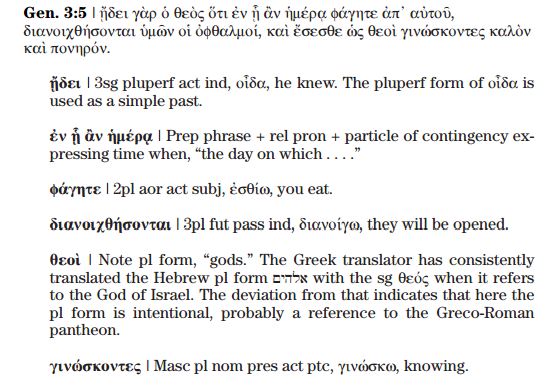
Here is a taste of what you get with this volume, taken from Genesis:

Gen. 1.6 snip

And another:

Gen 3.5 snip

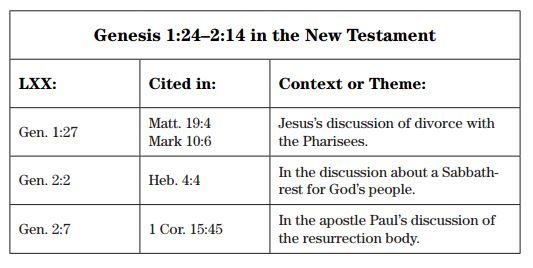
And here is an example of the table of NT references (where appropriate) for a given text section:

Text Section NT Refs snip

You can read more sample text by downloading a PDF excerpt of the volume free from Kregel (or here), which is where these snips come from.

What is it not?

Now that we’ve seen what this book is, we should also consider what it is not. The most obvious point is that this book is not a “Reader’s Edition” like the Greek New Testament: A Reader’s Edition published by Hendrickson (here), for example, or their Biblia Hebraica Stuttgartensia: A Reader’s Edition (here). While these books provide the entirety of their ancient corpus in standard, running text with footnotes throughout keyed to vocabulary, the Discovering the Septuagint volume that Jobes has edited is much more selective and incremental.

It is also worth pointing out that the majority of what this “guided” reader presents is lexical glosses and parsing, with very sparse commentary. Occasionally there is an exegetical comment of some sort, but usually these pertain to the biblical story in general, rather than any social or historical context of the Greek text per se as a translation. For more detail and a similar sort of textual and linguistic guide, one might consult F. C. Conybeare and G. Stock’s Grammar of Septuagint Greek (1905, but now in an updated version), which contains large portions of text for reading.

Evaluation

Conybeare and G. Stock presume significantly more familiarity with the Greek langauge in general, as well as grammatical terminology, than does Jobes’ edited volume, Discovering the Septuagint. For that reason, Jobes has provided a very good resource for students whose experience with the language is limited to NT Greek, even if they have completed two semesters. Even at that level, students generally have a very limited grasp upon Greek as a language in all its diversity (lexical and syntactic).

To my mind, however, the general level of reading aids given in Jobes’ volume are still fairly elementary, even for second semester NT Greek students. Additionally, sometimes the commentary seems somewhat far afield, and therefore possibly unhelpful for actually reading Greek (or inaccurate). For example:

Odd Comment snip

An Alternative

If one is looking for a more supplemented guide to reading Koine Greek than, for instance, the Greek New Testament: A Reader’s Edition, one might also consider McLean’s Hellenistic and Biblical Greek: A Graded Reader, which is the same price as Discovering the Septuagint. Not only that, but it includes a number of texts drawn from the Septuagint, along with the New Testament, Apocrypha, Church Fathers, Hellenistic literature, and even papyri and inscriptions. As a result, you get to read about the “everyday life of Hellenistic Greeks, with themes such as sexuality, slavery, magic, apocalypticism and Hellenistic philosophy” from a much wider selection of Koine Greek texts.

Conclusion

Nevertheless, I think that Dr. Jobes has done a service to the growing community of people familiar with NT Greek, but whose interest in the Septuagint is growing. Her care to format this volume for use in an academic year is laudable, and I sincerely hope that it will be taken up by many even at the college or seminary level.

A Response from T. Muraoka

T. Muraoka

Two weeks ago I posted some Initial Impressions of the brand new grammar of Koine Greek by T. Muraoka, A Syntax of Septuagint Greek. There must be a lot of people out there waiting to get their hands on their copy, or who are just interested in the Greek of the Septuagint in general, because this was one of my most widely read posts of all time.

It was so widely read, apparently, that even Muraoka himself found it somehow. Not only did he then read it, but he took the time to email me directly with a response. Because Dr. Muraoka addressed some of the items I pointed out as “Possible Drawbacks,” I thought it would be fair to post his response (with his permission). You can read that below, followed by my own brief follow-up notes.

Muraoka’s Response

Dear Mr Ross,

Very many thanks for your first impressions on my Syntax, fair, forthright, and much to the point.

Let me reply to only a couple out of many points dealt with by you.

You regret my use of transliteration of Hebrew and Aramaic. Some years ago I mentioned my approach to Sebastian Brock, who was very supportive.

The principal reason is that I wanted to make my work as accessible as possible to scholars and students interested in the Greek of the Septuagint, but not quite at home in Semitic languages. As you could see from Introduction, my Syntax is meant to be used not only by LXX specialists and biblical scholars, but also by Hellenists in general, most of whom wouldn’t know what to do with the Semitic alphabet. If you are to be strictly scientific, you would then have to present Heb. and Aram. unvocalized, which would be a disaster for many users of my Syntax. I’m writing this mail in China, where I have been teaching Hebrew as a volunteer to 9 Chinese beginners for six weeks since mid April. It has been a real pain to witness them struggling even with fully vocalised, simple Hebrew words and sentences. They simply can’t read Hebrew fluently, which is very odd, when their script consists of thousands of characters.

You think my indices could have been more extensive. A fairly extensive Table of Contents would go some way to make up for a relatively short Index rerum. I would like to share with you that compiling the index locorum was a real nightmare. The publisher couldn’t make it. The text file they had constructed to go to the printer needed to be made to match my own so that every page begins and ends with the same word in the two versions before I could begin to start indexing. This process alone took me quite a few hours. When I started indexing mechanically there emerged two snags. Though the list of biblical books was arranged in the conventional order of the Bible, my software would insist on rearranging it in the alphabetical order, so that 1E, 1K etc. would come before Ge! So I had to select all the references book by book, copy, and paste in the order as it should be. The second major nasty snag was that the software didn’t know what to do when more than one references follow one after another, the name of the book concerned mentioned only with the first reference. On every page there are lots of such instances. All these references giving just chapter and verse, or just verse number given had to be added manually. This alone cost me tens of hours, possibly more than hundred. Still prior to my retirement, I had the opportunity of spending one whole year in Goettingen as a visiting professor. Each German professor has at least one “wissenschaftlicher Mitarbeiter oder wissenschaftliche Mitarbeiterin,” a person like yourself, who could be readily entrusted with this sort of sheer, mechanical, manual donkey’s work. But in The Netherlands, even prior to retirement, if I had attempted such with my Ph.D. students, they would start looking for another supervisor. Faced with this gigantic drudgery I contemplated compiling a selective index, but then I realized that in order to select which references include I would have to read the text carefully. Besides, when I mention multiple references on a certain matter, I often had to select anyway. As you noted, I often attach my own glosses, so by not making an exhaustive ended locorum, I would not be doing justice to myself. The result is an index locorum in three columns in a smaller font, running into tens of pages.

I would be pleased to hear from you on substantive matters of the syntax as well.

Wishing you steady progress of your own research,

takamitsu muraoka

Brief Concluding Notes

The first item I would like to note is that my comments on transliteration of Hebrew were not meant to be entirely negative. As Muraoka points out, this feature of his volume makes it more accessible to both scholars of Greek (but not Hebrew) and linguists in general, which is no doubt a benefit to scholarship. Of course, for those who can read Hebrew, working with transliteration can be somewhat of an inconvenience until you do it long enough to adjust. But I admit that the cost/benefit ratio almost certainly goes in the direction of transliteration.

Secondly, I have absolutely no doubt that preparing the indices for this volume was “a real nightmare” featuring nothing but “sheer, mechanical, manual donkey’s work,” as Muraoka delightfully puts it. No one in their right mind would second guess that, nor can I blame even PhD students for fleeing from such a prospect. In fact, I cringe to think of Dr. Muraoka spending his time on such a menial task when he no doubt has numerous other projects that are much more important and fulfilling. What is dumbfounding to me is the decision by Peeters not to prepare an index themselves, since that would certainly increase the marketability of the book. I can only hope that in future editions (?) these indices will be substantially expanded.

I am very grateful to Dr. Muraoka for his feedback, and for allowing me to post his response here. Hopefully it will help those considering whether or not to get a copy of the Syntax for themselves (answer: yes!).