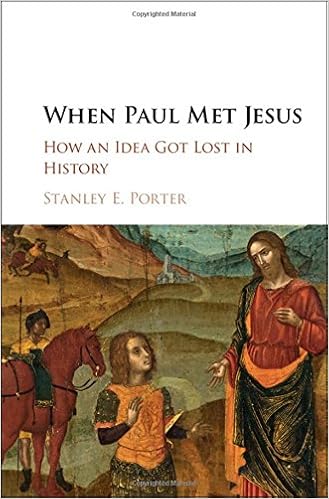
 Today I am going to offer some thoughts one of Stanley Porter’s recent books that has caught the attention of many: When Paul Met Jesus: How and Idea Got Lost in History (Cambridge, 2016). This is a fairly slim book, only running 180 pages in length, but it packs some serious punch in terms of content. In fact, you might say that it is a groundbreaking book – or maybe better, a book that excavates the forgotten groundbreaking work of past scholars. Yes, the thesis of the book is as straightforward as the title suggests:
I am examining the New Testament evidence for the notion that Paul might have seen, met, or even engaged in personal contact with Jesus before his encounter with the risen Jesus on the Damascus road (p. 1)
But this book strives to do more than that, as the subtitle indicates. Porter also provides a kind of intellectual history of scholarship on this intriguing question, tracing its origins in the 19th century among several scholars, and gradual eclipse in the wake of certain others.
In this review I will attempt to overview the book’s central arguments, and to zero in on some of Porter’s exegetical spadework at critical junctures, and then give an evaluation. Before I do that, I want to highlight that initially this book was retailing for over $100 (and still is on the CUP website). However, it has been available on Amazon for under $20 recently, although apparently the listed price is fluctuating widely (maybe demand-responsive?).
Overview
The outline of the book is straightforward, likely due to it having been presented initially as a series of lectures at Porter’s alma mater, Point Loma Nazarene University:
Introduction
1. What scholars have said in the past about Paul and Jesus
2. What scholars now say about Paul and Jesus
3. What the New Testament does and does not say about Paul and Jesus
4. The implications of Paul having met Jesus
Conclusion
The book is framed as an exercise in exegesis primarily, but one that self-consciously engages with what have come to be unimpeachable assumptions of New Testament scholarship. One of these is the axiomatic opposition in which the figures of Jesus and Paul are set, to the point where the latter is sometimes described as a “second founder of Christianity” whose ideas were not fully aligned – and to some, diametrically opposed – to those of Jesus. The rise and dominance of this sort of idea, according to Porter, has very much to do with the recession of his hypothesis from professional biblical scholarship today.
Chapter 1
In the first chapter, Porter begins by providing historical background for the mere plausibility of his thesis. He tantalizes the reader with the possibility that the lawyer/scribe who quizzes Jesus (Matt 22:35//Mark 12:28) and the “rich young ruler” (Matt 19:16-22//Mark 10:17-22) is quite possibly Saul of Tarsus (later Paul). He goes on to discuss the Pharisees in general, and then comments on the “parallel lives” of Jesus and Paul from a historical standpoint, covering matters of chronology, geography, various primary and secondary sources, and all the while addressing the complexities of the synoptic problem (pp. 12-25). He concludes,
The question that must be asked, logic seems to dictate, is not just whether it is possible that Paul and Jesus would have, almost literally, run into each other, but how it would have been possible for them not to have known of each other. In fact, I believe that it is at least a strong possibility (if not a virtual certainty) that they must have known each other due to the chronological but also environmental factors (p. 22)
After briefly addressing the passages in the NT that he will go on to discuss (1 Cor 9:1; 2 Cor 5:16; Acts 9:3-6), Porter then overviews the history of scholarship of the idea that Paul met Jesus. The three scholars to whom Porter traces this idea are all late-19th and early 20th century New Testament scholars, including William Ramsay (Scottish professor of archaeology and NT at Oxford and Aberdeen, 1851-1939), Johannes Weiss (German NT scholar and theologian, 1863-1914), and no less a figure than James Hope Moulton (Greek scholar extraordinaire and professor at both Cambridge and Manchester, 1863-1917). Porter then discusses in some detail the critical responses to their work, and the way in which the conversation about Paul’s first-hand knowledge of Jesus faded away following the Second World War.
Chapter 2
Porter then turns to discussing the current feelings about Paul and Jesus, focusing on the question: “So what happened?” (p. 44). He summarizes this chapter well by stating that
there is both a short and a long answer to the question of what happened to such an idea [about Paul and Jesus having interacted in person prior to the resurrection]. The short answer is Rudolf Bultman, and the long answer is the general history of Pauline scholarship, especially German Pauline scholarship, since Ferdinand Christian Baur to the present (p. 45)
This is where the bulk of the intellectual historical work is done, which I won’t summarize here. Suffice it to say that Porter closes this chapter with the hopeful (and helpful) notion that we must “return to the texts of the New Testament” to determine the viability of his hypothesis.
Chapter 3
I will focus on aspects of this chapter in my next section, but here Porter treats the three (sets of) texts that he considers most likely to indicated Paul and Jesus having met personally: Acts 9, 22, and 26 (the Damascus Road encounter); 1 Cor 9:1; and 2 Cor 5:16.
Chapter 4
Finally, Porter explores some implications of his hypothesis in Chapter 4. At this point, Porter simply assumes that he is correct in order to work out the “So what?” question (p. 123). Here, he first deals with “one set of general statements in Paul’s letters about the life of Jesus” that suggest Paul possessed considerable first-hand knowledge of Jesus (p. 123). He then walks through five texts (or groups of texts) that indicate Paul may have personally heard Jesus’s teaching. These include:
- Rom 12:9-21 on loving, blessing, and cursing
- Rom 13:8; Gal 5:14 on loving one’s neighbor
- 1 Cor 7:10-11 on divorce
- 1 Cor 9:14; 1 Tim 5:18 on payment
- 1 Thess 4:15-17 on the Lord’s return
This is one of the longer chapters, and it contains some of the most detailed textual work. In sum, however, Porter comes to the conclusion that the passages he examines contain “strong indicators that Paul had first-hand acquaintance with the words of Jesus, that is, that he was possibly present to hear Jesus utter the words … Paul may have even ventured to ask his own questions of Jesus (if Paul were the rich young man/ruler [in] or a lawyer/scribe who confronted Jesus” (p. 168, 170). Porter suggests that Paul’s encounters with Jesus began in the region of Galilee, including occasions like the Sermon on the Mount or Plain, and then continued as Jesus carried out his ministry and ended up in Jerusalem, where Paul likely encountered him on “numerous occasions” (p. 180).
Exegetical Highlights
I am not going to summarize all of Porter’s exegesis. It is quite worthwhile to read, for one thing because Porter is a master exegete. But for another thing, Porter is actually capable of writing up technical Greek exegesis in a readable and understandable fashion (no easy task). What I will do here is look at a few points that I found interesting or puzzling.
Acts 9, 22, 26
There are three accounts of Paul’s conversion on the Damascus road that, after dealing with some “housekeeping issues” for taking Acts seriously as a historical document, Porter looks into for evidence of Paul and Jesus having already known one another. Scholars have long noted the “inconsistencies” between these three accounts, but Porter rightly points out that these are not outright contradictions, but rather different ways of presenting the narrative “in keeping with the situational context of the individual account” (p. 82).
The main hurdle Porter has to clear is the difficulty of Acts 9:7, which says
Paul’s companions did hear a voice but did not see the speaker
ἀκούοντες μὲν τῆς φωνῆς μηδένα δὲ θεωροῦντες
while Acts 22:9 says
they did see the light but did not hear the voice
τὸ μὲν φῶς ἐθεάσαντο τὴν δὲ φωνὴν οὐκ ἤκουσαν
Porter suggests the issue can be resolved by attending to the use of negation. In Acts 9:4 we read that Paul “heard” heard the voice (accusative) and comprehended what it said, while in v. 7 we read those who were with Paul “heard” the voice (genitive) but somehow did not understand what it said. On the other hand, in Acts 22:9 we read they did not “hear” the voice (accusative) in the sense of comprehending it. Porter surmises that “the positive use of the genitive is semantically the same as the negated accusative and means that they did not perceive … [Paul’s] traveling companions did not understand what has happening” (p. 83). In other words, they saw a light but not a speaker, and heard speaking but couldn’t comprehend it.
Porter then looks at the exchange between the risen Christ and Paul, where he suggests Jesus’s question to Paul “Why are you persecuting me?” seems to presume Paul already knows Jesus. There is some interesting material here, but I was disappointed with the solution presented for what I felt was the biggest challenge in this passage: Paul’s response to Jesus. Paul asks quite baldly: “Who are you Lord?” (Acts 22:8, τίς εἶ, κύριε;). This certainly doesn’t sound like a man who did, in fact, already know Jesus.
But Porter suggests that
Paul is not now asking after identity but asking for clarification. He knows that this is a supernatural event, in which he is being addressed and even confronted by the Lord whose followers he has been persecuting (p. 91) … [Now] he asks the inevitable question: “Who exactly are you” … he wants to know how one moves from the person he once encountered but who was executed to the person who has just addressed him (p. 92, emphasis mine)
This is possible. But I also think there are problems with this answer. The biggest one is Jesus’s answer. In all three places where this narrative is told, Christ’s reply to Paul’s “who are you” question is just as simple:
ἐγώ εἰμι Ἰησοῦς [ὁ Ναζωραῖος,] ὃν σὺ διώκεις (9:5; 22:8; 26:15)
I am Jesus [of Nazareth], whom you are persecuting.
Note that Jesus doesn’t say something like “I am the divine and incarnate Son of God now raised to new-creational life by the Holy Spirit according to God’s eternal promise.” Rather, he simply states his humanly name and birthplace.
Now, this doesn’t mean Paul had never met Jesus before, or didn’t already know the information that Jesus responds with. But it does suggest that if Paul was “really” asking the kind of question that Porter claims, either Jesus did not understand the question, or didn’t feel compelled to give the specifics that Paul was asking for.
Porter goes on to give significant attention to two other passages in the New Testament, but I won’t dwell on those here. In short, these other discussions are also thorough and convincing for the most part, not least of which is Porter’s view of the phrase οὐδένα οἴδαμεν κατὰ σάρκα / “we know no one according to the flesh” in 2 Cor. 5:16. In the end, this chapter certainly succeeds in arguing that it is possible, if not likely, that Paul had known Jesus personally to some extent prior to the Damascus Road encounter.
Evaluation
I found Porter’s hypothesis to be quite persuasive overall. However, I do not think it is completely air tight from a textual/exegetical perspective (nor, most likely, does Porter himself). Nevertheless, after finishing the book I am fully behind the notion that Paul likely met Jesus personally before the resurrection, which I think Porter argues quite convincingly. Moreover, I greatly appreciated Porter’s audacity to challenge the reigning paradigms in New Testament scholarship regarding the relationship (historical, theological, textual) between Paul (or “Paul” to some) and Jesus.
Moreover, Porter rightly calls to attention the fact that the teaching of Paul and Jesus was “at least in his [Paul’s] mind, seen to be in conformity with and a continuation of the teaching of Jesus – the very teaching that he may have heard from Jesus himself as he publicly taught and interacted with both friends and foes during the time of his earthly ministry” (p. 4). The dominant paradigm in New Testament studies, says Porter boldly, is “driven as much, perhaps by a history of prejudice against a Jewish Jesus and the desire to exalt a Gentile Paul, as by any other factor” (ibid.). We do well to be wary of such assumptions, and to follow Porter’s example in giving our attention to the actual text of Scripture in a linguistically informed way.
________________
My thanks to Cambridge University Press for the gratis review copy, which has not influenced my thoughts on the book.
 The study of the Old Testament entails studying its ancient versions. That is, study of those translations that were made of the Hebrew Bible into other languages, such as Syrac, Latin, and of course Greek. These furnish our earliest and therefore most significant witnesses to the text of the Hebrew Bible, and provide objects of fruitful inquiry in and of themselves. It is the latter of these translations, known commonly as the Septuagint, that is of course the focus of this blog.
 Those not active in the discipline of Septuagint studies are unlikely to be familiar with the work of Soisalon-Soininen. However, within the discipline he is a seminal figure –
  Septuaginta &c.