
Remember the Alamo! (And the book exhibit. Never forget the book exhibit)
It’s still six months away, but there’s increasing buzz already about the 2016 Biblical Studies conference season. This year, ETS, IBR, and SBL will be held in San Antonio, Texas, between the 15th-22nd of November. I’ve said this many times before, but the annual conferences are a great experience, if completely exhausting. If you are a poor graduate student interested in going, you should definitely consider it (something I’ve posted about here and here). I have repeatedly benefited from joining and participating in the biblical studies societies ever since I was in my master’s degree program, so I always recommend it to others.
Each year I attend, these conferences get more enjoyable. This is due mostly to the fact that I have gotten to know more and more people, and attending the conferences is sometimes the only place I will see them and get to catch up. Another reason they get better over time is by participating. I’ll be presenting at ETS and/or SBL for my third year now (here and here) and I have found that it’s always worth the time for useful feedback from colleagues.
Upcoming Presentations
 As I mentioned in my last post, this year’s Septuagint Studies session at ETS will be an exciting event. Since I am on the steering committee and presented at the inaugural panel for this session in 2015, I won’t be presenting anything at ETS this year. However, I am really jazzed to see what kind of crowd shows up for what is a stellar lineup of biblical scholars talking about one of my favorite subjects.
Although I wasn’t sure it would work out this way, I have two presentations scheduled for the SBL conference. “How unwise,” you may think, “You’ll never get two quality papers written.” Well, yes that may be true, but it is just slightly more feasible than my predicament last year, when I had three presentations. So writing two papers seems quite manageable to me at this point.
The IOSCS Session
 As someone involved in Septuagint studies, I’ve been a member of IOSCS for several years, and I’m looking forward to presenting at this session at SBL for the third time. Because of a family health crisis that began in summer of 2015, I have had to step away from my dissertation for this academic year and focus on other important things. Thankfully, however, I have been able to stay active in various personal projects, one of which is the paper I’ll be presenting at the IOSCS session (and which is an outgrowth of part of my dissertation research).
The title of this paper is “The Lexical Value of the Septuagint for the Koine: The Use of ΠΑΡΑΤΑΞΙΣ in Marcus Aurelius,” and it will focus on one particular use of παράταξις in the Confessions. In the midst of discussing valorous ways to die as a devout Stoic, Aurelius uses Christians as a counter-example, stating that their manner of martyrdom is disdainful. The phrase where the reference occurs is disputed as a late scribal insertion, however, in part because it is one of the earliest references to Christians in ancient secular literature. But another reason is because the use of παράταξις in the phrase is difficult to construe. My paper will look at contemporaneous usage of the word (a considerable amount of which occurs in the LXX) and engage with the arguments for and against the phrase’s meaning and originality. This will also demonstrate the value of the Septuagint as a legitimate kind of lexical “database” for standard Greek usage (hence the paper title).
The Cognitive Linguistics in Biblical Interpretation Session
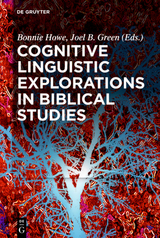
The paper I’ll be presenting here is called “‘Build Up the Walls of Jerusalem’: The Cognitive Unity of Psalm 51.” In sum, it’s common to read in commentary upon Ps. 51 that the last “chunk” of the psalm (usually vv. 15ff) was a later addition. The reason often given is that the sudden “topic” shift in v. 15 and mention of (what sounds like) a destroyed Jerusalem in v. 18 exhibits a second and later (i.e., postexilic) hand. My paper will examine this psalm from a “cognitive” perspective and demonstrate its unity and coherence in the face of the typical redaction critical conclusions.
Plenty of Time … Right?
Of course, these papers don’t exist yet. I’ll need to write them at some point. The challenge, I often find, is translating a proposal into a full-blown paper that is worthwhile and constructive … oh, and doing it on time for the conferences. Hopefully the next six months will allow just that to happen!


 0-4:10pm | Mrs. Jennifer B. Jones (Doctoral Student, McMaster Divinity
 It’s been a few weeks now, but the annual conferences of the major biblical studies societies have come and gone. Legions of scholars from around the world spent untold dollars and lost entire time zones of sleep to make it there, and are only now recovering. This year’s melee was held in Atlanta, a lovely city whose downtown area is apparently constituted only of gigantic hotels. And they all seemed to be full of the scholarly hordes for about a week in late November.
 I mentioned in a previous post that I would not only attend both the
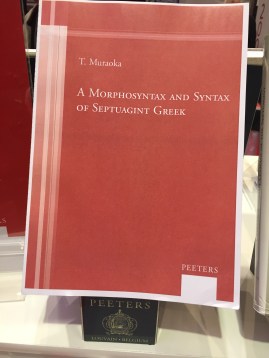 It sounds boring, but I believe I can show quite conclusively that the Judges translator knew and consciously re-employed features of the OG Genesis text in his version of Judges. In effect, he amplifies the relationship between the narratives, but also shows good (if intermittent) Greek style, and reveals something of the status and familiarity of the Greek Pentateuch in later eras.
 In case you don’t know, John is one of the top scholars of Koine Greek at the moment and has contributed extensively to lexicography. His work in the Greek Pentateuch is what spurred my own interest in Septuagint vocabulary and has provided much of the methodology for my doctoral research. Trevor Evans and Jim Aitken teamed up to put together an edited volume of essays in John’s honor, Biblical Greek in Context (Brill). This looks like an excellent resource that will hopefully get wide attention.
 Septuaginta &c.