Old Testament Studies

Origen, the Hexapla & its Institute

Origen

Just a brief post to convey the exciting news in the Septuagint blogosphere (which doesn’t happen very often): the Hexapla Institute‘s website is back up and running (thanks, Brian!).

http://hexapla.org/

A cooperative venture by The Southern Baptist Theological Seminary (spearheaded by Peter Gentry), VU University Amsterdam, and the University of Oxford, this project is attempting to assemble a new critical edition of Hexaplaric fragments. Essentially, this means that any ancient scraps of the Hexapla are being rounded up, examined, and text-critically adjudicated to determine the most original reading. The project, which will also provide online databases, will also shed further light on Greek rabbinical exegetical practice.

Overall, the Hexapla Institute is undertaking an exciting – if daunting! – project. Read more about its history here.

Origen: Ancient Text Critic

“Map” of Ancient Versions & Recensions of the OT (Click to Enlarge)

The Hexapla (Ἑξαπλᾶ) was produced in the 3rd century by Origen of Alexandria. By his day, several recensions of “the” Septuagint had already been completed (see chart at left), leaving religious communities in conflict over textual authority. For the most part, the Church had claimed the Greek Septuagint, while Jews laid hold of the Hebrew text. Origen considered the Greek texts to be significantly flawed, however, due to ordinary corruption in textual transmission, translational modification or error, and controversy over the “standard” Hebrew text. Origen assumed his received text (textus receptus) was correct. That assumption was both Origen’s point of departure and methodological flaw.
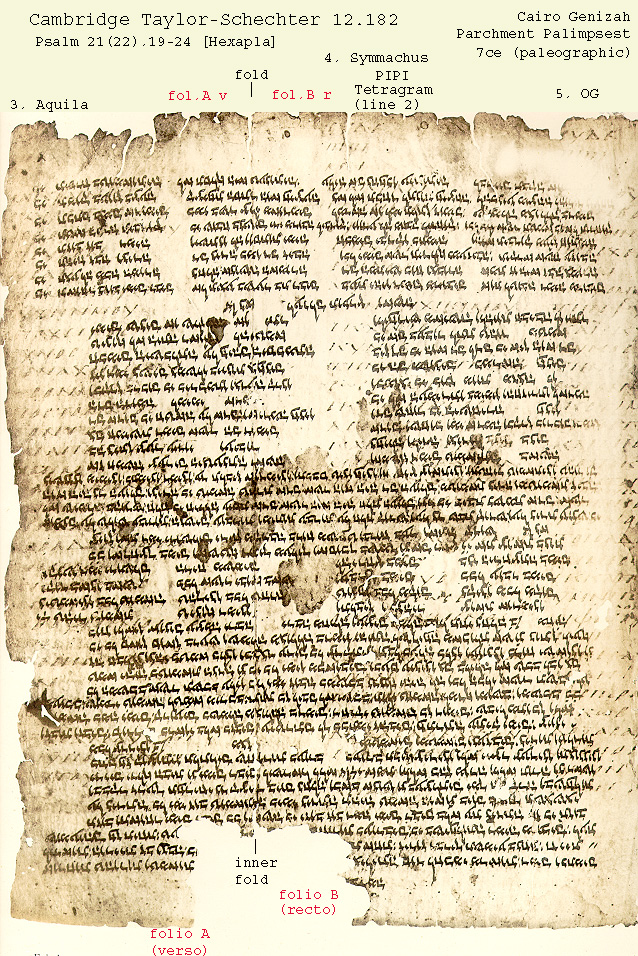
A catalogued fragment of the Hexapla, from the Cairo Genizah. Note the Greek writing *behind* the (upside down) Hebrew text. (Thanks, Brandon)

In any case, Origen decided to attempt to sort it all out, although it’s not totally clear what his primary purpose was in doing so. But it purportedly took him over 6,000 pages in 15 volumes to do it. Using the symbols of Aristarchus in his critical edition of Homer, Origen laid out six columns in which to denote how the textual versions related to one another. The asterisk (※) designated words added to the LXX, typically from one of the recensions, and a metobelus (↙) to mark the end of the textual insertion. He also used an obelisk (÷) to mark places in the LXX that were additional to the Hebrew. It’s not perfectly clear how Origen did this, and debate continues. But Origen’s textual work focused on Column 5.

The columns ran:

    1. Hebrew (textus receptus)
    2. “Secunda” – Hebrew transliterated into Greek
    3. Aquila’s LXX Recension (α′)
    4. Symmachus’ LXX Recension (σ′)
    5. The LXX with Origen’s Sigla (ο′)
    6. Theodotion (θ′)

Regrettably, Origen’s work never bore much fruit. It is doubtful that the entirety of the Hexapla ever existed in more than a single copy simultaneously. The fragments we have are copies, which in the course of events were themselves corrupted by erroneous copying of Origen’s sigla (!). In the end, the original Hexapla was destroyed during a Muslim invasion in the 7th century.

A New Critical Edition

The stated goal of the Hexapla Institute is to produce new critical editions, representing the most accurate “original” Hexapla to date. Prior editions (see here) will be superseded by the addition of textual data from new manuscripts, patristic sources, and newer editions of the Church Fathers. Given the profound influence of the Hexapla upon the textual history of the Old Testament, the work of these capable scholars will no doubt be welcomed.

The Major Contemporary LXX Translation Projects

Ancient Interpreters

Beginning with the present post, I am launching a Resource Review series devoted to the various current approaches among Septuagint scholars to “translating the Translation.” What I mean by this is the different strategies employed in the four current translations of the Septuagint itself. While one might think that the task of translating the LXX would be straightforward enough, it is not. Of course, even translating the New Testament – originally composed in Greek, not as a translation – can be controversial. But when it comes to translating a translation like the Septuagint, countless questions of methodology arise, each of which demands taking a stance on any number of other difficult and uncertain issues.

For beginners entering the discipline, this topic can be like navigating a corn maze that turns out to have been built over a minefield. Complexity and hazards abound. So for the sake of the newcomer, as much as myself, I would like to overview the four modern translation projects, some of which are complete, others ongoing. In this post, I will simply identify these projects and their respective teams of scholars, leaving the details of their work for future posts.

How to translate?Most of what I will do in this series will be to present the strategy of each translation project, without delving too much into critique. Enough scholars are spending their careers on that as it is, and in far heavier-hitting formats than blog posts!
(Hint: if you are looking for some place to find a doctoral supervisor in LXX studies, the scholars involved in these projects are some of the best.)

Current Translation Projects

As I said, there are four major, modern language translations. Hopefully you weren’t expecting them all to be in English; only one is. The other three are in French, German, and Spanish. You may be thinking, “I can’t read [insert one or more language here]!” Well, first of all, you should consider learning, especially if you are interested in Biblical Studies doctoral work. Secondly, even if you can’t read the translation translation, you can learn from how it was done. Remember, we’re talking about process, not (necessarily) product in this series.

New English Translation of the Septuagint (NETS)

The first project is NETS, the English translation complete with the deliciously long subtitle: “and the Other Greek Translations Traditionally Included under That Title: A New Translation of the Greek into Contemporary English – An Essential Resource for Biblical Studies.” NETS was completed in 2007 and has already undergone a reprinting. Carried out by a group of scholars under the auspices of the International Organization for Septuagint and Cognate Studies (IOSCS), this translation will eventually have a commentary series published along with it.

NETS is also accessible freely online (copyright), although owning a hard copy is well worth the cost since you’ll be referring to it so often. You can also purchase it for Accordance as well as Olive Tree.

If you’re monolingual (monolectorial?), you do have two very much older options to choose from in English. One is the translation by Charles Thomson (here), the other Sir Lancelot Charles Lee Brenton (here). Given the price difference, and the differences in the state of LXX studies, I would recommend NETS, generally speaking, for an English translation.

La Bible d’Alexandrie (BdA)

If you couldn’t guess, the BdA translation project is in French, published by Éditions du Cerf. Launched by the formidable scholarly figure of Marguerite Harl in 1986 at the Université de Paris-Sorbonne, and assisted by Gilles Dorival, Olivier Munnich and others, the project is not yet complete. A number of volumes remain to appear, awaited with great anticipation.

One of the main differences from NETS is that BdA includes rather extensive textual commentary throughout, which is the primary reason it is multi-volume. The introduction and translation notes made in each volume are themselves worth the purchase price if you are working closely on a particular OT book. In addition to providing a French translation of the Septuagint, BdA is a collection of top tier scholarship that cannot be overlooked.

Septuaginta Deutsch (LXX.D)

The LXX.D project was completed for the German Bible Society, and was the first of its kind in that language. The translation was undertaken between 1999 and 2008 by eighty seven scholars, and then edited by the eminent Drs. Wolfgang Kraus (Koblenz) and Martin Karrer (Wuppertal), along with nine co-editors.

As the picture to the left indicates, there are two volumes for LXX.D. In one volume, textual studies and book-by-book introductions are presented, while in the second volume the actual German translation appears, along with relevant commentary. This approach is similar to that of BDA, though less extensive, and likewise must be consulted for its valuable contributions.

La Biblia Griega (LBG)

Lastly, there is the Spanish translation, La Biblia Griega, published by Ediciones Sígueme under the leadership of Natalio Fernández Marcos and María Victoria Spottorno. This project will be produced in four volumes:  I. Pentateuco (=Pentateuch); II. Libros históricos (= Historical Books); III. Libros poéticos o sapienciales (=Poetry & Wisdom Literature); and IV. Libros proféticos (=Prophetical Books). The first three volumes came out in ’08, ’11, and ’13, respectively, and the last is due in 2015.

I have not personally seen any of these works, so I cannot comment much further. Suffice it to say that Natalio Fernández Marcos has produced one of the best LXX introductions available, The Septuagint in Context, so his work is well worth attention generally speaking.

More to Come

In the not-too-distant future I will deal with each of these translations and outline their various strategies to their task. Hopefully this will prove to be a useful introduction to some common issues in the discipline of Septuagint study.

Doctoral Studies in Old Testament

A few months ago I posted that I was working on doctoral applications and had begun to hear back from schools. As the cards have fallen, I have accepted a place as a doctoral candidate in divinity at the University of Cambridge. The decision took time given the many variables, but in the end I am very happy – honored, actually – to have the opportunity. Come Michaelmas Term of 2014, which begins 1 October, I will begin my work at Cambridge in Old Testament studies under the supervision of Dr. James Aitken (also here).

To those unfamiliar with how a British university system works (this is most of humanity), it comes as a surprise that my work will consist not of attending classes and taking exams. Instead, I will be conducting independent research and writing – lots and lots of writing. Much of this work will take place at my college, Fitzwilliam (“Fitz”) College,  and the Faculty of Divinity (which is a building, not just a group of people).

I have also arranged to conduct much of my research at the Tyndale House, which is located in Cambridge, close to Fitz and the Faculty (map). The Tyndale House is a research center specifically for Christian biblical studies scholars. It has carrels “to let” for long-term projects like mine, and even accommodations for shorter-term stays (like professors on sabbatical). It also has a fabulous library, of course!

So although many (many) details have yet to be worked out as to relocating my family across the pond, this is a basic picture of our next three or four years. I won’t discuss my research topic in detail here, but will leave it for a later post, perhaps. I will also likely post on some of the broad differences between British and American doctoral programs (and why my extended family is so confused about what I’ll actually be doing in England).

On a more personal note, my wife is hoping to keep up with posts on our “family blog,” The Ross Family in Cambridge, to post updates about our life in Cambridge. If you’re inclined, you can keep up with us that way!