 As much as it pains me to admit it, one of the top-tier locations for the study of the Septuagint is the Oxford Centre for Hebrew and Jewish studies (CHJS), which has been in existence now for almost fifty years. The focus of the Center is to promote education, scholarly research, and publication that embraces “the full scope of Hebrew and Jewish Studies from antiquity to the contemporary world.”
So, among the many lectures and projects under way at the Centre, the Septuagint frequently finds a prominent place. And two of the top scholars involved in the discipline are currently fellows there as well, Allison Salvesen and Jan Joosten (also see here).
Seminars in Advanced Jewish Studies
There are currently two research projects going on at the CHJS. The first is “Jews, Liberalism, Anti-Semitism: the Dialectics of Inclusion (1780-1950),” on which more can be found here. But the second is focused directly upon the Septuagint, and is entitled:
Greek expanded, Greek transformed: The Vocabulary of the Septuagint and the Cultural World of the Translators
This seminar is under the leadership of Drs. Jan Joosten (Oriental Studies, University of Oxford) and Philomen Probert (Classics and Linguistics, University of Oxford), with other members including Eberhard Bons (Faculté de théologie catholique, Université de Strasbourg), Trevor Evans (Ancient History, Macquarie University), and Gary Anderson (Theology, University of Notre Dame).
The seminar will run from January to June 2018, and is described as follows:
This Oxford Seminar will bring together an international team of scholars from different disciplines to work on the religious and political vocabulary of the Septuagint, combining the expertise of the Oxford Centre for Hebrew and Jewish Studies, where it will be based, with the resources of the Oxford Classics Faculty and the Faculty of Linguistics, Philology and Phonetics. The project will illuminate for biblical scholars the cultural world of those who produced and read the books of the Septuagint, and will illuminate for classical scholars the ways in which Jews of the Greek world adapted to the dominant culture and influenced it in turn.
Visiting fellows will be granted access to  the Leopold Muller Memorial Library and the Bodleian Library in Oxford. As it’s title indicates, the focus of this project is focus upon political and religious vocabulary used in the Septuagint and situate it within the Jewish Hellenistic context. This undertaking will bring together study of literary Greek in the Classical and post-Classical periods with investigation of the rich lexical evidence from Ptolemaic papyri and inscriptions. This is a lively area of research in Septuagint scholarship at the moment (and the one upon which my own dissertation is focused), so the results of this seminar should be very fascinating.
The intersection of a wide variety of cultures, religions, and languages in Ptolemaic Egypt produced a remarkable social context in which the Jewish translation project known as the Septuagint was undertaken. With that in view, there is a good deal of research going on at the moment into dialect, sociolect, bi-/multi-lingualism, context of situation, and usage-based linguistics in relation to the Septuagint. So when I read the prospectus for this seminar, I was glad to see the affirmation that the Greek of the Septuagint exerted its own influence within its linguistic community. This was more or less the idea that I addressed in a recent lecture at a conference in Wuppertal this past July, focusing upon one particular construction (see here).
The Seminar Schedule
This seminar will meet weekly in Oxford over two terms beginning in January of 2018, with a concluding conference in on 25-27 June. The window for application is currently open to senior scholars, postdoctoral students, and those at advanced stages of their doctoral program. The deadline for submitting an application is 16 December 2016. You can find more details about the entire seminar here.
 During the congresses, many sub-disciplines will host a meeting of their own international organizations. These include, among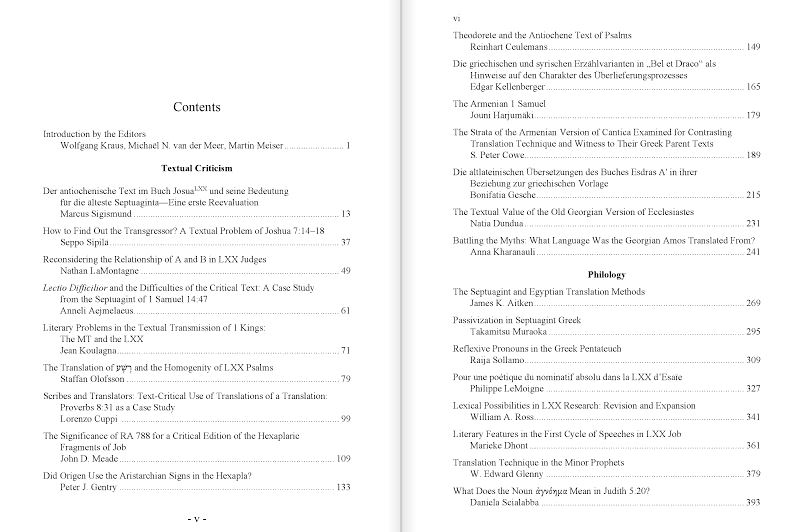

 The study of the Old Testament entails studying its ancient versions. That is, study of those translations that were made of the Hebrew Bible into other languages, such as Syrac, Latin, and of course Greek. These furnish our earliest and therefore most significant witnesses to the text of the Hebrew Bible, and provide objects of fruitful inquiry in and of themselves. It is the latter of these translations, known commonly as the Septuagint, that is of course the focus of this blog.
 Septuaginta &c.