Resource Reviews

Wagner, the “Sealed Book” and LXX Translation

Wagner and the Sealed Book

In this post I want to preempt a book review I am working on of J. Ross Wagner. Reading the Sealed Book: Reading Old Greek Isaiah and the Problem of Septuagint Hermeneutics. FAT 88. Tübingen: Mohr Siebeck / Waco, TX: Baylor University Press, 2013. Pp. xi + 295. ISBN 978-3-16-152557-5. €99.00 (hardcover). There is so much to talk about in this book, a review of it is almost impossible without vastly understating its contents. What I wish to focus on here, however, is his introductory material where Wagner discusses common approaches to LXX interpretation, or hermeneutics. While this may sound arcane, it is actually quite relevant for the LXX novice, since each of the (now four) major modern translations of the Septuagint take a different approach to their work based on their answer to the question: “How should we translate this translation?”

If you are interested in LXX studies, you need to know about this debate, since it is foundational to almost everything else in the discipline. What I will do here is highlight some of Wagner’s introductory material and interject my own “translation” of the technical details for a less familiar audience. This will pair nicely, I hope, with the series I’m working through right now on the major contemporary LXX translation projects (see this initial post).

Production & Reception

Wagner defines “LXX hermeneutics” as both “how to characterize the translators own interpretation of his source [text]” and “how a modern reader is to interpret the translated text” (2n8). This definition encapsulates the two central issues at almost every point in LXX studies, namely production and reception. The first – production – deals with the hypothetical Jew who sat down one day (or week or month) to actually translate (i.e. produce) a book of Hebrew scripture into Koine Greek; what was he looking at in his source text, what did he understand as he read, what did he mean by the words he wrote?

The second issue – reception – deals with what anyone else did with the translation he produced, whether that be read it, interpret it, apply it, translate it (again), and so forth, regardless of whether this agrees with the translator’s intentions. In other words, good LXX scholarship differentiates between what the translator read and understood and meant in his translation on Day 1 from what some later reader of the translation reads or understands (rightly or wrongly) on Day ‘n’. The first is difficult to prove, and the second is difficult to defend, unless that reader is you.

Two Questions in Translation

Two questions need answering in the face of the difficulty. First, we must ask to what degree “the textual-linguistic character of the LXX/OG translations conforms to target-language models” (3). In other words, how did the translator’s work stack up against original Greek literary compositions in his own day? To what degree were they similar or different, and how?

How would the LXX have compared to Greek works in the Library of Alexandria?

With this first question, we are on one level dealing with the perceived competency of the LXX translator(s) for their task, regardless of their intent. This question is primarily descriptive in terms of the qualities of the Greek itself. Part of what makes answering this question so difficult is that there are plenty of places where the Greek of the LXX is basically incomprehensible as Greek, yet because we know the Hebrew text “behind” that translation we can make sense of it as a translation of Hebrew. On the other hand, there are plenty of instances where the LXX translation is fabulous Greek as Greek (meaning in terms of stylistic flair and tone), yet it departs from the Hebrew (at least as we have it in the Masoretic Text).

At this point we have bumped into the second question that needs answering (they are related, but distinct), namely the intended relationship between Greek and Hebrew texts. In other words, was the Greek translation meant to stand on its own two feet? Or was it meant to be read always with the Hebrew original in hand (or at least in mind)?

On one side some scholars say the Greek text exists to serve its Hebrew “parent” text, and to represent it as accurately as possible for the Greek-speaking audience who (possibly) no longer knew Hebrew. Other scholars, however, view the LXX as an independent text, distinct from its Hebrew “parent” and aiming to interpret it for the Greek-speaking audience. Does the Greek translation of a given book of the Hebrew OT “mirror” the Hebrew (e.g., in word count, word order syntax, tone, etc.)? Is it the Hebrew text in “Greek clothing”? Or is it crafted to represent the Hebrew and pay more attention to easy Greek reading and style? Clearly translator competency comes into play meaningfully in these answers.

Yet another way to ask the second question is whether 1) the translation aims to preserve the textual form of the Hebrew at the expense of being good Greek (text-centered approach), or 2) the translation aims to preserve the textual meaning of the Hebrew with less concern for textual “shape” (reader-centered approach). The former views the Hebrew text as central, the latter the Greek reader as central. The former understands the LXX to be a means of preserving the Hebrew, while the latter understands it to be a means of conveying the Hebrew.

Modern LXX Translations

As we will see in the following posts in the Contemporary LXX Translation Project series, these are the main contours that will differentiate the various projects. Stay tuned for further refining and clarification! I will probably post my full review of Wagner eventually as well.

Origen, the Hexapla & its Institute

Origen

Just a brief post to convey the exciting news in the Septuagint blogosphere (which doesn’t happen very often): the Hexapla Institute‘s website is back up and running (thanks, Brian!).

http://hexapla.org/

A cooperative venture by The Southern Baptist Theological Seminary (spearheaded by Peter Gentry), VU University Amsterdam, and the University of Oxford, this project is attempting to assemble a new critical edition of Hexaplaric fragments. Essentially, this means that any ancient scraps of the Hexapla are being rounded up, examined, and text-critically adjudicated to determine the most original reading. The project, which will also provide online databases, will also shed further light on Greek rabbinical exegetical practice.

Overall, the Hexapla Institute is undertaking an exciting – if daunting! – project. Read more about its history here.

Origen: Ancient Text Critic

“Map” of Ancient Versions & Recensions of the OT (Click to Enlarge)

The Hexapla (Ἑξαπλᾶ) was produced in the 3rd century by Origen of Alexandria. By his day, several recensions of “the” Septuagint had already been completed (see chart at left), leaving religious communities in conflict over textual authority. For the most part, the Church had claimed the Greek Septuagint, while Jews laid hold of the Hebrew text. Origen considered the Greek texts to be significantly flawed, however, due to ordinary corruption in textual transmission, translational modification or error, and controversy over the “standard” Hebrew text. Origen assumed his received text (textus receptus) was correct. That assumption was both Origen’s point of departure and methodological flaw.

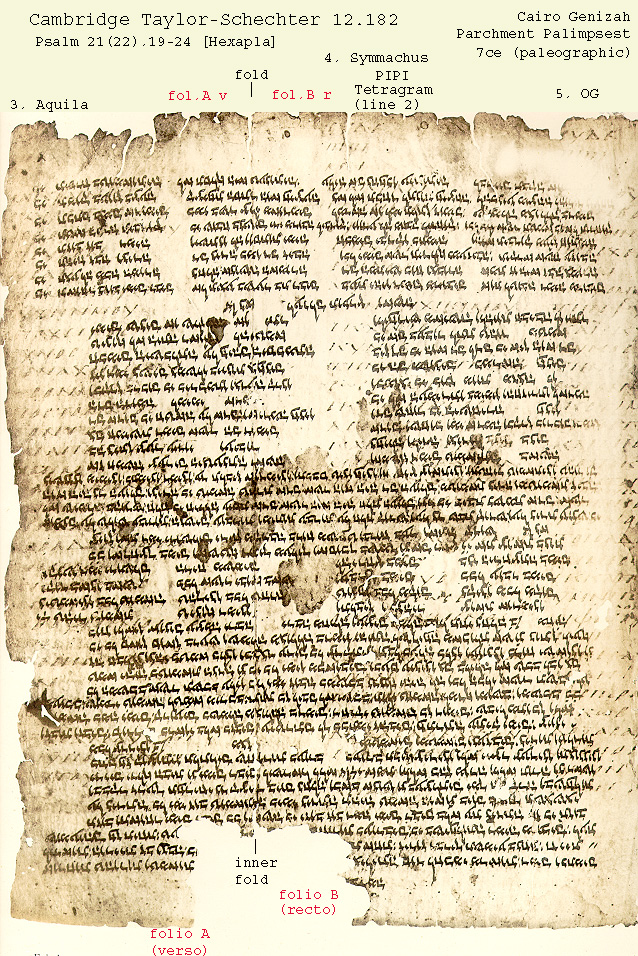
A catalogued fragment of the Hexapla, from the Cairo Genizah. Note the Greek writing *behind* the (upside down) Hebrew text. (Thanks, Brandon)

In any case, Origen decided to attempt to sort it all out, although it’s not totally clear what his primary purpose was in doing so. But it purportedly took him over 6,000 pages in 15 volumes to do it. Using the symbols of Aristarchus in his critical edition of Homer, Origen laid out six columns in which to denote how the textual versions related to one another. The asterisk (※) designated words added to the LXX, typically from one of the recensions, and a metobelus (↙) to mark the end of the textual insertion. He also used an obelisk (÷) to mark places in the LXX that were additional to the Hebrew. It’s not perfectly clear how Origen did this, and debate continues. But Origen’s textual work focused on Column 5.

The columns ran:

    1. Hebrew (textus receptus)
    2. “Secunda” – Hebrew transliterated into Greek
    3. Aquila’s LXX Recension (α′)
    4. Symmachus’ LXX Recension (σ′)
    5. The LXX with Origen’s Sigla (ο′)
    6. Theodotion (θ′)

Regrettably, Origen’s work never bore much fruit. It is doubtful that the entirety of the Hexapla ever existed in more than a single copy simultaneously. The fragments we have are copies, which in the course of events were themselves corrupted by erroneous copying of Origen’s sigla (!). In the end, the original Hexapla was destroyed during a Muslim invasion in the 7th century.

A New Critical Edition

The stated goal of the Hexapla Institute is to produce new critical editions, representing the most accurate “original” Hexapla to date. Prior editions (see here) will be superseded by the addition of textual data from new manuscripts, patristic sources, and newer editions of the Church Fathers. Given the profound influence of the Hexapla upon the textual history of the Old Testament, the work of these capable scholars will no doubt be welcomed.

The Major Contemporary LXX Translation Projects

Ancient Interpreters

Beginning with the present post, I am launching a Resource Review series devoted to the various current approaches among Septuagint scholars to “translating the Translation.” What I mean by this is the different strategies employed in the four current translations of the Septuagint itself. While one might think that the task of translating the LXX would be straightforward enough, it is not. Of course, even translating the New Testament – originally composed in Greek, not as a translation – can be controversial. But when it comes to translating a translation like the Septuagint, countless questions of methodology arise, each of which demands taking a stance on any number of other difficult and uncertain issues.

For beginners entering the discipline, this topic can be like navigating a corn maze that turns out to have been built over a minefield. Complexity and hazards abound. So for the sake of the newcomer, as much as myself, I would like to overview the four modern translation projects, some of which are complete, others ongoing. In this post, I will simply identify these projects and their respective teams of scholars, leaving the details of their work for future posts.

How to translate?Most of what I will do in this series will be to present the strategy of each translation project, without delving too much into critique. Enough scholars are spending their careers on that as it is, and in far heavier-hitting formats than blog posts!
(Hint: if you are looking for some place to find a doctoral supervisor in LXX studies, the scholars involved in these projects are some of the best.)

Current Translation Projects

As I said, there are four major, modern language translations. Hopefully you weren’t expecting them all to be in English; only one is. The other three are in French, German, and Spanish. You may be thinking, “I can’t read [insert one or more language here]!” Well, first of all, you should consider learning, especially if you are interested in Biblical Studies doctoral work. Secondly, even if you can’t read the translation translation, you can learn from how it was done. Remember, we’re talking about process, not (necessarily) product in this series.

New English Translation of the Septuagint (NETS)

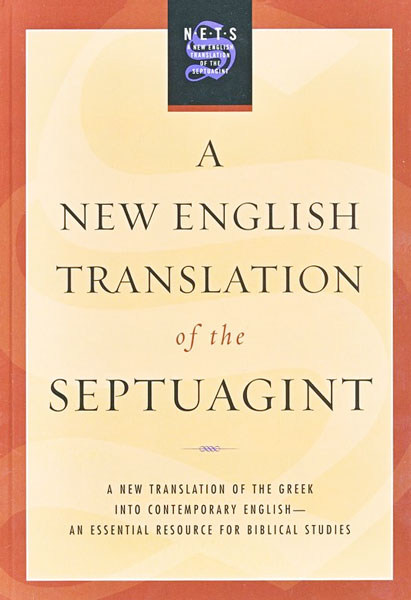
The first project is NETS, the English translation complete with the deliciously long subtitle: “and the Other Greek Translations Traditionally Included under That Title: A New Translation of the Greek into Contemporary English – An Essential Resource for Biblical Studies.” NETS was completed in 2007 and has already undergone a reprinting. Carried out by a group of scholars under the auspices of the International Organization for Septuagint and Cognate Studies (IOSCS), this translation will eventually have a commentary series published along with it.

NETS is also accessible freely online (copyright), although owning a hard copy is well worth the cost since you’ll be referring to it so often. You can also purchase it for Accordance as well as Olive Tree.

If you’re monolingual (monolectorial?), you do have two very much older options to choose from in English. One is the translation by Charles Thomson (here), the other Sir Lancelot Charles Lee Brenton (here). Given the price difference, and the differences in the state of LXX studies, I would recommend NETS, generally speaking, for an English translation.

La Bible d’Alexandrie (BdA)

If you couldn’t guess, the BdA translation project is in French, published by Éditions du Cerf. Launched by the formidable scholarly figure of Marguerite Harl in 1986 at the Université de Paris-Sorbonne, and assisted by Gilles Dorival, Olivier Munnich and others, the project is not yet complete. A number of volumes remain to appear, awaited with great anticipation.

One of the main differences from NETS is that BdA includes rather extensive textual commentary throughout, which is the primary reason it is multi-volume. The introduction and translation notes made in each volume are themselves worth the purchase price if you are working closely on a particular OT book. In addition to providing a French translation of the Septuagint, BdA is a collection of top tier scholarship that cannot be overlooked.

Septuaginta Deutsch (LXX.D)

The LXX.D project was completed for the German Bible Society, and was the first of its kind in that language. The translation was undertaken between 1999 and 2008 by eighty seven scholars, and then edited by the eminent Drs. Wolfgang Kraus (Koblenz) and Martin Karrer (Wuppertal), along with nine co-editors.

As the picture to the left indicates, there are two volumes for LXX.D. In one volume, textual studies and book-by-book introductions are presented, while in the second volume the actual German translation appears, along with relevant commentary. This approach is similar to that of BDA, though less extensive, and likewise must be consulted for its valuable contributions.

La Biblia Griega (LBG)

Lastly, there is the Spanish translation, La Biblia Griega, published by Ediciones Sígueme under the leadership of Natalio Fernández Marcos and María Victoria Spottorno. This project will be produced in four volumes:  I. Pentateuco (=Pentateuch); II. Libros históricos (= Historical Books); III. Libros poéticos o sapienciales (=Poetry & Wisdom Literature); and IV. Libros proféticos (=Prophetical Books). The first three volumes came out in ’08, ’11, and ’13, respectively, and the last is due in 2015.

I have not personally seen any of these works, so I cannot comment much further. Suffice it to say that Natalio Fernández Marcos has produced one of the best LXX introductions available, The Septuagint in Context, so his work is well worth attention generally speaking.

More to Come

In the not-too-distant future I will deal with each of these translations and outline their various strategies to their task. Hopefully this will prove to be a useful introduction to some common issues in the discipline of Septuagint study.