This is the third post in a series of an eventual five that highlight a batch of publications from this year. You can read the first two here and here.
This particular publication is an essay entitled “The Syntax of Year Expressions in Hellenistic Greek Papyri and Ancient Jewish Translation.” It is published in a very large collection that presents the proceedings of the thirtieth International Congress of Papyrology, which was held in Paris in 2022, where I initially presented my research. (Remarkably, the volume is available to download for free here.)
Essentially, my essay is an investigation of how dates are phrased in Greek, specifically dates that state a year. For example:
ἐν ἔτει τριακοστῷ καὶ ἐνάτῳ Αζαρια βασιλεῖ Ιουδα καὶ ἐβασίλευσεν Μαναημ
“In the thirty-ninth year of Azaria king of Iouda, Manaem also ruled” (2 Kgs 15:17)
I became curious about this topic while reading Pestman’s New Papyrological Primer a few years ago. In a brief section on p. 35, he mentions that in reading the papyri, “One notices that the year (ἔτος) is in the genitive, the day (ἡμέρα) in the dative and the month (μήν) in the genitive.” That was enough to get me wondering whether Septuagint syntax follows the same patterns, and what other patterns there might be for date expressions in papyri and the Septuagint corpus.
Admittedly this essay is on the more technical side, since it deals with some arcane aspects of papyri (e.g., alphanumerics and other sigla) and Greek syntax. I also use a basic form of linguistic analysis to present syntax trees of the date expression patterns, which will not be familiar to most biblical scholars, for better or worse. One interesting result of the research, however, was that I identified two sets of syntactic structures used in year expressions:
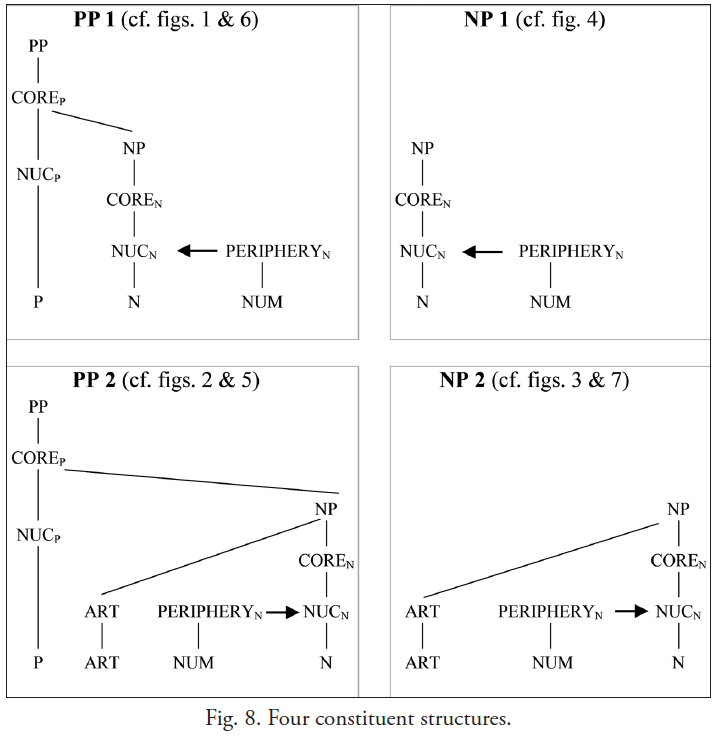
You can see that the left side structures are just preposition phrase versions of the right side structures, plus the top row structures are anarthrous, while the bottom row are articular.
Curiously, this research is what helped me bump into an anomalous syntactic structure for year expressions used in the Septuagint corpus but nowhere in papyri. That in turn led me to write the “Flouted Conventions” paper that I highlighted in my first post. It just goes to show what primary source research can turn up! I’m sure there is plenty more to find in this area, since there are many more date expressions with month and day phrases as well that I did not look into.
 Septuaginta &c.
2 comments