Every three years the International Organization for the Study of the Old Testament meets at a different international location. This is such a momentous event for the discipline of Old Testament biblical studies that these meetings are not called a mere “conference,” but are given the grandiose title “Congress.” Most recently this was held in September of this year in Stellenbosch, South Africa.
 During the congresses, many sub-disciplines will host a meeting of their own international organizations. These include, among others, the International Syriac Language Project (ISLP), the International Organization for Masoretic Studies (IOMS), the International Organization for Targumic Studies (IOTS), and – of course – the International Organization for Septuagint and Cognate Studies (IOSCS).
The IOSCS Proceedings
Prior to this year’s Congress, the 15th IOSCS Congress met in Munich, Germany in August of 2013. That was my first time presenting research at a major scholarly conference (see here and here). Another aspect of this event for the IOSCS crowd – I’m not sure about the other organizations – is the compilation of the proceedings from each congress into an edited volume. This year was no different, and I was pleased to have my own contribution included (here). The volume is entitled:
Wolfgang Kraus, Michaël Van Der Meer, and Martin Meiser (eds), XV Congress of the International Organization for Septuagint and Cognate Studies: Munich, 2013 (Atlanta, SBL Press: 2016). (SBL / Google Books)
Table of Contents
There is a wealth of cutting-edge research in Septuagint scholarship in this volume, which is now for sale and shipping (unfortunately) at the cost of an arm and a leg. But be sure you have your library pick up a copy, as it is well worth having on hand.
Here’s an overview of the Table of Contents, which includes sections on Textual Criticism, Philology, and Interpretation & Reception:
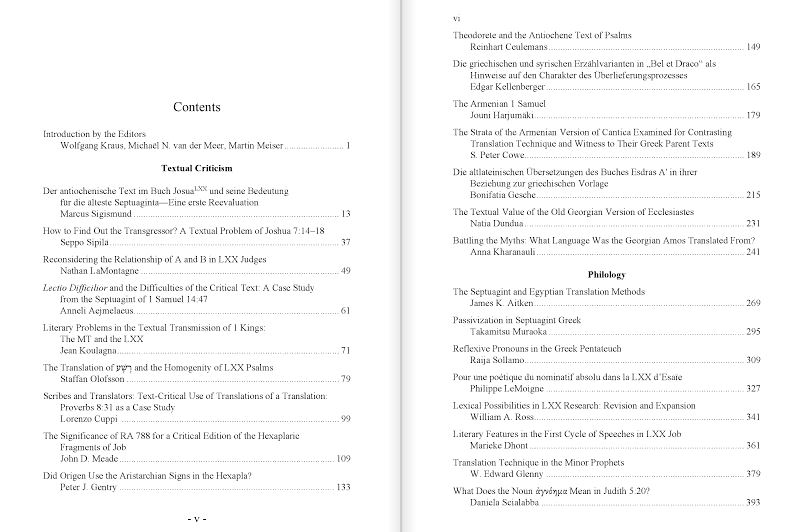

If you’re interested in seeing my contribution, you can read it here.
Up with Septuagint Scholarship!
Just a brief mention here that I’ve received a handful of notes recently in support of my work on this blog for Septuagint studies. I’m very glad to see that this site is helping get the word out about various aspects of this fairly decentralized discipline. (But things are improving now! Especially with the newish IOSCS Facebook Group). Today I reached a milestone for the blog when I passed 30,000 site visitors. Thanks for reading!
 The study of the Old Testament entails studying its ancient versions. That is, study of those translations that were made of the Hebrew Bible into other languages, such as Syrac, Latin, and of course Greek. These furnish our earliest and therefore most significant witnesses to the text of the Hebrew Bible, and provide objects of fruitful inquiry in and of themselves. It is the latter of these translations, known commonly as the Septuagint, that is of course the focus of this blog.
 Septuaginta &c.